Friday, February 26, 2016

Fifty years ago, a championship team and season

      (Second in a series)
     One reason the 1966-67 Louisiana Tech basketball team was special to me, other than the friends: It was the first conference championship team I experienced in my four years (fall 1965-spring '69) at Tech.
     That 1966-67 team was my sophomore year. The only other Tech team to win a conference championship in those years was in golf of my senior spring, the last of many championships for legendary athletic director/football and golf coach Joe Aillet.
     Great as the football tradition was -- and is -- at the university, not even Terry Bradshaw, in his breakout junior season, could deliver a title (he did with the 1969 Bulldogs, but I had graduated). 
     Great as the Tech baseball tradition was, we missed a championship by a half-game in my freshman year, losing both ends of a final-day doubleheader after winning six consecutive doubleheaders.
Charlie Bishop and Richard Peek, back row, left side. Bob Watson ducked
out of this photo. (from the Shreveport Journal game story)
     So basketball provided the big thrills in many ways in that 1966-67 season, remembered for our "Triple Towers" at center -- Richard Peek, Bob Watson and Charlie Bishop.
     But that team had so much more ... and we thought from the start of practice this would be a great season. It was.  
     We had two veteran guards who could flat-out shoot -- senior Leon Barmore (you might have heard of him, as a women's basketball coach chosen to the Basketball Hall of Fame) and junior Jimmy Pruett, back after a redshirt season (knee injury).
      The other starter was senior small forward Jon Pat Stephenson (6-foot-3), the team's most versatile, fastest and all-around best athlete.
      The bench was strong, led by two juniors -- rugged 6-7 forward Tommy Gregory and tenacious defensive star Malcolm Smith (6-4). In many of the key games, they were on the floor at the finish.
      All five of those players, like Bishop, were from Louisiana. Two other top reserves were guards -- senior Billy Ray Stokes (Yazoo City, Miss.), a junior college transfer in his second year at Tech, and true freshman Wayne Smith (Tishomingo, Okla.) in his only year at Tech.
      Three key factors in this team's success: (1) the big guys, Peek and Bishop as a devastating low-post combo; (2) great balance, all five starters averaged scoring in double figures -- Barmore 15.6, Bishop 14.6, Peek 14.1, Pruett 11.4, Stephenson 11.1; and (3) solid defense -- if you played for Coach Scotty Robertson, you had to play defense ... or you'd sit.
---
       The season began with a victory against a "major" -- at Texas A&M. But December was rough, with four consecutive losses (none all that close) to SEC teams, and a tournament loss to Morehead (Ky.) State in Shreveport.
       Then came 17 victories in the next 19 games -- and an 11-1 record (and championship) in the Gulf States Conference, an all-Louisiana league with bus road trips and longstanding, strong and often heated rivalries.
       No rivalry then, and for the next few years, was more intense than Tech vs. Southwestern Louisiana -- USL. Coach Beryl Shipley had one of the first integrated programs in the Deep South, maybe the first, and Shipley had gone far to recruit very talented -- and many suspected, well-financed -- players.
        This USL team was the first of that program's powerhouse era, which included a couple of NCAA Tournament Division I bids and -- eventually -- a "death penalty" handed out by the NCAA for a large number of rules violations.
        Frankly, we did not like those guys. There was an arrogance about the Ragin' Cajuns. So beating USL twice was the highlight of the season, the difference between first and second place.
        In the first meeting, the first game of 1967 (Jan. 4), Tech won 72-66 on USL's floor. I won't forget that score, hopefully; I remember looking at the scoreboard afterward at old Blackham Coliseum in Lafayette and thinking: This is a huge win.
        But the second meeting, a month later in Ruston, was -- in reality -- the conference championship game. We were tied for first place, and Memorial Gym (which seated 5,000) was crammed to the rafters with about 6,000 fans. It was one of the tightest, most tense games I can remember. I've rarely been more nervous about a game -- and I was just keep statistics.
        Our fans went crazy often that night, especially on dunks by Peek and Bishop which shredded USL's vaunted, stretched 1-3-1 defense. Barmore had 22 points, Bishop had 20 and Peek had 14 rebounds.
        Tech 80, USL 78. Beautiful. Good Guys beat the Mercenaries.
        (I have told people for years: In my four years at Louisiana Tech, this game and victory were topped in athletics only by the Terry Bradshaw-to-Ken Liberto, 82-yard touchdown pass in the final 25 seconds to beat Northwestern State in the 1968 State Fair Game in Shreveport.)
        The GSC title clincher came a few games later by beating another hot rival, Northeast Louisiana, at Memorial Gym. And with a final 19-7 regular-season record came an NCAA Tournament (College Division) invitation -- a first for Tech.
---
        So it was off to the four-team Midwest Regional in Bloomington, Ill., where Illinois State was the home team. It was a plane trip (rare for Tech teams in those days), but without Bishop and Wayne Smith because freshmen were ineligible for College Division postseason play and in Division I, period.
        Without Bishop, the opening-round game was a challenge because North Dakota (19-5 record) had a gangly 6-8 forward/center who was setting all sorts of school records and, we heard, was a hot NBA prospect. His name: Phil Jackson.
        Yes, that Phil Jackson -- two NBA championships as a player (New York Knicks), a record 11 rings as a head coach, and currently running the Knicks.
        The North Dakota coach was Bill Fitch, who 14 years later coached the Boston Celtics (with Robert Parish) to an NBA championship. Fitch's assistant, Jimmy Rodgers, also went on to become a Celtics' head coach.   
        Jackson played well against Tech (21 points, 9-of-13 from the floor), but he didn't dominate. Fact is, Jim Hester -- future New Orleans Saints tight end -- was the Sioux's top scorer with 22. But Tech's balance -- five double-figure scorers, led by Barmore (20) and Stephenson (18), and one near-miss (Gregory had eight) -- led to an 86-77 victory. Peek had 13 points, 10 rebounds.
       That set up a game against Illinois State for a trip to the College Division final eight.
        In the consolation game the next night, Jackson had 52 points against a school named Parsons. The regional title game that followed wasn't pretty for us.
        Illinois State won in a rout and our wonderful season (20-8 record) was finished. So were the college careers of our seniors, including Peek and Watson.
        Bishop remained at Tech for three more seasons and he wasn't a great star, but he starred in many games. Tech basketball played on -- for 50 years, and the women's program founded in the mid-1970s became more of a national power than the men's program.
         Life had just really started for those of us at Tech then, adulthood -- hard as some of us fought it -- and careers awaited. But we had those sweet memories of that basketball season.
         (Next: Bob Watson, big man in town) 


Wednesday, February 24, 2016

A long-ago basketball team that hit the heights

     (First in a series)
     They were our "Triple Towers" -- a basketball team with, if you can imagine, three (nearly) 7-footers.
     It's only been 50 years ago, just a short passage of time. But the memories of the 1966-67 Louisiana Tech University team are clear to those of us who were there.
     It was a championship team, the first Tech team to play in an NCAA Tournament (College Division).
photos from Shreveport Journal, 1967
     And it had that huge front line -- 6-10 senior Bob Watson, 6-11 senior Richard Peek and 7-foot freshman Charlie Bishop. 
     That was unique then ... or in any season. Opposing teams weren't necessarily intimidated, but they took  notice. It had to be one of the country's tallest teams.
     A friend recently suggested I write about those big guys, and that season, and -- to be honest -- although I stay in touch with several of the players from that team, I was not current with the three centers.
     To my dismay, as I began to research, I found on the Internet that Richard Peek, the only one of the three to make a professional regular-season roster, died two years at age 70. Then the news came that Charlie Bishop had died in Ruston -- home of Louisiana Tech -- on Valentine's Day at age 68. 
     I also found a story from May 2014 that Bob Watson was retiring after 29 years as the superintendent of schools in El Dorado, Ark. He still lives in that city, about 53 miles and one hour directly north from Ruston.
     Peek was from Pensacola, Fla., a metropolis compared to the hometowns of Watson (Logan, W.Va.) and Bishop (Summerfield, La.).
     In 1966-67, they were part of a classy, unselfish team -- the best team in our little part of the world. The big guys were fun to watch; the whole team was. 
     These Bulldogs played hard, they were competitive -- and they were smart players. They reflected the head coach, Scotty Robertson. 
     They were serious about winning, but there was lots of joking and laughter. It was a close-knit, friendly, happy bunch, even the team managers and one student sports information assistant/statistician/would-be sportswriter. 
---
     Watson arrived first, coming to Tech in 1964 as a transfer from home-state West Virginia University, where he spent part of one year. When he became eligible to play for the second semester of the 1964-65 season, he became the tallest player in Tech's long basketball history.
     He joined a team that was talented but lacked any significant height. And he was an immediate sensation, although that would not last.
     Peek arrived a few months after Watson and sat out a season as a transfer. He also originally had stayed in his home state, going as a heralded recruit from Escambia High School to the University of Florida, where he had played for two seasons (one on the freshman team, one as a varsity letterman).
     Peek was a starter from the start for Tech in the 1965-66 season, averaging 17.4 points a game and leading the team in rebounding. He basically replaced Watson, who had been ill and never regained a regular spot.
     A team with no seniors showed promise late in the season, going from a 6-9 record to eight victories in the final 10 games, including the memorable comeback from six points down with 21 seconds to play against Centenary (the "Donnie Henry punch game," subject of a previous blog piece: 
http://nvanthyn.blogspot.com/2013/03/the-punch-line-what-finish.html).
      So the only starter not returning for the 1966-67 season was shooting forward George Stone, who opted for a pro baseball career (and made the majors).
     His starting replacement: Charlie Bishop. We went from 6-foot-3 to 7 feet. Prospects for this team were promising.
     Bishop was a true freshman in the fall of 1966, a much sought-after recruit by Robertson (about to enter his third season as head coach at Tech), a player with size that had rarely -- maybe never -- had been seen in North Louisiana. He had some ability, he'd averaged close to 30 points a game for his Class C (smallest classification) school, but he was a raw college prospect.
    Charlie wasn't shy, he was willing to work, eager to learn and Peek -- quiet, reserved, determined and a polished, skilled offensive player with strong moves around the basket -- was a mentor.
    Fans loved them, especially their dunks off lob passes from the wings or guards, as Robertson installed a double low-post offense. That helped beat a lot of teams.
    Watson was the roughest of the three centers and while he played mostly in a mop-up role, the home fans loved him, loved his spirit. He was a crowd favorite. He was all arms and legs, and jerky motion, and action always picked up -- one way or the other -- with him on the floor.
---
    Peek was drafted by an NBA team, but played with the Dallas Chaparrals the next season, the first season of the American Basketball Association. Two trades and a hurting body convinced him to stop playing ball.
    Watson graduated with a BA degree in Education, then earned a masters' degree in Speech and moved into a 45-year career as an educator/administrator.
    Bishop played three more seasons at Tech and started 97 games in his college career. He was Tech's No. 4 career scoring leader (1,398 points) when he finished, he made all-conference, and his 11.5 per-game rebound average is still fourth on the all-time Tech list (Peek is No. 5 at 10.3).
    Bishop had a shot at the NBA, but a knee injury spoiled that, and basketball was soon over for him.
Bob Watson
     A little-known secret, as I remember it: None of our "Triple Towers" were 7-footers then. Not even Bishop.
     Watson was a hulking 6-10, kind of a stooped figure at times. We listed Peek at 6-11; the next year the Chaparrals made him a 7-footer. His widow, Carole, says he actually was 6-10 1/2.
     And Charlie was listed as 6-11 in high school. Measured before his freshman season, he was 6-11 3/4. Close enough, said Scotty Robertson, let's round it up. So he was listed as 7 feet. Maybe he grew into that.  
    Here is a thought I had: Not many fireman were as tall as Peek (that was his occupation for 33 years in Dallas); not many school superintendents were as tall as Watson; not many industrial mechanics were as tall as Bishop. They were -- pun here -- in the upper echelon of their professions.
     I can tell you for sure that those three big guys were all popular and friends with their teammates.
Charlie Bishop
     Subsequent three blog pieces will tell of the lives of our "Triple Towers." They each had interesting and what I consider rich lives -- careers, many interests, families they were proud of (and families proud of them). They had to deal with tragedy -- a son killed, a spouse's death, and for Peek and Bishop, debilitating health issues in later years that led to their deaths.         
     Louisiana Tech has had many outstanding men's basketball teams, before and after -- 21 conference champions. The 1966-67 team wouldn't make my top five of Tech teams, maybe not even top 10 (when Tech moved to Division I, the schedule got tougher and the talent got better).
      But this isn't an objective sportswriting piece. That "Triple Towers" team in 1966-67 were my guys -- and they still are.

      (Next: A championship team and season)            


Monday, February 15, 2016

In today's world, it's all about ... me, me, me

     Watching and listening to today's politicians is about the only thing more difficult than observing today's athletes.
Personally, I don't care what Cam Newton says or doesn't say ... win or
 lose. But the media gives him a lot of attention (photo from nfl.com)
     I have written -- and railed -- about this previously. It came to mind again after  Super Bowl 50.
     Cam Newton's lack of humility, his showoffness (how's that for coining a word?), his outrageous celebrations, and then his postgame petulance -- pouting, sulking, whatever -- is too much. But even the sainted Peyton Manning sank to the occasion afterward. I mean ... what's the deal with repeatedly telling us he was going to drink a lot of beer, a lot of Budweiser?
     Really, I didn't want to hear that.
     But I'm not here to pick on Cam Newton. There's been enough of that, and I'm not piling on. He's a wonderful athlete and when, a day later, he explained that his brief, moody postgame session with the media was because he is a "sore loser," I can identify with that.
     My old friends from Shreveport can vouch that I've long had that trait. And I'm not apologizing.
     Sure, Cam could have been more accommodating for the media. But -- this is a sign of being an old ex-media person -- I no longer pay attention to what coaches and/or athletes have to say. It's all BS to me now.
     I have friends who write about the NFL and deal with the athletes, and I'm happy for them because they love it and it keeps them employed. But ...
     There is a reason I haven't watched an NFL game live in 2 1/2 seasons. Can't stand the on-the-field behavior; can't stand the off-the-field crap. If this sounds as if I've written it previously, I have.
     I did record some games a year ago when the Cowboys had a contending team, and watched them late at night -- sometimes knowing the result, sometimes not. But the past season's Cowboys were a lost cause; didn't record the games, didn't listen to the radio play-by-play.
     If I never see another interview with the Cowboys' owner/(ha) general manager, that's OK.
     Last NFL game I watched live, it actually was a matchup of the Super Bowl 50 teams -- Panthers vs. Broncos. But this was the 2013 season and in the first five minutes, two players -- a Denver cornerback and a Carolina receiver -- had three fights. With that, I turned off the TV and I haven't been back to live action.
     Still haven't seen Odell Beckham Jr.'s ugly incident vs. the Panthers this past season -- and don't want to.
     Confession: I did record this Super Bowl and -- not knowing the result -- watched it starting at about 11:30 that night. Only reason is I wanted to see how Peyton Manning did. Fine. Glad he went out a winner. But those beer comments afterward?
     But this is not just about the NFL. Take just about any sport, and athletes are acting out. Tennis stars are screaming after winning points; pitchers are screaming after key strikeouts; bats are being flipped after home runs; basketball players pose after thunderous dunks; a college basketball player I watched two weeks ago hit a hot streak and, after his third 3-pointer in about a minute, strutted around like a peacock.
     Even golf, in my opinion the most genteel of the major sports, has its characters that I am sure fellow competitors find hard to tolerate. (Hello, the former Tiger Woods and Kevin Na.)
     The on-field celebrations by baseball teams are ridiculous, especially for "walkoff" victories; so is the pouring of the Gatorade/water coolers on the players being interviewed, and bless the media people that are doused as they do the interview.
     (The always cutting-up Texas Rangers' shortstop who loves doing this and soaked the woman interviewer early last season should worry more about his defense in the decisive playoff game that ended his team's season.)
     The championship celebrations, with the champagne and the goggles, are off-limits on my television. Hey, win the World Series ... and then go for it. The Kansas City Royals deserved it.
     Love seeing the old stars -- for instance, Bill Russell (NBA) -- be part of the title-trophy presentations. But that's for nostalgia's sake, and I like nostalgia.
---
     Yes, I'm sounds like a bitter old man who has seen better days. My view: sportsmanship and humility are dormant; brashness and ugliness are in.
     Nowhere is that more true than in this Presidential campaign. Politics -- the "sport of politics" are you hear so often (I heard it on the nightly news just a week ago) -- has become name-calling and trash-talking. It is absolutely worse than ever, and I am sick of it ... with nine months before we vote. Heaven help us.
     But back to athletics. Used to be, many years ago, that you never "showed up" opponents. It was taboo. Athletes were acted out, or were all about themselves, were considered "hot dogs." Now there are so many hot dogs, there is not enough relish and mustard in the Western Hemisphere to cover them all. We'll have to borrow from China.
     My wife says that my view of athletics, and today's athletes, and the way I react to them is a personal problem. Maybe. So I checked with some friends, and some feel the same way. But it's not a problem for some. They feel it's a generational gap; the older you are, the more you resent athletes acting out.
     And then I think, we had athletes in the 1960s and '70s who were pretty darned confident, pretty brash. Muhammad Ali set the standard; he was "The Greatest" at trash talking. Joe Namath. Thomas "Hollywood" Henderson. Elmo Wright, at the University of Houston in the late 1960s, started the touchdown-dance revolution. Mark Gastineau was the NFL's first "sack dancer" in the mid-1980s. Darryl Dawkins and others began tearing down backboards with thunder dunks in the NBA.
     Now many more athletes than not have their own "celebration" moves. Yeah, there are now rules in place against "taunting" the opponent ... but it still happens.
     An example: Some of my favorite basketball players -- Wesley Matthews, Chandler Parsons and even the great Dirk Nowitzki, all of the Dallas Mavericks -- let the world know whenever they pump in a big 3-point shot.
     Not much I resent more than watching an LSU wide receiver signal first down after his catch or an LSU defensive back wave his arms after a pass breakup ... and LSU is behind by 20 points at the time. That's really awful. I have complained about that before.
     Today's world in sports and politics (and other areas): Look at me, me, me. A friend says that's what Facebook is about.
---
     But here is a disclaimer. Look at this blog: A lot of it is about ... me. It's about my family, my opinions, things that interest me (and hopefully the readers). I try to put my spin on it. I have had people, friends, make suggestions for blog  pieces -- good suggestions -- and I told them I didn't want to do those because I don't have a personal connection.
     Truth is, I could not, would not have done this blog until I retired as a full-time newspaper journalist. But the time to begin, at my wife's urging, was right four years ago.
     So as I was thinking of writing this piece, I was reading the book The Time of Our Lives by political analyst Peggy Noonan -- one of President Ronald Reagan's main speechwriters in the 1980s -- and came across a segment of her writing about her son's eighth-grade confirmation class in the Catholic Church in 2001.
     She writes how much she loved some of those children, how kindhearted and brave and "deep inside good" they are. But then she writes:
    "Some are victims of the self-esteem movement. They have a wholly unearned self-respect. No, an unearned admiration for themselves. And they have been given this high sense of themselves by parents and teachers who didn't and don't have time for them and who make it up to them by making them conceited. I'm not sure how this will play out at they hit adulthood. What will happen to them when the world stops telling them what they have been told every day for the first quarter century of their lives, which is: You are wonderful."
    All about me, even in an eighth-grade Catholic confirmation class.
    Makes me think of Cam Newton. Even more, it makes me think of college football's National Signing Day. I think that college football recruiting -- maybe more than anything -- is overblown, overpublicized. This is a blog topic to itself, but the glorification of these young men is magnified so greatly on that day.
    It is such a spectacle, and this year one recruit took to skydiving to reveal his college choice (Ole Miss). What next?
    My opinion -- and it's in the great minority -- is to do away with National Signing Day for football. Instead let's have a National Signing Day for kids signing scholarships for real educational subjects.
    I digress. Back to Cam Newton. The other side, as a friend pointed out, is that the pouting Super Bowl-losing QB has -- and I looked this up -- three times in the past year or two done something really special for young men stricken by cancer.
    Another point: When Peyton Manning was the losing Super Bowl QB with the Colts, he walked off the field and did not congratulate any players from the Saints (the team in his hometown). So consider that.
    Finally, I saw a wonderful moment a few weeks ago when Dirk Nowitzki made the game-winning basket against the Los Angeles Lakers and, after he shot, wound up right in front of Kobe Bryant (injured and not dressed out) on the Lakers' bench. Kobe tapped Dirk on the behind in a sign of congratulations, and Dirk turned and tapped Kobe on the shoulder -- mutual respect from two of the NBA's biggest current stars.
    That's the kind of sportsmanship that still plays well. Nice to see. I'm not bitter about that. 


Thursday, February 4, 2016

'Shape of Shreveport' hits a home run

     Those of us who are fond of Shreveport-Bossier and its people very much appreciate The Shape of Shreveport documentary series.
     Especially, episode 7 -- on professional baseball in Shreveport.
     Sure, that's personal because (1) baseball has been a passion for about 60 years; (2) I've written about baseball in 24 previous blog posts over four years; and (3) eight of those blogs pertained to the old Shreveport Sports, Braves and Captains.
     And another reason: I was one of the people interviewed for The Shape of Shreveport baseball episode.
     In case you haven't followed my e-mails and Facebook posts in the last year, The Shape of Shreveport is a project created by Will and Jim Broyles through their Ring Media Group.
     Here is the objective, borrowed from the "Shape" web site: "... Our end goal is to create civic pride in Shreveport. As lifelong Shreveporters, we believe we and this city will see the benefit of this investment in the long term if people come together and begin to understand our past so we can move forward as a community with a unified vision of what we want to become."
     Not having lived in Shreveport-Bossier since 1988, I can't judge what kind of shape it's in -- financially, socially, artistically, spiritually, etc. -- and I don't know what kind of clout it has within Louisiana or the Ark-La-Tex; I don't know how strong its leadership is. 
     What I can tell you, having seen most of the episodes in this series, is that The Shape of Shreveport is well done. The material is interesting, well-researched and well-written. The history -- often difficult -- is fascinating, especially if you are nostalgic (as I often am).
     Episodes 1 through 4 premiered last summer, and episodes 5 through 8 were introduced last Thursday (Jan. 28). Both premieres were grand occasions, with  sellout crowds at Shreveport's venerable and renovated Strand Theatre.
       We were invited to a private preview and the Strand event last week. Planned to attend, but were unable to because of a bad break (some people will know the hidden meaning in that sentence.)
     Sorry to have missed it. From all I have read and heard, it was -- in baseball terms -- a big hit. And that's all the episodes -- on Shreveport during the Civil War, on "The Bottoms" and the roots of musical great Huddy "Lead Belly" Ledbetter, and on Barksdale Air Force Base.
     Hard to say that they were better than episodes 1-4, which includes pieces on Martin Luther King Jr. and Elvis Presley's visits to Shreveport, and "A Tale of Two Crashes."
     But I'm not objective or impartial here: I loved the baseball episode. And -- bragging rights -- it was 23 minutes, 40 seconds. That's 5 minutes longer than any other episode so far; more than half have been in the 15- to 16-minute range.
     Not saying that baseball is more important ... oh, yes, I am.
---
     So I'm honored to have been asked to participate. Three blog pieces I wrote last summer dealt with the Shreveport ballparks -- SPAR Stadium (known as Texas League Park until 1959) and Fair Grounds Field -- and those caught the attention of The Shape of Shreveport people.
     Much of the credit for the series belongs to Chris Charles Scott III, the writer and producer of the episodes, and -- in my case -- the interviewer who came to Fort Worth. He is from East Texas (Chapel Hill, near Longview), a Baylor U. grad who is now based in Las Vegas but has made Shreveport a second home.
     It's his interest, research and vision that ties the episodes together. And the narrators -- in the baseball episode, Shreveport media personality Tim Fletcher -- add the drama.
     I can't speak for the rest of the people interviewed, but I know this: They took the segments from my interview and made the most of them. Believe me, in a session that took well over an hour, I stumbled through many thoughts (not unusual).
     I have no complaints with how it all came out on screen.
     This is a solid history and narration of Shreveport's baseball story, from early on through the demise of the ballparks and the Class AA franchise (it left after the 2002 season).
     I am nitpicking: I wish there had been mention of two Sports player/managers -- Francis "Salty" Parker (1940s) and Mel McGaha (mid-1950s). Both became Shreveport residents for a couple of decades and went on to  manage and coach in the major leagues.
     Wish that Jon Long, the 1980s/early 1990s Captains general manager who died so suddenly and much too soon, had been recognized.
     And maybe credit should have been given to the Atlanta Braves, whose investment and interest helped bring pro baseball back to Shreveport in 1968 and put an aging ballpark back into working shape, and the San Francisco Giants, who provided the players for our teams and had a strong, stable working agreement with the franchise for 24 consecutive years.
     So now I've filled in those minor gaps.
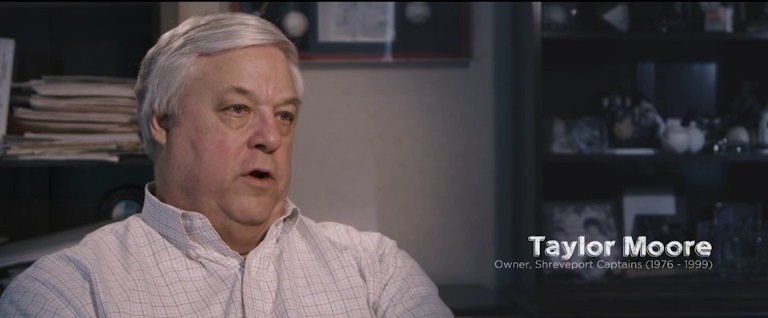
     Among those interviewed, it was nice to see the perspectives of longtime Captains main owner/operator Taylor Moore, a friend for decades; 1980s assistant general manager Elizabeth Denham (now Oliver), who was a pioneer of sorts among Texas League front-office personnel; and old friend J.W. Jones, the Sports' 1950s catcher and then for three decades a mainstay in the Caddo Parish Sheriff's Office.
      Don't want to share too much of what's in this baseball episode or the other episodes because, well, this is a commercial enterprise, and The Shape of Shreveport has the videos on sale -- episodes 1-4 are available now on the web site and episodes 5-8 will go on sale in late spring or early summer. It's $20 for each set.
     It's just the beginning; there are plans for 20 episodes. And back to where I started, if you love Shreveport-Bossier -- as I said in the baseball episode, "it will always be home" -- seeing these videos is worth the effort.
---
     Web site: http://shapeofshreveport.com/home/
     Facebook page: https://www.facebook.com/Shape-Of-Shreveport-1625294684373775/           
     Note: Images taken from Episode 7, with permission from The Shape of Shreveport


Wednesday, January 27, 2016

"I Found A Silver Lining"

      Today -- Jan. 27 -- is International Holocaust Remembrance Day. This is the 71st anniversary of the liberation of the Auschwitz-Birkenau concentration camp in southern Poland.
Rose and Louis Van Thyn
(The Shreveport Times photo)
      My father, Louis Van Thyn, was among the Jewish Holocaust survivors liberated from there. My mother, Rose, had been imprisoned in Auschwitz until a few weeks earlier; she was among those who trudged the cold of the western Europe winter on a "Death March" and was one of the survivors freed from another concentration camp.
      Both lost all their immediate family and their first spouses -- among the 6 million Jewish people exterminated by Nazi Germany.
      Rose and Louis met after World War II ended, back in their hometown (Amsterdam, The Netherlands) and married in October 1946.
      Mom wrote this in January 1991. It is entitled "I Found A Silver Lining."
---      
      Once upon a time, in my younger years, before the world was set ablaze, I lived the good life. I had no fears, no worries, a loving family, lots of friends, laughter, dancing and singing. What a joy life was. Everybody had a name, everybody had a face.
       For me the sun was always shining bright, the fragrance of blooming flowers everywhere, the birds sang their melodies in tune. If the sky had dark clouds, I did not see them; if it was cold and wet outside, it did not bother me; I felt warm and secure.
       In my blindness or innocence, it never crossed my mind that everything could change so drastically. Sometimes when I cried, for what must have been an unimportant reason, my sweet, dear and oh-so-wise mother would so, "Dry your eyes, my darling, and save your tears for when you really need them." I thought, what a strange thing to say. I later wondered if she had a premonition, had she known something I was not aware of.
      Then, as in ancient times, a tyrant came to power. All that had been good and decent vanished; hate and evil triumphed. This demagogue and his consorts wanted all the Jews murdered. They were gathered, thrown into cattle cars, tortured, used as human guinea pigs, robbed of their dignity, their spirit, in a most atrocious way.
      They were brought to one of the most lugubrious and desolate places in the world. There they were disposed of in a worse way than animals. They were pushed into big, black ovens, hundreds of them at the same time -- men, women and children. The poor, poor children -- 1 1/2 million of them, they had not even a chance to live yet.
      Big red flames spew their choking odors of burned flesh and poisonous gas high into the air, ashes were spread all around. Nobody seemed to hear the sorrowful cries for help. Would anybody ever comprehend the depth of this enormous tragedy. It went on for years.
     When it was all over there was this scary deadly silence, a great big emptiness. They called this most tragic event ever, a Holocaust; definition, total destruction of human life, by fire. Few people came out of this hell. I am one of them.
      Experts came up with a statistic, a number -- 6 million. They had no names nor faces; they were only shadows now.
       To me, they were not a statistic or a number; they were the souls of my brethren. I knew and felt that their souls would forever be entwined with mine. I cried and cried till I had no more tears. I then understood what my dear mother had meant. I felt so sad, not even for my suffering but for 6 million humans whose only  crime had been that they were Jews.
      I had so many questions. How could the so-called civilized world have tolerated this unbelievable cruel injustice? How could I go on living? How come I was still alive? Where and when was I to start anew?
      One thing I was sure of, that this was not only a loss for us as Jews, but a loss to mankind.
      But God gave me strength and courage. Slowly I learned to start living and to cope. I got married again to a sweet, caring man, Louis Van Thyn. He understood; he had lived through the same horrendous experience.
     We have two children, one of each -- a boy and a girl. We are fortunate to have come to this country and Shreveport with the help of some wonderful people, the Gilbert family, and the Shreveport Jewish Federation. We will never forget that.
      ... We have a family again. They make life worth living. I thank God every day for all the blessings.
      People tell me I was lucky. That is really not the word. Lucky is when you win a lottery. I did not win anything. I was given something, the most precious gift, a second chance at life.
      I will forever grieve in my heart for 11 million people who perished lonely and forsaken. I realize now that I have an obligation to them, to tell of their suffering to anybody who wants to hear and learn of the Holocaust.
      Although the sun does not shine as bright as before, the fragrance of blooming flowers has dwindled somewhat, the birds sing out of tune now and then, and I can see clouds in the sky now, I am very blessed. God has been good to me.


Friday, January 22, 2016

Minden's best ever: Moreland ... and Dunbar

     (Part II: Sweet Lou Dunbar -- Minden to the Globetrotters)
       If you ask oldtimers, who is the best basketball player to come out of Minden, La., the answer is likely to be Jackie Moreland. But a younger group will say Louis Dunbar. Tough choice.
     Moreland, a 6-foot-7 center/forward who led Minden High School to a 1955 state championship, was so dominant in high school that he was described as "a man among boys." He was the subject of a huge recruiting battle which ultimately left several schools with NCAA penalties.
Jackie Moreland
at Louisiana Tech
     He chose North Carolina State, but never played there. Instead, he went to nearby Louisiana Tech -- after a dalliance with Centenary -- and starred for three seasons, making Little All-American and setting all sorts of Tech scoring and rebounding records. 
     He was Tech's best-ever player, certainly as a big man,  until Mike Green reset the record books in the early 1970s,
     How good was Moreland? Yes, he played in an all-white world in high school and college, but he proved he could last in the NBA. He was the No. 1 draft pick of the Detroit Pistons in 1960, the fourth pick overall.
     Here's what he did that Dunbar didn't: He played eight years of real pro basketball -- five with the Pistons and, after a year out of the game, three with the New Orleans Buccaneers of the new American Basketball Association.
     The NBA and ABA weren't as integrated as they would become, but there were a lot fewer pro teams then -- eight in the NBA in Jackie's rookie season -- and only 12 roster spots, so it was an elite league.
     Moreland was a good pro, especially popular in the ABA in his home state. He retired after the 1969-70 season and became a project engineer on the Superdome being built in New Orleans. Sadly, only a year later, pancreatic cancer quickly took Jackie at age 33.
     He was a Minden/Louisiana Tech legend, and I never saw him play except with the Pistons on TV in the early 1960s. But I knew how good a player he was -- I was told many times by Minden and Tech people -- almost everyone said he was a wonderful person.
Sweet Lou: Globetrotters' "clown prince"
     I saw how good a player Dunbar was at Webster High School (see Part I) and the University of Houston, and for 25 years, with the Harlem Globetrotters.
     I mentioned in a previous blog that I always wondered how it was he didn't play in the NBA; there were rumors he wasn't a fit for the Philadelphia 76ers, who drafted him in the fourth round in 1975. He was their fifth pick; their first two were Darryl Dawkins and World B. Free -- both significant NBA stars-to-be.
     So the word was that Dunbar could not come to terms with the Sixers. Maybe they didn't offer enough money; maybe he wanted too much. Anyway, he wound up going to play in Switzerland, played for the European League champions, and came back to a Houston Rockets summer-league team and tryout camp.
     It was there the Globetrotters scouted him, loved his game and thought he would fit well with them. The rest you know; it's 39 years later, and he's a Trotters' Legend.
     He's traveled the world many times over, met a Pope and several U.S. Presidents and other world leaders, and he's had them -- and so many fans -- laughing. And it's been a personal joy, too.
     Louis summed up his career well in an interview with Larry Guest of the Orlando Sentinel in 1998.
     "When you mention names like Goose Tatum and Meadowlark Lemon and Geese Ausbie, you're talking about the cream of the crop," he said. "To think you're doing some of the routines they did, it's really something special. You just try to go out and do your best knowing and hoping that one day people will say, 'Hey, Lou Dunbar did that.'
     "When you become a showman, you have to bring something to the party."
     Dunbar is not in the Louisiana Sports Hall of Fame. I think he should be soon. The team he's been with hasn't lost a game in 37 years.
     Yes, Lou Dunbar did bring something to the party, and fans loved him. Going back to Webster High and Minden, he always had a fan here.
 

Thursday, January 21, 2016

Sweet Lou: From Webster to Globetrotters

     "Certainly Dunbar and Woodlawn's 7-foot junior Robert Parish rank as the most dominant players in the Shreveport area this year."
     -- my column, The Shreveport Times sports section, Dec. 20, 1970
Sweet Lou Dunbar today (photo from
ESPN telecast)
---
     The late, great Meadowlark Lemon was not my favorite Harlem Globetrotter. Sweet Lou Dunbar was.
     He was only Louis Dunbar -- not yet "Sweet Lou" -- when I met him and first watched him play basketball late in 1970. He was playing for Webster High in Minden, La., and his game was as sweet as any I've ever seen in high school.
     How fortunate I was that in my second year as a fulltime sportswriter, I covered games and wrote about the two greatest high school basketball players I've seen. Both would become legends.
     Robert Parish is in the Naismith Basketball Hall of Fame after a 21-year  NBA career in which he played more regular-season games than anyone. Louis Dunbar is among the Harlem Globetrotters "Legends," a player for 25 years -- their "clown prince" for much of that time -- and the past 14 years their director of player personnel and a bench coach.
     Which is why I tuned in last week when the Harlem Globetrotters' 90th Anniversary Show came on ESPN. I wanted to see what it would have on Meadowlark, who died Dec. 27, and if Sweet Lou was part of the show.
     And there he was, the (very) big man in the dark suit sitting on the Globetrotters' bench, a few pounds (well, a lot) past his playing weight at Webster and the University of Houston. He was tall and thin then -- "sleek" is what comes to mind -- an explosive jumper, great passer and ballhandler (as his Trotters' days proved) and superb shooter. 
     He was, as many have called him, Magic Johnson before Magic. At 6-foot-9, he could play any position -- center, forward, point guard -- and did. Excelled at all.
     After he got to Houston, he grew an enormous Afro -- the subject of an earlier blog piece http://nvanthyn.blogspot.com/2012/07/it-was-only-willie-mays.html because when we ran his photo on the sports front of The Shreveport Times, the editors told us no-no. 
     The hair is shorter now, and much of it is gray. So is his goatee. He is -- hard for me to believe -- 62 (4 1/2 months younger than Parish). But I recognized him instantly sitting on that bench.
The young man from Webster
High School (1970 Shreveport
Times photo)
     Good to see Louis. The young sportswriter who talked to him after a few Webster games in 1970 and '71 and saw him again a couple of years later did not ask enough questions to draw out the delightful, upbeat personality. He was a polite, bright young man, not as reticent as Parish.
     He probably never before had talked to a white sportswriter. Little did I think that later he would entertain and keep audiences laughing for years and years. Maybe he didn't either. We both probably thought he'd be a college and NBA star. 
     And he was a star, an All-American choice by some, at the U. of Houston. Saw him a couple of times after Houston played Centenary in the early 1970s, when Dunbar and Parish (and their teams) had some epic battles -- just as they'd had in high school -- and the last time I talked to him was in the early 1990s when I called him at the Globetrotters' hotel when they played in Jacksonville, Fla., where I was working.
     Just after halftime of the ESPN show last week, we saw him up close on screen.
     Sideline broadcaster Sam Gore began: "A legend, Sweet Lou Dunbar. We lost one of the great showman on this earth, Meadowlark Lemon. Your thoughts about Meadowlark, Lou?"
     "He was my mentor," Lou answered. "My very first year with the Harlem Globetrotters (1977), I played with Meadowlark and Curly [Neal], and he [Meadowlark] taught me everything I know about this game of Harlem Globetrotters basketball, and he is going to be truly missed.
     "I mean he's a legend in his own time. And for those of you who did not know Meadowlark, he was the Harlem Globetrotters."
     With that, Sweet Lou went back to the bench and began laughing -- just as always -- at routines he has seen hundreds of thousands of times. The Globetrotters, if you love seeing a basketball move at rapid paces and slick ballhandling tricks and dribbling, are still fun to watch.
 ---
     My most vivid memory of Dunbar's final season at Webster: The state championship game in Class AA (third-highest in Louisiana then) and Webster about to win it all, with Louis practically dribbling out the final 3-4 minutes by himself and making the free throws his team needed to hold on.
     The 75-68 victory against Franklinton -- which had won the state title the year before -- ended a 34-1 season for Webster.
     Reminded of that record by my source at The Times, my far-back memory told me that the lone loss was to Silsbee, Texas, in a tournament. So the Wolves did not lose to a Louisiana team.
     They also did not play against Woodlawn and Parish, a team that was -- my opinion -- the best (most talent, most depth, most size) of the five Woodlawn teams that reached state championship games in a 12-year period.
     Webster vs. Woodlawn, Dunbar vs. Parish, would have been a super matchup. But Woodlawn was in Class AAAA, two classes above Webster, and the respective coaches did not schedule a meeting.
     As my 1970 column noted, Webster and Dunbar had faced Parish -- then at all-black Union High -- in the previous season. Webster beat Union twice in the regular season, but Union won the bidistrict state playoff game (Parish led his teams, Union and Woodlawn, to four consecutive state tournaments). Parish scored 30, 25 and 29 points to Dunbar's 22, 31 and 24.
     Parish fouled out of both of his 1971 state tournament games. Dunbar, with two dominating performances, was an easy choice for "Outstanding Player" in the state tournament; by acclamation, if I remember the sportswriters' vote.
---
     Some background: Integration of Louisiana high school began in earnest in January 1970, but many all-black schools remained open for the rest of the school year. In the fall of 1970, many of those schools were phased out or made middle schools -- which is why Parish went from Union to Woodlawn. 
     But Minden -- 30 miles east of Shreveport on Interstate 20 -- was a holdout, and its all-black school (Webster) remained open, leaving Minden High only partially integrated. (In many parishes, private schools -- all white -- opened to skirt forced integration.)
     So Webster kept its powerhouse basketball team intact, and Dunbar & Co. remained with the already legendary Webster coach, a kindly old man -- at least he seemed like it to me -- named Ozias Johnson. 
     Much of my 1970 column is about him because by then his teams had won 818 games, which made him the winningest coach in the state (75.2 percent). His Webster teams had won state titles in the all-black athletic organization in 1961 and 1962 with 45-3 and 43-2 records, and they kept winning, with four 30-wins-plus seasons after that, including 31-3 in Dunbar's junior year.
     As a young man, Johnson had gone to Grambling when it was a junior college and in his mid 20s and early 30s -- before Eddie Robinson began coaching there -- Ozias was the head football coach for a couple of games and then the head basketball coach. That was only a partime job; he also was the postmaster in Grambling. 
     He was a soft-spoken, smaller man (maybe 5-7, 5-8), pleasant and humble. He was fortunate to have talented players on hand, and he knew how to get them to play together. (And to put it into perspective, Coach Johnson was 60 when I wrote about him; he seemed old to me then. Not now.)
     The 1970-71 Webster team had other quality players -- a 6-3 guard, Con L. Flournoy, and 6-6 junior forward Billy Bennett. But Dunbar was the man. In leading the Wolves to an 11-0 record when I wrote the column, he had averaged 30.1 points, 15.2 rebounds and 9.5 assists per game. Flournoy was averaging 22.9 points. 
     I don't recall their final stats, but they likely were in the same range ... pretty impressive and probably accurate. (Webster had a very good statistician, a sharp kid named Rodney Seamster.)
     Johnson told me then that Dunbar had developed more quickly than any player he'd ever had: "He played for me as a freshman and he's the only one to  do that."  
     Ozias, who had arrived at Webster in 1946, coached only two more seasons and finished with 889 victories. Few have topped that. But the smartest thing he did in 1970 and '71 was let Dunbar run the show -- player/coach, perhaps -- on the floor.
---
     Obviously Dunbar was being recruited by every college that thought it had a chance. While I was visiting Webster, a coach from LSU called to check when the team was playing again. But LSU, where Press Maravich was in his next-to-last season as head coach, didn't have a chance. No one did, except Houston.
     The word was that Houston was going to outbid everyone for Dunbar. Yeah, read between the words.
     Houston was an independent and had a reputation as an "outlaw" program, in football and especially in basketball under Coach Guy V. Lewis. Was it fact? Can't recall an NCAA probation ever, but Lewis and his chief assistant/recruiter, Harvey Pate, had recruited some great Louisiana talent in the 1960s, notably future NBA stars Elvin Hayes and Don Chaney.
     (The story is that Pate, recruiting Dunbar, made himself at home in Minden and in the Dunbar home. Near signing day, Pate sat next to the phone at the Dunbars. When it rang, he picked up the receiver ... and hung it up. True? Who knows?)
     Lou became one of Houston's top players ever. Here is the link to a 2011  story for a Houston-area newspaper that caps his UH and Globetrotters careers:
     http://www.yourhoustonnews.com/bay_area/sports/sweet-lou-dunbar/article_2a1966a7-4520-5b64-bdde-28c8540a87e6.html 
     He certainly was a fit between the Hayes/Chaney NCAA Final Four teams of the mid-1960s and the Phi Slama Jama teams -- Akeem Olajuwon, Clyde Drexler and Co. -- that twice lost NCAA title games in the 1980s.
     Houston wasn't as successful in Dunbar's time, but a tough opponent for anyone ... including Centenary (and Parish). Dunbar was in a lineup with Dwight Davis and Dwight Jones, each also about 6-foot-10, and that was much for Parish to handle. But there were some classic Houston-Centenary games in the '70s.
     I saw one matchup at Hofheinz Pavilion in Houston in which Parish, a freshman, outplayed all three of those guys -- probably the best game I saw Parish play for Centenary (and he played a lot of great ones). Houston won, but tight officiating was one factor.
     In the return game at Centenary, Parish again starred -- except for the finish. Fouled while shooting as the clock ran out, with Houston ahead by one point, he had two free throws. The clock read 0:00, no one lined up on the lane, and Centenary's No. 00 stood alone. Win, tie, or lose. There was another zero.  Miss. Miss.
     The next season, though, Parish and Centenary got the best of Dunbar and Houston in the Gold Dome in Shreveport -- maybe the most significant of Centenary's 89 wins in the Parish Era.
     Parish and Dunbar never faced each other again. Lou was headed to the NBA a year earlier than Robert, or so we thought. Didn't happen.
      Next: Part II -- Minden's best ever?


Thursday, January 7, 2016

Sixty years in America: a day, a trip, to remember

       Sixty years ago today -- Jan. 7, 1956 -- we got our first look at the Statue of Liberty. It was a moment to remember, and to treasure.
       We arrived in the United States that day, the boat trip from The Netherlands at its conclusion after 10 mostly seasick days.
       It was Dad and Mom -- in their mid-30s -- and my sister Elsa and me. None of us spoke much English, just a few words Mom had learned from a book -- and I had no clue what the Statue of Liberty meant or represented.
       She welcomed us. She held her torch high.
       I do remember my mother telling us, in our little cabin, that we needed to go upstairs on the deck to see the Statue of Liberty. OK, Mom, whatever.
       On Jan. 7, 2016, I can tell you it was one of the great experiences of a lifetime.
       I have written about this previously, in the first year of my blog (2012), but today I present my mother's version of the trip from Holland and our first week in the United States. 
       She wrote this in January 2006, on the 50th anniversary of our arrival, and read it as part of her speech to a group in Shreveport that honored my parents then. There are details in it that I remember differently, but Miss Rose sometimes didn't let the facts get in her way.
        It's lengthy, but I think it's touching and it's neat, so bear with it ...
 ---
        "We applied for an American visa but the immigration laws were so strict we had to have a relative sponsor, and we didn't. In 1953, this country made a special law for Holocaust survivors called the Non-Quota Law. We could come, but we had to have a work sponsor. The HIAS (Hebrew International Agency for Survivors) found us a family in Shreveport, Louisiana, who were willing to sponsor us. They also had a job for Louis in an oil pipe and supply company. They were responsible for the first five years we were here. The owners were Abe Gilbert and his two sons-in-law, Lazar Murov and Neal Nierman. They were what we call in Yiddish real "menschen," which means exceptionally good people.
The earliest photo I have of us in the United States, spring
1956, in front of the duplex on Jordan Street. That's me, Elsa
and Dad with Janet Vandenberg (Mom took the photo). Janet
and her father, Ed, were the first people of Dutch heritage we
met in Shreveport and they were wonderful friends.
       "We had gone in Amsterdam to the American consulate to learn about Shreveport. We knew that we would live a complete different life, but we were determined to adjust. Our friends in Holland didn't understand why we would go to a place where we didn't know anybody. To us, it was a challenge. The 10 years we had lived in Holland (after World War II) were extremely difficult. It probably would have been easier to give up. But how many people get a second chance on life? And if you are fortunate enough to get that chance, then you must try hard to do the best you know how.
      "... We got a visa to come to this great country. We have never regretted it one second that we came here.
      "Someone asked me the other day if I remember where I was New Year's Eve 50 years ago. Yes, I remember it well.
      "We had booked with the elegant, beautiful ship of the Holland-America line. The date was 28 December 1955. All our friends had passes to come on board with us to say our last goodbyes. We all shed some tears. It was very emotional. I realized that nobody made us leave.
      "We were informed that there would be some great parties on board celebrating New Year's Eve 1956 and lots of entertainment. I had made an evening dress of champagne-colored taffeta for Elsa, our 4-year-old daughter. Our very observant son, Nico, who was 8, wanted to know what the brown paper bags on the railing were for. I told him I hoped we never needed them. Just wishful thinking.
      "We went from Hoek of Holland (a city on the North Sea) to Marseille, France, through the English Channel to Southampton. Up till then, the trip was enjoyable. We had a nice cabin with two bunk beds and a great view of the North Sea. The people we met were interesting and amicable. The food in the dining room was scrumptious. Our children were having a good time, which was very important to us. The sea was calm and nobody was seasick.
     "The trouble started going in to the Atlantic Ocean. The ship went east to west and the waves from north to south. Not a very pleasant feeling.
     "Our 4-year-old daughter, who always got carsick, was doing great. She would go by herself to the dining room and told the steward there that the three of us were seasick. She would bring back apples for us, which were supposed to make you feel better. No such luck. We weren't able to take part in any of the parties.
     "If you ever plan a trip to Europe on a ship, don't go in January. After 10 days of misery, we landed in Hoboken, N.J. I kissed the ground, not only to be glad to be in America, but also to be off the ship. I swore I would never go on a ship again, not even a rowboat.
     "There were several people to welcome us; we had known them from Holland and Belgium. Some of them had come to America before the war or right after the war was over. They were all diamond polishers and offered Louis a job. He didn't accept, and I was delighted. I had enough of snow and ice and temperatures far below freezing. We were invited the next day (Sunday) for dinner by some of our friends. They were living on Long Island.
     "Our friend, Sally, picked us up from where we were staying. The HIAS had brought us there. It was on Lafayette Street (in New York City). The building used to be an old school. It was now a place for immigrants. There were people there who had lived there for years. It was nothing to compare with the Hyatt. Fortunately, we had to be there for a few days.
     "We had a wonderful time with our 'old' friends talking about 'the good (?) old times.' After dinner, Sally dropped us off at the railroad station. We took the train to Great Neck, N.Y., where we had to change to New York City. It was the first time we were on our own. Not knowing exactly where we were, not speaking the language well, with two children to whom it all was different and strange. It was sort of stressful.
      "Back in New York, we took a cab to Lafayette Street. The next day we took the subway to Broadway to see the Rockettes dance. It was maybe the only chance we would get to do that; we probably would never come back to New York. It was fabulous except for the ice cold, freezing, snowing weather.
     "Tuesday, we again took a cab to Penn Station to catch the train to Chicago. There, we had to change platforms and another train. We waited three hours for the train, which would bring us, hopefully, to St. Louis. It was Thursday, 12:30 a.m., when we arrived in St. Louis.
     "We left there with our two tired, sleepy children at 2:45 a.m. At 5:50 a.m., we stopped in Hope, Arkansas, where we had to go to another platform. The station was closed. There was not another train coming until 6:40 a.m. We sat outside on the two suitcases we had, not very comfortable. At 7:30 a.m., Jan. 12, we arrived in Shreveport.
      "The Jewish Federation director was there to welcome us. He was very kind. His name was Maurice Klinger. We were impressed with the car he was driving. It was a 1956 Chevrolet two-toned, grey and pink. In our eyes, it looked like a limousine. In Holland, you wouldn't see cars like that. Everybody drove small cars, like little toy cars.
      "We had an address on our papers for a hotel downtown, the Caddo Hotel. The Jewish Federation had rented a room there for us for two weeks. Mr. Klinger brought us to Jordan Street, to a two-story house. I said to Louis in Dutch, never seen a hotel like this. It turned out to be a duplex; it was nicely furnished. There was some food in the refrigerator, among other things, a chicken. Our first meal in Shreveport was chicken soup, of course.
     "The next morning we found an elementary school in the neighborhood. Louis and I thought the faster Nico would go to school, the faster he would learn English. Afterward, we came to the conclusion it was a big mistake. We should have given him time to acclimate. He had a very difficult time in the beginning. He became good friends with the rabbi's youngest son, who was a tremendous help to him and us.
     "There were no public kindergarten schools, only private, and we couldn't afford that. With the help of Nico, I tried to teach Elsa at home. There was one word she was familiar with: 'cute.' Everything was 'cute," from toys to cars to flowers. Even some food. She heard that word over and over again because that was what people would say to her.
     "Friday night, we went to Shul (Agudath Achim, on Line Avenue). It was about three blocks from where we lived. It was quite an experience. They made us all feel welcome -- something we really needed. Until then, we hadn't met many people.
     "The next day, we walked around the neighborhood to get familiar with our surroundings. On Sunday, we walked all the way to Kings Highway, about an hour from Jordan Street. There we took the city bus to the Mansfield Road where Gilbert Pipe Co. was located. We wanted to see how much time Louis needed to go to work.
     "The next day Louis went from diamond polishing to the oil pipe and supply business. He was hired for six weeks and stayed for 28 years. He learned the business from the bottom to the top. He not only liked the work, he did what was even more important -- he liked the Gilbert family and so did I.
      "... We are blessed in so many ways having come to Shreveport, meeting so many people and making so many good friends. All of them showed us love, care and kindness. We can't thank everybody personally, but we want you all to know how much we love  you and appreciate you."
---
     It is 10 years since she wrote that and gave the speech. She's gone, Dad's gone, and they had more than 50 years in this country. Elsa is in New Jersey, and I'm in Texas. There are now six Van Thyn great-grandchildren.
     And we're grateful.
     The Statue of Liberty stands in that harbor and it might be debatable to some, but not to me: She is a welcome sight still.
     It's 60 years and counting for us. Seems like a lifetime.