Chapter 26
The contributors
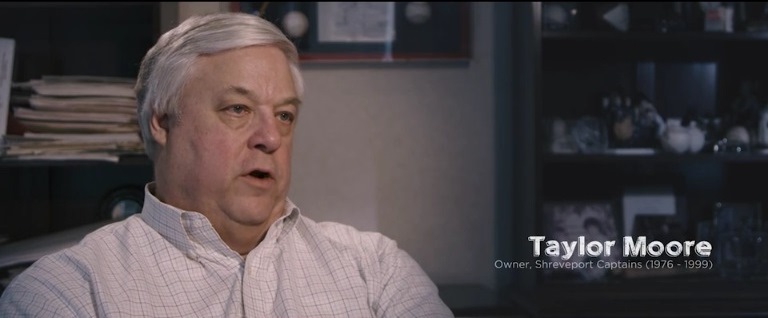
 TAYLOR MOORE --
 |
| The Captains' front-office team for much of the late 1980s/early 1990s: (from left) Taylor Moore, president-general managing partner; Jon Long, general manager; Elizabeth Denham, assistant GM. |
 RAY JOHNSTON -- The Dallas businessman bought a Texas League franchise after the 1970 season and moved it from El Paso to Shreveport, where the Atlanta Braves had owned the team for three seasons (1968-70). Johnston was majority owner of the team -- renamed the Captains before the 1971 season -- for five seasons before selling the majority share to a group of Shreveport-Bossier residents. Named the "King of Baseball" during his Captains' days (1973), Johnston also owned the Triple-A Iowa Oaks, based in Des Moines, from 1969 to 1981.
 ALBERT A. GAEDKE -- For some 25 years, he not only tended to the grounds at Texas League Park/SPAR Stadium, he lived there. A Polish-American, a World War I veteran with roots in Milwaukee, he came to Shreveport-Bossier as a bricklayer in the construction of Barksdale Air Force Base in the early 1930s. When Biedenharn Park burned down, he was hired as a guardian of the old baseball grounds and when the ballclub returned in 1938, he became the ballpark superintendent, groundskeeper and maintenance man. A bachelor, he lived in a shack in the right-field corner of the stadium. He kept a garden there -- hence the nickname "Gaedke's Gardens" -- and at times in the off-season set up a miniature golf course at the stadium, or used the field as grazing area for a herd of goats. He was an active Shriner, drum major for the El Karubah band. He died (natural causes) at the stadium; found in his shack on Sept. 1, 1965, at age 76.
PERRY "POP" NEWMAN -- For two decades, he was the groundskeeper at Shreveport's professional ballpark -- the one known as Gassers Park/Biedenharn Field, located on the lot on the right side of where Texas League Park/SPAR Stadium stood. He also was a longtime member of the Woodman of the World fraternal benefit society. He died in Shreveport on Oct. 3, 1942.
 ARCHIE "ABE" MILLER -- He was the Shreveport Sports' ace pitcher in 1931, a right-hander with a 16-16 record in 46 games (35 starts) and 273 innings. His minor-league career went through the 1930s, and he was in the East Texas League from 1937 to 1940, then made his main contribution to the Sports as the chief scout for team managing partner Bonneau Peters through the 1940s and '50s. He found and signed many of the surrounding area players and also was a parttime coach helping the field managers. He was known as "Payday" and a spinner of stories.
 WALTER MORRIS -- When the Caddo Parish Baseball Associated group bought the Shreveport baseball team in 1932, he became its business manager. By then, he was long established in Organized Baseball; his playing career went from the University of Texas to a stint with Shreveport in the early Southern Association. He became Texas League president in 1916 and in 1920 helped start the Dixie Series -- which for 37 years matched the playoff champions of the TL and Southern Association. At various points, he was part owner and business manager of the Fort Worth and Dallas teams; helped organize 14 pro leagues and build nine ballparks, and was league president of seven (late in life, he simultaneously led the Evangeline, East Texas and Cotton States leagues). When Shreveport came back to the Texas League in 1938, he also returned as the team's front office.
 WALTER K. MEGARITY -- From 1938 to 1961, he was the Shreveport Sports' business manager and traveling secretary. Originally from a large family in Corsicana, Texas, he was an integral -- but mostly hidden -- part of the Sports' operation. A Shreveport resident for 65 years, a self-employed accountant after his baseball days, he died on July 18, 1974, at age 83.
 B.A. HARDEY -- The longtime independent oilman, involved in the business from 1914 until his death in 1963, was mostly a behind-the-scenes fan and part team owner of Shreveport's teams. A University of Texas graduate, commanding officer of the U.S. Army's 64th Anti-Aircraft Battery in World War I, he was a co-owner of the Sports from 1938 to 1961. He reached the rank of major in the Army, and was involved in a wide variety of civic causes and government agencies. He died in Shreveport on Oct. 12, 1963, at age 69.
 C.A. "BUD" NEWMAN -- The son of Shreveport ballpark groundskeeper Pop Newman, he was a minor-league umpire for two decades -- beginning in the Evangeline League in 1935 and including a couple of years in the Texas League in the early 1950s. He retired from pro umpiring when in the American Association in 1955, but continued to call basketball and baseball in North Louisiana for years and still subbed in the Texas League as late as 1970. Distinctly, he was partly deaf and the story that he could turn off his hearing aid when being yelled at fans, managers and/or players drew national attention. As a youngster at the old ballpark in Shreveport, he worked the scoreboard (for 50 cents a game), was an usher and then a grounds worker for his father. He died at age 75 on Feb. 27, 1979.

IRV ZEIDMAN -- The New York native first broadcast baseball for the Monroe Sports in 1951-53, then was the radio play-by-play announcer for the Shreveport Sports from 1954 to 1961 and also for Centenary College basketball for a decade. "This is IZ for 5D, or IZ for JD" were familiar phrases, touting primary sponsors, and "going ... going ... and there she goes!" was his home-team home-run call. Later in life, he was an insurance salesman and, with a strong voice, a community theater musical and drama star, most notably as a terrific Tevye in a Shreveport production of Fiddler on the Roof. Died Nov. 6, 1975, in Shreveport (heart disease) at age 57.
 PAUL MANASSEH -- A Shreveport native and Byrd High School graduate, he was public relations director for the Shreveport Sports in the early and mid-1950s and general manager of the Monroe (La.) Sports. He went from Shreveport to PR director for the Denver Bears' baseball team in the American Association, then for the Denver Broncos in the first four years of the American Football League. He returned to Louisiana as sports information director at Louisiana Tech in 1968, then became SID at LSU for 12 years -- the Tiger Stadium press box is named in his honor -- and then director of the Independence Bowl in Shreveport. Died Feb. 20, 2000, in Baton Rouge (from injuries suffered in an automobile accident) at age 79.
 ALARIC SMITH -- He was a Bossier City resident all his life and the Bossier High graduate got into umpiring in the late 1940s, was in the TL through much of the 1950s, often teaming with Frenchy Arceneaux for a Shreveport-Bossier-based tandem (as they did in area high school and college basketball). Smith moved on to the International League, then to the American League for five seasons (1960-64) for 798 regular-season games, plus All-Star Games in 1961 and 1963 and the World Series in 1964 (home plate in Game 6). He was let go after the 1964 season, reportedly for a variety of off-field issues; the “official” cause was that he had exceeded a weight limit. Died Nov. 14, 2006, in Bossier City, at age 81.
 |
| Game 5, bottom ninth inning, 1964 World Series: Alaric Smith, the first-base umpire, faces off with New York Yankees’ manager Yogi Berra after Joe Pepitone, right, was called out (after a throw by Cardinals pitcher Bob Gibson) on a close play. Film proved Smith made the correct call. The next batter, Tom Tresh, hit a game-tying, two-out home run. St. Louis won 5-2 in 10 innings. (Associated Press photo) |

 FRENCHY ARCENEAUX -- His given name was Kurcy Paul (K.P.), but he was "Frenchy" to everyone, and he was one of the Texas League's best known -- and most controversial -- umpires, starting in 1949 and working through the 1950s. He was an imposing figure (6-foot-2, 230 pounds) and stories abound about his toughness and his competence. He also officiated area college and high school basketball games for years, many times partnering with fellow baseball umpire Alaric Smith. After retiring from the field, he did work for the Shreveport Braves’ front office in the late 1960s, and died in 1971 at age 48.

 JAMES C. FARRAR -- "The Man From Lillie (La.)" was a scout for the Houston Colt 45s/Astros for a couple of decades, and for a time, a coach with their rookie league teams in the summers. He combined his scouting days with a very successful baseball/football coaching career at Fair Park and Northwood High Schools in Shreveport in the 1960s/early 1970s, then became baseball coach (1978-85) and head of the health and physical education department for a couple of decades at Centenary College (where he was Dr. Farrar). After retiring from baseball at Centenary, he resumed his Astros' scouting position -- the “name” player he spotted and signed was longtime ace pitcher Roy Oswalt -- and was named the organization's "Scout of the Year" in 2002. Died Oct. 30, 2012, in Shreveport at age 81.

 |
| Dave Nitz with Willie McCovey, a Baseball Hall of Famer and former Texas League player with Dallas, at Fair Grounds Field in 1987. |
 DAVE NITZ -- For 20 years, he was the radio play-by-play announcer and de facto publicity director for Shreveport's pro baseball teams -- 14 years (1986-99) with the Captains in the Texas League, six years with independent league teams. (KEEL carried those games for 12 years; KWKH for four; KRMD for three; and KYLA-FM for one.) The West Virginia native, in 2017, was in his 36th year of minor-league baseball announcing (the last nine years with the independent Sioux City Explorers), having passed the 4,000-game mark. In the fall of 2019, the longtime Haughton, La., resident will begin his 45rd year as play-by-play announcer for Louisiana Tech University athletics, nearing 3,000 Tech games.

 BARRY WEINBERG -- From Silver Spring, Md., he was the trainer for the 1976 and 1977 Shreveport Captains, part of the Pittsburgh Pirates' organization. (He played left field for the Captains in three games at the end of the '77 season, going 1-for-6, and the hit was a double.) He made the major leagues as assistant trainer of the New York Yankees in 1979-81 and spent 33 years as an MLB trainer, 24 with teams managed by Tony La Russa (16 years in Oakland, nine in St. Louis). That means three World Series championship rings for Weinberg (1989 Athletics, 2006 and 2011 Cardinals). At age 66 in 2017, he was with the Cardinals as senior medical advisor.
 |
| Barry Weinberg as Shreveport Captains' trainer in 1976-77. |
 Also on radio: JERRY BOZEMAN, an enthusiastic promoter and man-about-town, was the play-by-play announcer on KWKH-KTBS for the Sports and various other sports events, from 1938 to 1942, usually accompanied by wire operator Seth Rachel. ... AL DONALDSON, who had been a sports radio announcer since 1937, was the Sports' play-by-play man on KENT for five seasons (1948-52). There were no game broadcasts in 1953. ... DOUG GREENWALD was the Captains' play-by-play announcer in 2000 on KWKH, then did Swamp Dragons' games in 2001 on KEEL. No game broadcasts in 2002, Shreveport's last season in Organized Baseball.
 Also: ALEX THOMAS (left), longtime clubhouse man for the Fort Worth Cats and Shreveport Braves/Captains. … Shreveport Braves general managers BOB MORRIS (1968) and BOB BURTON (1969-70), Captains general managers EARL JOHNSON (died during the 1971 season), DAVID SZEN (1972-73), MIKE HALBROOKS (1975, JOHN W. MARSHALL III (1979-80) and JON LONG (assistant 1979-80, GM 1981-92); GILBERT LITTLE and ROXY DANCY in the 1990s; assistant general manager ELIZABETH DENHAM in the 1980s and early 1990s (as one of the first women in a baseball management role); JAY CICERO, assistant GM; TERRY SIPES, who served in the front office during the 1990s and 2000s and was general manager of the independent league teams.