Friday, April 1, 2022

"Our Janice" was always a champion

     Came across a fond memory of a spectacular woman ...

     Janice Cahn was as close to a grandmother as we -- my younger sister Elsa and I -- ever had.
     She was Mom's surrogate mother, the beloved angel our mother needed so badly after she lost her mother -- and the rest of her immediate family -- to Nazi-made deaths in the Holocaust.
     Mrs. Cahn -- "Granny Cahn" to us, "our Janice" to Mom -- was one of our lives' greatest blessings, as she was to several immigrant families in Shreveport for decades.
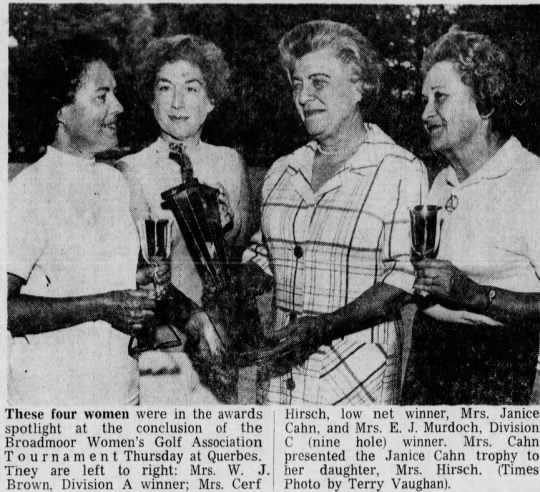
     Almost 10 years ago, I did a blog piece on her. And here is an update because two nights ago while researching Shreveport pro baseball material in May 1970, I came across this photo.
      This was a heart-tugging, tear-inducing moment. A memory of someone so dear to us. There she was -- again -- on the sports page of The Shreveport Times. And by that time, I was on the sports staff there.
     It reminded of something I knew, but had never really researched:
     Janice Cahn -- or Mrs. Abry S. Cahn, as the newspapers in the 1930s, '40s and '50s called her, every time -- was a helluva competitive golfer. 
     She didn't talk about it much in our many visits from the late 1950s through her passing in June 1986. She wasn't one to brag. 
     Looking over the clippings I found Friday, she had so much she could have said. For starters, she was the first from Shreveport to win the Louisiana women's state amateur (in 1932). 
     She knew I loved sports, and so we'd talk about golf in the early 1960s when I was a fan only because of TV coverage and because of Arnold Palmer. 
     Among the many, many gifts Mrs. Cahn gave me was a book, The Gilded Age of Sport, written by Herbert Warren Wind. He was considered the finest golf writer in the country for decades (yes, before Dan Jenkins) and was one of Sports Illustrated's stars for a few years after its 1954 inception. 
     This book was first published in 1945, and updated every year. Mrs. Cahn gave me the 1961 version. I was 14; the book -- honestly -- was a bit above my level then. But it aged, and so did I, and it has been re-read often. It sits within reach of where I am typing this blog.
     Mrs. Cahn knew how to pique my reading interest ... among many other things this wise woman knew.
     Please read my 2012 blog piece on her (and know that we now have four grandchildren; it was three then):
https://nvanthyn.blogspot.com/2012/06/granny-cahn-set-example.html
     And I am adding these clippings and photos that will tell you much more about Janice Cahn, and what a powerhouse she was, what a contribution she made to Shreveport-Bossier and to life itself.
     It is this simple: She was one of the greatest people we've known.


From a golf column in The Shreveport Times, 1953


December 1959, Shreveport Journal


From a 1970 Shreveport Journal story


Saturday, March 19, 2022

One October day in 1962, Ralph Terry stood tall

     Ralph Terry died this week, another of our 1960s baseball heroes gone. Their days, and their ranks, are dwindling.

     There was a special personal affinity for Ralph Terry, for several reasons. Primarily because he was the hero of the 1962 New York Yankees' season and World Series championship team.       
     If you've watched the '62 World Series film -- and it's played on this computer about, oh, 62 times -- you know that Ralph threw the last pitch of Game 7, and that the San Francisco Giants' big man, Willie McCovey, knocked the heck out of that pitch ... a screaming line drive right to -- thank goodness -- Yankees second baseman Bobby Richardson.
     Sweet redemption for Ralph (and the Yankees).
     Because two years earlier, he also threw the last pitch of the World Series. That ball ended up sailing off the bat of the Pittsburgh Pirates' Bill Mazeroski and over the wall in left field at Forbes Field. So ... 10-9, Pirates, and an immortal baseball moment.
     Another reason Ralph Terry was one of our guys: (roll your eyes) He once pitched, at age 17, for the Minden Redbirds in the summer semipro Big Eight League, based in North Louisiana. (Yes, we are partial to that area.)
     He was an Oklahoma kid, tall and rangy, a pro prospect looking for good competition. A year later he had signed with the Yankees and was pitching for their Class A farm team. Two years later, he made his major-league debut.
     But he never had a winning season in "the bigs" until 1960, and -- see above -- that season didn't end well (no thanks to Mr. Mazeroski).
 However, when my top  personal memory of
Ralph Terry goes to 1962, specifically Tuesday, October 16, Game 7, and the victory ride his teammates gave No. 23 off the field at Candlestick Park.
      That was, as happens so often, a tense, dramatic, memorable Game 7.
      And my memory takes me to the football practice field at Woodlawn High School, a few minutes -- if I recall -- past 2:30 p.m.
---
     Sophomore year, football manager (equipment dispenser, tower picker-upper, etc.). Innocent (naive) 15-year-old, a sports maniac. Really, the only interest in life, and baseball (Yankees) was the No. 1 concern (Woodlawn was 1-A).  
     But on that Tuesday afternoon, at  practice, my mind wasn't on football. It was on the baseball game on my transitor radio -- brown case -- that I had to my ear.
     Practice? Who cares? There were other managers around.
     We had a helluva good team, a carryover from the "Cinderella" district champions the year before. We were 5-1, 4-0 in district, and that week was a tense one at Woodlawn because our opponent on that Thursday was Byrd High School, the arch-rival.
     Uh, we didn't like Byrd. 
     We had routed a good West Monroe team 26-0 the previous Thursday. Byrd was 2-0 (and had a big, bad team that -- spoiler alert -- would go on to play in the state-championship game). 
     We knew we'd have to play without our promising sophomore quarterback, our friend Trey Prather. He had been the backup QB the first six games, and against West Monroe had emerged as a star, 3-for-3 for passing with two touchdown connections to Edwards Walker (12 and 23 yards). Trey also ran four times for 28 yards. But on his last run, Trey was knocked out of bounds across the field at the West Monroe bench. He didn't get up. Result: broken left wrist.
     Trey easily was our best passer. But the starter, Joe Geter, came back in and found Walker for his third TD catch. (Our friend, Ed Walker, who passed away in Houston just a month ago.) 
     We digress. Sorry. Byrd High was on everyone's mind. Mine was on the Yankees-Giants Game 7.
     Great game, great Series. Rain-delayed for three days before Game 6 in San Francisco. Giants won that one to force Game 7.
     Ralph Terry had been the Game 2 loser at Candlestick and he'd never won a World Series game (his Series record was 0-4)... until a complete-game victory in Game 5 at Yankee Stadium, helped by rookie Tom Tresh's three-run home run to break a 2-2 tie in the bottom of the eighth.
     In Game 7, Ralph was the right guy on the mound in the right place. He had won 23 games in the regular season (23-12 record), pitched almost 300 innings, by far his greatest season. Also gave up 40 home runs, but so what?
     On this day, he stopped an outstanding Giants team -- the first San Francisco National League champion -- on four hits. Some defensive gems helped him.
     Tresh saved him in the seventh inning
with a running backhanded catch in left field on a drive hit by ... Willie Mays. 
McCovey followed with a long triple, but he was stranded at third. Thus, the Yankees' 1-0 lead was preserved.
      Classic ninth inning. Yankees failed to score after loading the bases with no outs -- forceout at home, double-play grounder (5-U, 5-3 if you're scoring, baseball fans). Bottom nine: Matty Alou pinch-hit, perfect drag bunt single. Terry struck out the next two batters. 
     Up comes the mighty Mays (oh, Lord, I'm shaking listening to this). Lines a hit to right field. Roger Maris, a terrific outfielder, rushes over to the corner, cuts the ball off before it can get to the fence and hurries his throw to the cutoff man -- Richardson, in short right, relays it home and Alou has to stop at third. Phew!
     Mays is at second, the potential winning run on a single. 
     McCovey, an awesome man, is up. First base is open; Orlando Cepeda is on deck. Yankees manager Ralph Houk goes to talk to Terry, and they decide to forgo the "percentage" move (walk McCovey, get a righty-on-righty matchup with Cepeda). Huge gamble.
     First pitch McCovey hits a long, long drive ... foul. I'm listening, and really shaking now. Second pitch: the line drive to Richardson.
     Game over, Series over ... the Yankees win! (World Series title No. 20, the 10th of my lifetime. Would have to wait 15 years for  another one. Damn.) 
     Radio goes flying in the air as high as I could throw it, but I didn't yell. Didn't want to disrupt football practice. Probably the coaches and the guys didn't notice. I didn't care. I loved Ralph Terry then, and I loved him forever.
---
     Another scene, two years earlier: Junior high eighth-grade math class, Maurice K. Nickels the excellent teacher, sometime before 2 p.m. We're taking a test, Game 7 of the '60 World Series is going on. I know the Yankees were ahead 7-4 in the eighth inning. Mr. Nickels leaves the room, comes back in after a while and announces to the class that the Pirates have won the Series on a home run by Bill Mazeroski.
     One kid, age 13, in Mr. Nickels' class sinks in his seat, feeling ill. Doesn't want to believe it. Doesn't know that Ralph Terry gave up that home run.
     Two years later, we forgive Ralph.
---
     Met him in the early 1990s when he was playing the Seniors PGA Tour and was in an event at the Valley Course at TPC Sawgrass in Ponte Vedra Beach, Florida. He was that good a golfer, maybe the best-ever baseball player-turned-golfer. It was the day I followed Arnold Palmer's round, but sought out Terry afterward.
     Thanked him for 1962, mentioned Minden, which brought a laugh. He said it was a good memory.
     He was 86 when he left us this week. The only other Yankees who played in that Game 7 in 1962 still living also are 86 -- Bobby Richardson and Tony Kubek. Giants players from that game still with us are the greatest player I've seen: Mr. Mays, and Felipe Alou and "The Baby Bull," Cepeda. 
     Heck, they're all legends. But on October 16, 1962, Ralph Terry was The Man.
--- 
      One postscript: Talk about tense, what we didn't know that day, but would learn by the following Monday ... This item taken from history.com, a "This Day in History" listing:
      "In a televised speech of extraordinary gravity, President John F. Kennedy announced on October 22, 1962, that U.S. spy planes have discovered Soviet  missile bases in Cuba."
       (The Soviets. The Russians. Troublemakers. Some things don't change.)
       Yikes. And we thought the World Series and Byrd-Woodlawn football were tense. Right.


Tuesday, January 25, 2022

A broadcast halftime guest to remember

Detroit, December 28-29, 1976, the Motor City Classic ...

Dick Vitale
(photo by Matt Cashore, USA Today sports)
     A few years before he became the World's
Ambassador of Basketball, he was the halftime guest interview on the Centenary College broadcast.
     We knew this could be interesting.
     We had seen his "act" the previous night when he coached the best basketball team the University of Detroit had ever had to a close victory against our team, the Centenary Gentlemen. He was, well, a wild man, frantically -- obsessively -- directing his Titans. 
     The next night, as our guys played a consolation -- third-place -- game, he came to our radio-broadcast position to talk at halftime. His team would play the championship game about an hour later.
     All Jim Hawthorne, Centenary's play-by-play broadcaster on KWKH-Shreveport (1130 AM on the radio) in the late 1970s, had to do was ask one question. Dick Vitale -- yes, the omnipresent basketball guru -- took it from there.
 You might have seen him, and especially heard him, a time or two over the past 40 years. 
     Of course, he talked and talked and talked. He was intense, excitable, enthusiastic, loud, funny, crazy. Pick an adjective.
     It was unforgettable. And to think that then, 1976, not many people outside of, say, New Jersey (where he grew up and first coached) and Detroit knew of this blind-in-one-eye, balding, babbling nut case.
     Dickie V., baby.
     A footnote to this lead-in: A couple of hours later, after his U. of Detroit team had struggled to edge a less-than-.500 Kent State team in overtime, Vitale -- did we say intense? -- and Kent State coach Rex Hughes engaged in a shoving match that had to be broken up. Hughes wasn't happy with the game's outcome; Vitale wasn't happy with his team's subpar effort.
     Saw it happen. Not a good scene. But here is a fact: Both Vitale and Hughes were basketball lifers, and both were head coaches for a short time in the NBA. One little skirmish didn't matter.
      We did appreciate Vitale coming on our halftime show. What Hawthorne -- who would go on to be LSU athletics' "Voice of the Tigers" for three decades -- remembers is telling.
      "He was sitting with me in a press booth at the top of the arena [Detroit's Calihan Hall]," Jim recalls, "and he told me, 'I just get so nervous.' "
       If Dick Vitale was nervous -- and maybe that's what took him out of coaching for good only a couple of years later -- think about how many TV viewers he made nervous over the next 40 years.
---
     He was, and still can be, outrageously colorful -- dancing with cheerleaders, being the object of crowd-surfing, wearing goofy wigs, using his Vitale terminology ("diaper dandy," "PTPer," etc. ... here is the list -- https://dickvitaleonline.com/about/dick-vitales-dictionary)
     He also is outrageously positive and popular -- an emotional, wonderful friend of coaches, players, and the world. A charitable human being, always promoting good causes. The University of Detroit named its basketball court for him; he's been inducted into the Naismith Basketball Hall of Fame.     
     To listen to Vitale as the color announcer on TV basketball games, mostly college games but also a couple of years of NBA games, required patience and a good set of ears. Many people -- confession, I am one -- took it small doses, or not at all. Here is where the "mute" button came in.
     (My Dad loved basketball, but not Vit-al-ee, as he pronounced it in his broken Dutch/English. He always turned off the sound on Dickie V.'s games.)          
     Now, though, "mute" is not a happy word when we consider Mr. Vitale. This has been a tough time for the 82-year-old longtime Florida resident -- first melanoma, then lymphoma, chemo for months, and now vocal cords damaged to where surgery is required. He can't talk, and this week ESPN announced that he won't be back on the air for the rest of this basketball season.  
     It is no time for jokes about his voice.
     You know the sports world is rooting for him, and his full recovery.
---
    We saw him, and he did that radio interview, in his greatest season as a coach. It was his fourth year as the University of Detroit coach, and his 1976-77 Titans went 25-4 (and one loss, to Minnesota, was reversed by forfeit).
      They won 21 games in a row -- Centenary was No. 6 in that streak -- and the last of those was a 64-63 upset (on a last-second shot) of No. 7-ranked Marquette in Milwaukee. Oh, Marquette went on to win the NCAA championship.
     Here is a funny Vitale moment: His dance at midcourt after that victory at Marquette: https://twitter.com/dickiev/status/804121343553925120
     Detroit made the NCAA Tournament for the first time in 15 years, and won one game, then lost in the Sweet Sixteen to state rival Michigan.
     That team included three future NBA players -- guards John Long and Terry Duerod, and forward/center Terry Tyler. 
      Earl Cureton, a 12-year NBA player, came to Detroit as a transfer while Vitale was the coach (and then athletic director for a year). When the 1977 team had a 40-year reunion, and Vitale attended, Cureton said this:  
    "Bringing back Dick Vitale is huge. Usually, when you talk Titans basketball, you talk Dick Vitale. His name always comes up. I had a great deal of respect for what Dick did during his career, not only in basketball, but what did for us out of basketball.
      "He taught us about the game of life. He prepared us for life after basketball and how important it was for us to get an education and go from boys to men. He kept us on the straight and narrow and was definitely a role model. Just to show there was a lot of respect for Dick, all of them coming back 40 years later to see him. There's going to be a lot of excitement for him coming back in the building.
      "For a mid-major ... to create that type of excitement and to create the group of young men he created, I think, was amazing. What he did at U-D was just phenomenal."
---
     Charlie Vincent was a transplanted Texan who wrote sports for the Detroit Free Press for three decades and was the beat writer for U. of Detroit basketball in 1976-77 (later covered the Detroit Pistons and then became a popular, crafty columnist for years). He could be tough, though. Here is what he wrote after Vitale's team barely beat Kent State:
     By the end of that season, Vincent was a bit more complimentary of Vitale's work.
     Joe Falls was a Detroit sportswriting legend, covering 50 years, the Free Press' lead sports columnist during Vitale's U. of Detroit time (and one of my favorite writers on baseball). Here is what he wrote about Vitale's influence:
      That crusader, that non-stop talker, that entertainer came into our personal vision in 1976, and had us shaking our heads (and covering our ears). So much fun, so endearing. 
       We wish him well, and when he gets back to television, we might even turn up the sound. Because he is Dickie V., baby.

Saturday, January 15, 2022

Surviving Shanghai: A Marine's story

      A girl with Russian Jewish roots meets a U.S. Marine in China.

     The first few years of Jim Randolph Jr.'s life were spent in miserable conditions -- in a Japanese internment/prison camp in Shanghai, China.
     Jim doesn't remember it; he was too young. Good thing.
     His mother could not forget. Her life would never be the same. 
Ida Roskin Randolph
     Ida Roskin Randolph was Jewish, from a family with Russian heritage whose ancestors fled -- "escaped" is another description -- from Russia to China when Communism took over the USSR. Ida and her parents grew up in Shanghai, and they were there when World War II broke out in the Far East in December 1941.
     In the end, hers is a wonderful "rest of the story" -- incredibly -- in west/central Louisiana.
James W. Randolph Sr.
     Ida was 17 when James Randolph Sr., 19, a U.S. Marine from Many, Louisiana, came into her life. It happened quite a bit: Girl from "overseas" meets American serviceman on duty, and they become a couple.
     They met through mutual friends, a girlfriend of Ida's was dating a Marine friend of Jim's. Jim found Ida attractive, and they were a match. Language wasn't a barrier; she had learned English in international school in Shanghai. Soon they were in love ... and they married. And soon, she was pregnant.    
     So James Jr. was born in Shanghai as an American dependent. He was 10 months old when the world was about to change, not -- in the short term -- for the better.
     James Sr. would have a 21-year U.S. Marine Corps career. In October 1941, he was sent from Shanghai to join the Pacific forces preparing for what became 3 1/2 years of combat against the Japanese. He made six stops of islands and countries in the Far East, survived it all and eventually returned to the U.S. as a decorated war veteran.
     And he would reunite with his wife and son in the U.S. Jim Jr.'s first memories of his father were when he was nearly 6 and they met in San Francisco in 1946.
     While Jim Sr. was in combat, Ida and Jim Jr. had been through a sort of hell of their own: prisoners of the Japanese. 
---
The young coach, 1966
     We remember Jim Jr. as a high school basketball coach (and principal) in North Louisiana from the mid-1960s through the 1980s. A very good basketball coach, an organizer and promoter of the game, dedicated to it and to the relationships with the kids he coached. In the early 1970s, as a young sportswriter, we covered games that involved some of his best teams.
     We also knew that his first cousin is Stanley Tiner, our friend from late 1960s Louisiana Tech days and later our boss as editor of the afternoon Shreveport Journal, one of several newspaper editor positions Stan had over three decades. That included heading one Pulitzer Prize-winning staff in 2006.
     What we didn't know was Jim Randolph Jr.'s back story, and that of Stanley's "Aunt Ida." (Stan's mother was Jim Sr.'s sister.) Stan alerted us to the story, and provided Ida's photo.
     What Jim Jr. and Stan also share is Marines' duty. 
     Jim followed his father's path and joined the Marines at age 17 in 1958, immediately out of high school. Jim Sr. administered Junior's induction. His four years of service were during a non-combat time, and the tough Marine life  included some fun -- he played on camp basketball teams, including time as a player-coach. 
     Stan joined the Marines in the early 1960s and became a Vietnam veteran, a war correspondent and photographer. 
     Another commonality: They each went from the Marines to college -- Jim at Northwestern State (1962-66, health/P.E. major), Stan back to La. Tech (1967-69 for a degree in journalism).
     Even before he graduated, Jim (at age 25) had been named as a head basketball coach at Springhill High in April 1966. 
     His 12-season coaching career (four schools, 290 victories, a .625 winning percentage) included five playoff seasons at Zwolle (where he was high school principal for another five years) and ended in 1984 as the first successful basketball coach at Shreveport's Southwood High.
     He is 81 now, happily retired and living with wife of 28 years, Judy, in Rockwall, Texas, where he was high school principal for 10 years, the last of 25  fulltime years as a school administrator. He stays involved with his church (Lutheran) and in Marines' veterans activity.
     He doesn't push his early adventures. His family and some close friends know, and there have been stories written, but in North Louisiana, it wasn't common knowledge other than references to his being a Marine veteran. 
     Fact is: He and Ida were camp survivors.
--- 
     Shanghai, the large southeast China port city, was a safe place in particular for Jews escaping the growing Nazi Germany terror. Jews were accepted there without visa requirements; some 20,000 fled there from eastern Europe from 1933 to '41. Many Russian refugees, such as the Roskin family, had been there for a couple of decades.
     The U.S. 4th Marine Regiment was based there from 1927 to 1941. Known as the "China Marines," they were protecting American citizens living and working in a city which had an international zone, a mix of many nationalities. 
     The Jewish population there was well-established and comfortable. But when Japanese troops took over Shanghai in 1941 -- on December 8 (note the date) -- they were instructed by Nazi Germany's leaders to round up the city's Jews and place them in a ghetto (known as Tilangiao).
     The Roskins, and the Randolphs (Ida and Jim Jr.), were in that ghetto. Jim was 14 months old when they rounded up.
     And by now, Ida was estranged from her parents -- their choice. They were appalled that a Jewish girl would out of faith, an American serviceman at that.
     "They disowned her," Jim Jr. recalled. "She gave up everything for our family, and she never saw her parents or her brother again."
     The Japanese were not as hell-bent on punishing, or killing, the Jews as the Nazis in Germany. Conditions were harsh, food was scarce and whatever work the prisoners were forced to do was labor, but most of Shanghai's Jewish population -- remarkably and fortunately -- survived. 
     Jim Jr. noted that "due to economic and personnel reasons, Japan shut down the internment camps a few years before the end of the war, and we were released."
     Ida, he said, "shut it down, almost totally. I don't remember her talking about it much."
     Jim did not remember the camp. "I didn't think a whole lot about it," he said. "It wasn't meaningful to me. Didn't make much difference."
     But he does have memories of the subsequent years in Shanghai; for instance, one story his mother did relate. "She said the Japanese were trying to find where her husband (Jim Sr.) was located," he said, "and they threatened to cut me in half if she didn't tell them. They did that with many women and their children. If that's a true story, I don't know."
     He also early memories of watching military troops marching, of Chinese "coolies" (low-wage laborers) attacking his mother and stealing a week's worth of food from her, and of living in a basement room and his mother having him sleep with her because she was afraid of rats gnawing on her little boy. (Pleasant dreams.)  
---
     The Roskin parents and brother returned to Russia, and Ida learned they received harsh treatment and were forced to work on farm communes. In 1952, she got word her father had died. That was the last contact with her original family.
     But her new family soon was reunited. Ida heard her husband had survived and was back in the U.S. He sent for Ida and Jim Jr., and they took a ship from Shanghai to San Francisco.
     "I remember seeing the Golden Gate Bridge," he said, and he met -- first time in his memory -- James Randolph Sr.
      "He wasn't a big man -- about 5-foot-10, 165 pounds," he recalled. "By the time I was in high school, I was about 6-foot-1."
      They lived at Camp Pendleton in California before and after three years at Pearl Harbor in Hawaii. When Jim Sr. was assigned duty in the Korean Conflict in 1952, he took them "home" to Louisiana, to Many near Jim Jr.'s grandparents. 
     Ida and Jim Jr. began attending church in Many, the Jewish girl converted to Baptist. She would become involved in that church and one in Hornbeck, about 18 miles from Many where Ida and Jim Sr. eventually settled.
     Ida, her son remembers, "was fluent in English, and she worked to hide her accent. She wanted to be accepted in her new world."
     Jim began high school in Many, making the varsity basketball team as a freshman in 1955. When Jim Sr. was assigned duty at a New England Marine base, they moved to Kittery, Maine, where he spent his last three high school years at Traip Academy (as an all-county forward in basketball and track/field competitor).
     From there it was on to the Marines, Northwestern State (he didn't play basketball, but was a fan/spectator and student of the game when he wasn't an all-night campus security guard), and then on to teaching and coaching.
      Preparing to teach history courses, he learned more of the Japanese occupation of Shanghai and appreciated the travail he and his mother had survived.
---
     Much of Jim Jr.'s family -- two sons (one deceased), three grandchildren, one great grandson -- remained in North Louisiana. Two stepchildren and two grandkids live in or near Rockwall.
     One family member who did move far away is Jim's sister, Mary. Seven years younger than him, a Florien (La.) High graduate -- also near Many -- she met her future husband while they worked at Fort Polk, the U.S. Army base near Leesville, La. She moved with him to his hometown of Lansing, Mich.
      Near the end of Jim's working career, the lives of the two people who brought him into the world ended in Shreveport -- James Sr. at age 79 in July 1999; Ida at age 78 in late January 2000.
     It had been some 60-plus years since their meeting and courtship, in Shanghai -- the start of quite a story, a mix of Russia, China, Louisiana, Judaism, Baptists, and the U.S. Marines.
     Ida's obituary in The Shreveport Times said she was "a loyal wife, loving mother and devoted child of God."
     Her son will tell you that she was courageous, adventurous, generous and a person who sacrificed so much for a good life in the United States.
Jim and Judy Randolph, at home in Rockwall, Texas


Friday, December 31, 2021

Every day is a day for gratitude (and journaling)

      Gratitude (definition): The quality of being thankful; readiness to show appreciation for and to return kindness. 

     This is about gratitude, and how it is part of our everyday life.
A decade of gratitude journals
     Tonight I will make the final entry into my
2021 gratitude journal. It will conclude the 10th consecutive year of daily gratitudes; the photo shows the books (and does not include the two years in which I kept the entries on separate sheets, which later were converted into a digital file. Wish I could locate those ... but I will.)
     Wrote about this in detail almost four years ago ... https://nvanthyn.blogspot.com/2018/02/scanning-gratitudes-and-memories.html
     The idea, as stated then, is to find something positive in every day, no matter what's happened. 
     The last two years -- the COVID years -- have tested that objective. But, dang it, we can do it. Even on January 6, 2021 -- a day that will die in infamy -- the positive was that democracy works (shaky as it is).
     Anyway, we are grateful for another year. Older we get, the more grateful we are. There are more health issues -- general soreness, for one -- and we have to make some changes to protect that health. But here we are. (And we are not volunteering to try the COVID experience.)
     Personally, 2021 was much better than my heart-stopping few months of 2020. Don't know that my longtime roommate would say that about her personal health, but she's determined to hang around.
     We are so grateful for our friendships -- the ones that are decades-long, and the newer ones we've gained the past few years (mainly at Trinity Terrace), but also from other places.
     It is a bit hurtful, and disappointing, that with many old (and new) friends, we don't agree on politics and social issues. Frankly, we have had to split with some people or reduce time talking (or writing) with them. They are entitled to their opinions; we all are. Sharing those opinions often does not go well.
     There doesn't seem to be much chance for compromise, and that's too bad. I think you know the disagreements, for the most part, center on one person. And that's all I'm going to say about that.
     But I am grateful to live in a place where people can express those opinions openly if they want to do so.
     To me, civility is a crucial part of life. I don't always get there, and I'm sorry about that. But there are times to stick up for what you believe in. Time and place is important.
     That said, civility was greatly missing on January 6. Period. Before and after all that mess.
      Back to gratitude. We are beyond grateful, if that's possible, for the kids and grandkids, the most special part of our lives. Nothing is greater in our lives than family.
      Just to touch on athletics for a moment: It was nice to see games and matches played before live, in-person crowds for most of this year (the Summer Olympics were an exception, and the empty stands took a lot away from the excitement).
      Don't know how wise it is late in this year to have full houses of spectators, and it is distressing in the last month to see so many players "in safety protocol" or on inactive (COVID) lists, and so many games cancelled or postponed.
       Could write a whole blog on this -- and I've said it before, and will continue to say it: (1) Athletics these days is far too much about m-o-n-e-y; college football and the NFL are prime examples; (2) watching all the athletes with their "look-at-me" celebration antics takes the fun out of it for me. I know it doesn't bother a lot of people (let's say, younger people). But I'd just as soon turn off the TV as watch that crap.
        And as much as I love baseball -- always have since I was 8 -- I don't like much of the trends in today's game. But -- money rules -- with the current lockout in the major leagues, we likely won't have to worry about any games until, say, mid-summer. 
        Don't like saying "who cares?" about baseball, though. I have been rooting for my favorite team since 1956, and I will always care.
---
         A final word on gratitude. Recently read Michael J. Fox's book The Future is Now, and the part I like best was his writing about his father-in-law, Stephen Pollan. He was "by profession, an attorney, financial advisor, and life coach" and  had a plaque on his desk that read, "Professional Fear Remover."
     In dealing with Stephen's death, Michael writes, "In our family vigil, there was love for him and for each other, and a sincere aura of acceptance, which was a big part of Stephen's philosophy. The prevailing mood and spirit around Stephen -- gratitude -- was the very essence of the man. That's what he inspired in all of us. Always thankful for everything in his life, his gratitude was manifest in how much he loved his wife and family, and how appreciate he was for all of his experiences, positive and negative. A true optimist, he was known for his trademark assurance, 'Just wait, kiddo, it gets better.' 
      "The core lesson Stephen left with me was this: With gratitude, optimism becomes sustainable."  
      Love that last sentence. 
      Michael goes on to write this:
      "... As for the future, I haven't been there yet. I only know that I have one. Until I don't. The last thing we run out of is the future.
     "Really, it comes down to gratitude. I am grateful for all of it -- every bad break, every wrong turn, and the unexpected losses -- because they're real. It puts into sharp relief the joy, the accomplishments, the overwhelming love of my family. I can be both a realist and an optimist."
      From this realist and optimist, and from our place at Trinity Terrace, we wish you a great 2022. With gratitude.