Showing posts with label college basketball. Show all posts

Monday, July 25, 2022

The Best Game Ever

     Just finished reading The Best Game Ever, a book we came across 3 1/2 months ago the day before the men's NCAA Tournament basketball championship game.
      North Carolina vs. Kansas, remember?
      The 2022 final matchup was the same as the 1957 championship game that was the subject of my April 3 Facebook/e-mail post ... and this book.
      That '57 game was a classic, the only NCAA title game to go three overtimes. A classic matchup, too -- an undefeated North Carolina team vs. a Kansas team featuring the incomparable, imposing, awesome 7-foot giant, Wilt "The Stilt" Chamberlain. 
     The book's subtitle: "How Frank McGuire's '57 Tar Heels beat Wilt and revolutionized college basketball."
     No national TV coverage then,  scant newspaper coverage. But, as I wrote in my April 3 post, it was the first college basketball game I remember. (Reading about it then, when I was 9 and had never seen a game in person, it made an impression ... and a memory).
     Looking for a photo to go with my April post, I found a copy of this book cover. Soon, we had the book ... and there is a reason. 
      First, though, a summation: Published in 2006, this was written by Adam Lucas (billed then as publisher of the newsletter Tar Heel Monthly, author of books on North Carolina basketball and still today writer of the blog page goheels.com). 
     So, yes, this book is written from a North Carolina view, about its 1956-57 team, and the covers have Carolina blue ink on black backgrounds.
       It is a good read, an interesting history lesson ... and I am not, never have been, a North Carolina or Kansas fan. But basketball and Wilt, yes.
---
     George Barclay was our friend here at Trinity Terrace, our seniors residency in Fort Worth. He was always in our media/computer/copy machine room, spent much of his waking days there, helpful to anyone who needed to work the machines. He had a long, successful career in banking and financial institutions, he had traveled the country, and he was very interested and very knowledgeable -- and very opinionated -- about athletics. Particular interests: horse racing (he was an owner), track and field (he ran in high school and college) and -- aha! -- basketball.
     So we spent many hours -- as I worked on books and blogs in that room -- discussing sports. And George had many stories about his life, his work, and his sports involvement.
      Many stories. He was from Philadelphia, he had seen the young Wilt Chamberlain -- a high school phenom -- play pickup games on the Philly hardcourts. George had attended, he counted, 11 colleges/universities, and one of the early ones, in the mid-1950s, was North Carolina (where he ran track, as a quartermiler). So he was there as coach Frank McGuire recruited the half-dozen New York City kids who were the nucleus of this Tar Heels program.
    When I mentioned my North Carolina-Kansas post and finding this book, George took note.
     We watched the April 4 NCAA final together, stunned -- as many were -- by Kansas' quick comeback from a 15-point halftime deficit and the Jayhawks' eventual 72-69 victory. 
     It was a get-even outcome, 65 years later, for Carolina's 54-53 3-OT title victory against Wilt & Co.
      A day or two later, George had a surprise for me: He had gone online and ordered the book. Paid $9 for it, plus shipping cost.
      "You want to read it when I'm done?" he asked. Sure.
      A week later, April 15, our friend George Barclay, 86, collapsed at lunch in our dining room. MedStar medics came quickly, and rushed him -- unconscious -- to a nearby hospital. I didn't see the collapse, but knew there was an emergency. A couple of hours later, I learned it was George.
      Called the hospital twice the next morning to check on him. No record of a George Barclay. Huh?
       An hour later, someone downstairs told me: George had died. 
      Next day I happened to see his daughter, son and spouses as they came to his apartment. They told me it was a brain aneurysm that ruptured. He went as he had desired: quickly.
      Helped them find his storage area in one of our parking garages. In the apartment, he had every detail written for them -- financial records, what to do with his belongings (a car donated to kids who care), request for cremation, no funeral, just a memorial dinner for family and friends.
     I told them about the book. It was on a table next to his couch. They graciously gave it to me.
      George's bookmark was on page 42. It is still there.
---
       There are many familiar names and connections in this book, including -- of course -- a couple to Louisiana. 
       I did not know much of the history of college basketball in North Carolina. Did not realize that the Tar Heels only had occasional basketball success -- an NCAA Tournament title-game loss in 1946. But the NCAAs had only a limited field and limited interest through the 1940s and much of the 1950s.
     The big event in that time was the Christmas-time Dixie Classic, an eight-team, three-day tournament that always included the four "Tobacco Road" schools (Duke, Wake Forest, North Carolina and North Carolina State) and four "outside" schools from around the country. That was the tournament to win.
     That, and the postseason tournament in the widespread Southern Conference and, beginning in 1953-54, the new eight-team Atlantic Coast Conference. The tradition was that only the tournament winner -- not the regular-season champion -- would go to the NCAA Tournament.
    The postseason tournament for years was played at North Carolina State because (1) it was the league powerhouse team; (2) its coach, Everett Case, was the dominant figure, one of the earliest proponents of fast-break, running offenses and an innovator (such as cutting down the nets after significant victories and having a pep band play at games); and (3) NC State's Reynolds Coliseum was the first modern and sizeable (12,400 seats) arena in that area.
     But slick Frank McGuire -- smooth talker, fancy dresser, dynamic motivator, explosive manner -- came to Chapel Hill in 1953 and in a couple of years had a program to match Case's.
        And Case's program was never the same after 1957 and an NCAA penalty for recruiting violations. And here is a Louisiana connection (some of my friends will know this -- think Minden High School, mid-1950s, and a 6-7 superstar player ...)
    From page 37: "The NCAA Tournament was growing in popularity, and to gain notoriety teams had to succeed on the national stage. Case struggled to do that. Soon, he would find his program embroiled in a recruiting scandal. Jackie Moreland, a Louisiana native, originally had signed a letter of intent with Texas A&M but  also had committed to Kentucky. He showed up somewhat unexpectedly at NC State in 1956 and immediately landed the program in trouble. The [Wolf]Pack had just finished a one-year probation for holding illegal tryouts when reports of cash gifts to Moreland and scholarship offers to his girlfriend hit the papers. The ramifications were serious: The NCAA leveled State with a five-year probation deemed 'the most severe ever assessed' by the athletic association."
     (Another Case connection to Louisiana: He coached through two games in the 1964-65 season when cancer forced his retirement. He was succeeded by his assistant coach ... Press Maravich.
    Similarly, when McGuire's program was hit by recruiting violations in 1961 and he was forced to resign, he was succeeded by his assistant, Dean Smith. You might have heard of him.
     Smith, incidentally, was not rooting for North Carolina in the 1957 title game. He was an assistant coach at Air Force then and attended the national semifinals and finals -- not yet known as "The Final Four" -- in Kansas City with a couple of friends of McGuire. But he made it clear he was rooting for his alma mater, Kansas. He had been a little-used guard on the Jayhawks' 1952 NCAA championship team.
      But when McGuire, impressed with the young man, offered his assistant's job a year later, Smith became a Tar Heel ... for life.
---
     Amazing thing about North Carolina's 32-0 season in 1956-57 is that four of its victories went overtime, and its last two games (Michigan State and Kansas) were triple overtimes.
      Also amazing: The Tar Heels played the last 1:45 of regulation and all three OTs vs. Kansas without their star player and leading scorer, 6-5 forward Lennie Rosenbluth, who fouled out with 20 points.
      And yet, they held off the mighty Wilt, who finished with 29 points and 13 rebounds. Of course, they surrounded him whenever they could, but at the end, Wilt's foul led to Carolina's decisive two free throws.
     Chamberlain, already a future NBA "territorial" draft pick by his hometown Philadelphia Warriors, wound up at Kansas when recruited by legendary coach Phog Allen and -- secretly -- cash payments by KU boosters.
    As a freshman, not eligible for varsity play, he had 42 points and 29 rebounds to lead the freshmen to a 10-point victory over the varsity.
     A year later in his varsity debut against Northwestern, Wilt shattered KU and Big Seven Conference records with 52 points and 31 rebounds. He was a record-setter in many ways, always.
     But as throughout his NBA career -- which began after he left Kansas after the one varsity year and title-game loss, and a year with the Harlem Globetrotters -- Wilt could be difficult. He was his own man, a super-strong force.
    "Wilt was politely disobedient," a Kansas assistant coach said. "He was a prodigy long before his time. He was well beyond his years physicially, but he still had so much he could learn. Most people learn to accept that they have to be patient with change. Wilt could not be patient with change because he had so much pride in being able to do something well. He had taught himself to shoot the ball, and he had pride in that. That could make him difficult to coach."
    (Funny, I always rooted for Wilt.)
     Kansas lost road games at Iowa State and Oklahoma State -- both times Wilt was stymied by physical play -- and that is why it lost the No. 1 ranking to North Carolina. But Jayhawks' fans were convinced that Wilt would lead them to the national championship.
     Didn't happen. The Best Game Ever tells us why.
       Thanks for the book, George Barclay. Miss you.


Tuesday, January 25, 2022

A broadcast halftime guest to remember

Detroit, December 28-29, 1976, the Motor City Classic ...

Dick Vitale
(photo by Matt Cashore, USA Today sports)
     A few years before he became the World's
Ambassador of Basketball, he was the halftime guest interview on the Centenary College broadcast.
     We knew this could be interesting.
     We had seen his "act" the previous night when he coached the best basketball team the University of Detroit had ever had to a close victory against our team, the Centenary Gentlemen. He was, well, a wild man, frantically -- obsessively -- directing his Titans. 
     The next night, as our guys played a consolation -- third-place -- game, he came to our radio-broadcast position to talk at halftime. His team would play the championship game about an hour later.
     All Jim Hawthorne, Centenary's play-by-play broadcaster on KWKH-Shreveport (1130 AM on the radio) in the late 1970s, had to do was ask one question. Dick Vitale -- yes, the omnipresent basketball guru -- took it from there.
 You might have seen him, and especially heard him, a time or two over the past 40 years. 
     Of course, he talked and talked and talked. He was intense, excitable, enthusiastic, loud, funny, crazy. Pick an adjective.
     It was unforgettable. And to think that then, 1976, not many people outside of, say, New Jersey (where he grew up and first coached) and Detroit knew of this blind-in-one-eye, balding, babbling nut case.
     Dickie V., baby.
     A footnote to this lead-in: A couple of hours later, after his U. of Detroit team had struggled to edge a less-than-.500 Kent State team in overtime, Vitale -- did we say intense? -- and Kent State coach Rex Hughes engaged in a shoving match that had to be broken up. Hughes wasn't happy with the game's outcome; Vitale wasn't happy with his team's subpar effort.
     Saw it happen. Not a good scene. But here is a fact: Both Vitale and Hughes were basketball lifers, and both were head coaches for a short time in the NBA. One little skirmish didn't matter.
      We did appreciate Vitale coming on our halftime show. What Hawthorne -- who would go on to be LSU athletics' "Voice of the Tigers" for three decades -- remembers is telling.
      "He was sitting with me in a press booth at the top of the arena [Detroit's Calihan Hall]," Jim recalls, "and he told me, 'I just get so nervous.' "
       If Dick Vitale was nervous -- and maybe that's what took him out of coaching for good only a couple of years later -- think about how many TV viewers he made nervous over the next 40 years.
---
     He was, and still can be, outrageously colorful -- dancing with cheerleaders, being the object of crowd-surfing, wearing goofy wigs, using his Vitale terminology ("diaper dandy," "PTPer," etc. ... here is the list -- https://dickvitaleonline.com/about/dick-vitales-dictionary)
     He also is outrageously positive and popular -- an emotional, wonderful friend of coaches, players, and the world. A charitable human being, always promoting good causes. The University of Detroit named its basketball court for him; he's been inducted into the Naismith Basketball Hall of Fame.     
     To listen to Vitale as the color announcer on TV basketball games, mostly college games but also a couple of years of NBA games, required patience and a good set of ears. Many people -- confession, I am one -- took it small doses, or not at all. Here is where the "mute" button came in.
     (My Dad loved basketball, but not Vit-al-ee, as he pronounced it in his broken Dutch/English. He always turned off the sound on Dickie V.'s games.)          
     Now, though, "mute" is not a happy word when we consider Mr. Vitale. This has been a tough time for the 82-year-old longtime Florida resident -- first melanoma, then lymphoma, chemo for months, and now vocal cords damaged to where surgery is required. He can't talk, and this week ESPN announced that he won't be back on the air for the rest of this basketball season.  
     It is no time for jokes about his voice.
     You know the sports world is rooting for him, and his full recovery.
---
    We saw him, and he did that radio interview, in his greatest season as a coach. It was his fourth year as the University of Detroit coach, and his 1976-77 Titans went 25-4 (and one loss, to Minnesota, was reversed by forfeit).
      They won 21 games in a row -- Centenary was No. 6 in that streak -- and the last of those was a 64-63 upset (on a last-second shot) of No. 7-ranked Marquette in Milwaukee. Oh, Marquette went on to win the NCAA championship.
     Here is a funny Vitale moment: His dance at midcourt after that victory at Marquette: https://twitter.com/dickiev/status/804121343553925120
     Detroit made the NCAA Tournament for the first time in 15 years, and won one game, then lost in the Sweet Sixteen to state rival Michigan.
     That team included three future NBA players -- guards John Long and Terry Duerod, and forward/center Terry Tyler. 
      Earl Cureton, a 12-year NBA player, came to Detroit as a transfer while Vitale was the coach (and then athletic director for a year). When the 1977 team had a 40-year reunion, and Vitale attended, Cureton said this:  
    "Bringing back Dick Vitale is huge. Usually, when you talk Titans basketball, you talk Dick Vitale. His name always comes up. I had a great deal of respect for what Dick did during his career, not only in basketball, but what did for us out of basketball.
      "He taught us about the game of life. He prepared us for life after basketball and how important it was for us to get an education and go from boys to men. He kept us on the straight and narrow and was definitely a role model. Just to show there was a lot of respect for Dick, all of them coming back 40 years later to see him. There's going to be a lot of excitement for him coming back in the building.
      "For a mid-major ... to create that type of excitement and to create the group of young men he created, I think, was amazing. What he did at U-D was just phenomenal."
---
     Charlie Vincent was a transplanted Texan who wrote sports for the Detroit Free Press for three decades and was the beat writer for U. of Detroit basketball in 1976-77 (later covered the Detroit Pistons and then became a popular, crafty columnist for years). He could be tough, though. Here is what he wrote after Vitale's team barely beat Kent State:
     By the end of that season, Vincent was a bit more complimentary of Vitale's work.
     Joe Falls was a Detroit sportswriting legend, covering 50 years, the Free Press' lead sports columnist during Vitale's U. of Detroit time (and one of my favorite writers on baseball). Here is what he wrote about Vitale's influence:
      That crusader, that non-stop talker, that entertainer came into our personal vision in 1976, and had us shaking our heads (and covering our ears). So much fun, so endearing. 
       We wish him well, and when he gets back to television, we might even turn up the sound. Because he is Dickie V., baby.

Friday, June 11, 2021

"Sweet Lou" Dunbar -- Louisiana Sports Hall of Fame inductee

 Louis Dunbar was one of the two greatest high school basketball players we had the pleasure to cover, both early 1970s superstars (Robert Parish was the other). He became "Sweet Lou" Dunbar, clown prince, then coach -- and legendary star -- of the Harlem Globetrotters.


Friday, May 17, 2019

The hypocrisy of college athletics. You know it's true

     We are hypocrites when it comes to college athletics.
     We love the entertainment, the excitement. We especially love when our teams win. We don't love the other teams, the officials, replays/reviews, TV timeouts.
     But we know there is cheating in college athletics. Lots of it, especially in bigtime football and basketball. And we can easily excuse it.
     Of course, it happens. Always has, and -- unfortunately -- always will because ... people are people, and people are greedy. Human nature, and all that.
     Not even the mighty NCAA has enough clout to keep big money out of college athletics. In fact, it welcomes the millions the TV networks and the athletic wear/shoe companies pour into the college coffers.
     So what those of us who love college athletics, and have for a long, long time must recognize: It is a world of hypocrites. A big, often dirty business.
     You know darned well that many of these college "student-athletes" are not there for the "student" part, at all.
     There are there because it is a necessary stop to "the next level." You can book that, although "book" is a mostly foreign word to many of these kids.      
     You know that there is money flowing to athletes, all underneath the surface, of course. You know that this is particularly true of the "major" powers -- football and basketball -- and that they have their ways of getting this done (so that the NCAA can't touch them).
     You know there are payments -- money, clothes, food ... whatever -- far above the NCAA-approved stipends, and it has been that way forever.  
     (Ask me, and I can give you the name of a dozen athletes -- football and basketball -- from Louisiana tied to the above-the-norm scholarships and involved -- in their time -- to recruiting bidding wars. And that's dating to the 1950s to the present. We'll get to the present soon.)
     One more aside, though: We were told -- no basis of fact -- that a prominent LSU running back of recent vintage, now in the NFL, where he was a very high draft pick, was worth a $200,000 payment to his family. You can guess his name and hometown (it is a big, easy answer), but I suspect you know. I trust the source of that rumor.
     OK, other "cheating" methods: Impermissible phone calls or recruiting visits by coaches; changing entrance-exam test scores, or having someone take tests for the athletes; athletes taking "crip" courses, and not even having to show up for classes; athletes being given favorable grades for work done poorly or not done at all. (Hello, North Carolina.)
     We could go and on, but you have the idea.
     Hypocrisy in so many ways.
     It is too broad a subject -- we have not even touched on the idea that athletes should be paid for the use of their images in advertising or for promotion. 
     About paying athletes above they are receiving now: My opinion -- where do you draw the line? How many sports and scholarship athletes does this include? Yes, the "major" schools can afford it, but what about the mid-majors (yes, I am thinking of Louisiana Tech). 
     Isn't a free scholarship for one to five years enough? Yes, I am old-school about this.
---
      Let's narrow the focus of this piece: college basketball.
      Specifically the investigation, the rumors/reports, and the  subsequent corruption trial concluded a little more than a week ago.
      To be more narrowly focused: LSU's coach and program. And a strange interloper named Christian Dawkins.
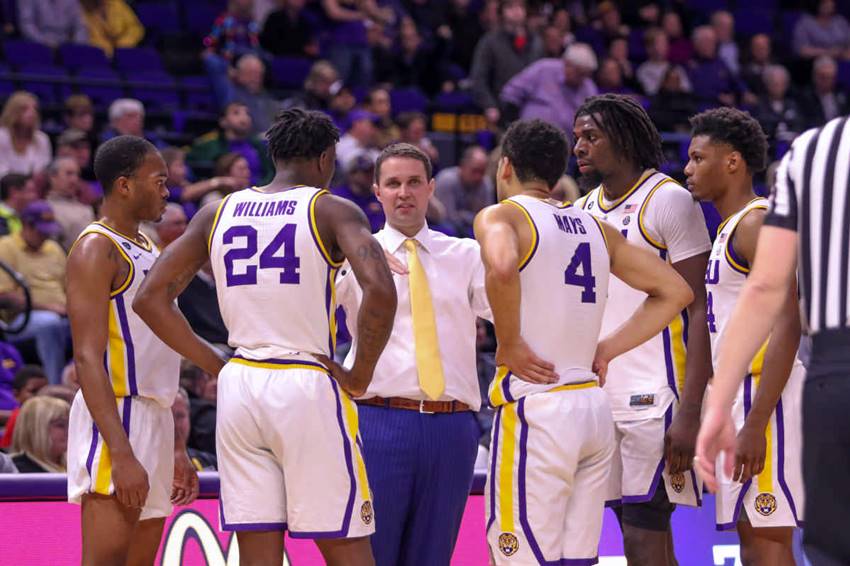
How many of these players (and the coach) will be in the picture
for LSU basketball next season? (photo by (Photo: Jonathan Mailhes)
      We have seen Will Wade's case discussed, cussed (and praised) ad nauseum the past couple of months. Who knows where the program stands?
       We know, after Wade's postseason suspension and subsequent reinstatement, that four or five frontline players (heck, we lost count) from LSU's regular-season SEC championship team -- Wade's crowning achievement in just two seasons with the program -- want to go pro. Maybe they'll make the NBA, maybe not, and maybe some will come back to LSU after all.
       We know, too, from social-media reaction, that many of the LSU faithful don't believe Wade did much wrong, or at least it is not proven that he did.
       Their view is that he did nothing more than what the "sainted" coaches at Duke, Kentucky, North Carolina, Kansas, UNLV and dozens of other basketball powers over six-seven decades have done (and hidden well enough that they are in the NCAA's "untouchable" range). 
      Nevertheless, there's a lot of smoke there ... or maybe just hot air.
     Which brings us to Dawkins, who was among the 10 men charged with wrongdoing in this "scandal." Four of those were assistant basketball coaches -- you probably know one, Chuck Person (Auburn); they all took plea deals.
      The recent trial ended with guilty verdicts for two men. Dawkins is one.
     Here is how Sports Illustrated writer Andy Staples described him in an article on college basketball's "black market" last week: 
     One low-level hustler: Christian Dawkins, truly the man at the center of the investigation, was a runner for agent Andy Miller. Dawkins was convicted Wednesday [May 8] of bribery for paying assistant coaches to influence players with regard to their agent selection. Dawkins also was convicted of fraud following an October trial.
    As anyone following LSU's travails knows, Dawkins is the voice on the other end of the phone tied to the Tigers.
     Again, from Staples' story (and many earlier similar reports): "Somewhere, there's audio of LSU coach Will Wade talking about a "strong-ass offer" to a middleman representing Javonte Smart, who was the Tigers' sixth man this past season.
     (That, of course, led to Wade's suspension when he refused to meet with LSU officials about the rumor.)
     Another audio played in court: Ex-Arizona assistant coach Emanuel "Book" Richardson (another guilty-plea case) claiming that Wade had a $300,000 deal for forward Naz Reid. 
     (Not confirmed, folks, but a helluva claim. Naz pointedly denies it happened.)
     Let me interject a thought: Seems that Javonte Smart, from Scotlandville (right outside Baton Rouge), a three-time Louisiana "Player of the Year," would have been a natural recruit for LSU, one who would not/should not have required a payment. But the word was that Smart, already the father of a baby, and his family needed the money.
     Reid was the 6-11 center from Asbury Park, N.J., a force inside with long-range shooting ability, too; raw and often unpolished, but a big talent.
     Makes more sense that LSU would need extra incentive to sign the big kid from up north rather than the 6-4 guard from closeby.
      As a friend pointed out, maybe some other school would have been willing to spend, say, $300,000 for Naz Reid -- or Javonte Smart. It happens, or so we keep hearing.
      Not saying that's what happened at LSU. I don't know, and neither do you. 
      LSU faithful are writing that Dawkins and Richardson -- guilty already -- are talking to save their butts. Maybe. But that smoke surrounding Will Wade and LSU smells a bit.
     Another opinion (shared by many), and thinking of Naz Reid (and many other potential pros): One-and-done is a bad deal for college basketball.
    True, we get to see some great talent -- for one season. But it just ramps up the recruiting bidding wars for these kids who obviously appear ready for the NBA out of high school. 
     Hard to judge the kids' maturity and how they would fit into the NBA at age 18. Plus, how they would handle the big money -- even bigger than the colleges pay -- at that young age. 
      Good news: The NBA and its players' union, which forced the one-and-done plan (it wasn't the NCAA's idea), are showing signs of doing away with it soon. That will work.
---
     Interesting to see the reactions of some of my friends to the article by SI's Staples we posted last week that basically said little or nothing will come of this college basketball "scandal." (See my friends' comments below.)
     Here is how Staples summed it up: "Today, we know what the millions of our tax dollars they [FBI and U.S. Attorney's Office] spent on the investigation netted: A fart in a stiff wind."
     Going to post some of my friends' reactions below, and will tell you that it sparked an exchange between two ex-Louisiana head basketball coaches (and friends), LSU's Dale Brown and Centenary's Tommy Canterbury.
     And if you know much about Dale Brown, you know that he has been critical of the NCAA for four-plus decades -- and has offered many suggested for improving the NCAA oversight and, with it, college athletics.
    (If you want the full copy of Dale's "messages" for the NCAA -- ones he has mailed out and made public repeatedly
over the years -- let me know, and I will send them to you.)
---
      So maybe it passes, and Wade continues at LSU, with or without Naz Reid, Tremont Waters, Skylar Mays, Javonte Smart, Emmitt Williams. Or the new LSU athletic director Scott Woodward and other LSU officials decide they need a new start, a new coach.
     If you think nothing happened, and basketball players with Louisiana ties, haven't been "bought" or "rewarded," here are some names for you to consider: Jackie Moreland, Cotton Nash, Barrie Haynie, Elvin Hayes, Marvin Winkler, Elvin Ivory, Charlie Bishop, Mike Green, Andy Knowles, Jim Jenkins, Dwight Lamar, Roy Ebron, Louis Dunbar, Robert Parish, Poo Welch, Edmond Lawrence, Joe Dumars, Mike Sanders, Benny Anders, and who knows how many others.
    That's just basketball, people. Football? Just think about it.    
     And, look, I do not want to be "holier than thou," but it is not how I want college athletics to be. Yet it is part of the hypocrisy. What is true -- money aside -- is we enjoy watching these players and these teams.  
--- 
Staples' SI story: https://www.si.com/college-basketball/2019/05/09/ncaa-trial-fbi-bribery-corruption-mark-emmert?utm_campaign=si-extra&utm_source=si.com&utm_medium=email&utm_term=SI%20Extra%20-%20USE%20THIS%20-%20List


Monday, March 18, 2019

Overdosing on basketball this week?

The LSU Tigers take it all in Sunday when they were announced as a No. 3 seed in the South Region of the NCAA Tournament. 
Photo from LSU web site; please note the man on the far right -- sports information guru Kent Lowe (from Shreveport).
     The NCAA Tournament -- men's basketball, that is --is always a helluva lot more interesting if you have a team in it.
     This season, I'm interested. It hasn't been that way all that often the past 26 years.
      At the risk of taking verbal or written shots, considering the past couple of weeks, thank goodness for LSU's team.
      OK, it is what it is, and everyone has their opinion -- and I have heard and read plenty -- but I have enjoyed watching these Tigers. They have not (laugh here) cheated their fans.
      Whether the NCAA, or some of the nation's sports scribes, don't think LSU deserves to be in this NCAA Tournament because of the recruiting/payment allegations is a moot point. The Tigers, as we watched on TV Sunday evening, are in the bracket.
      Which is why, for the first time in four years, I watched the NCAA Tournament Selection Show on CBS. 
      Lot more fun waiting to see where a team you like is seeded, who the first-round opponent is going to be, and the time and place of the game (and hopefully, games).
      Would love to see Louisiana Tech back in the tournament some day; it has been 28 years. Used to be that the Lady Techsters were automatic for the women's tournament, but those days have passed, too.
     I am not the basketball junkie many people are, so without LSU or Tech involved, much of the recent NCAAs have been played without me. Love the game, always have, but it is not 24-7-365 with me. I can take it, or leave it.
     (And, dang it, no "Big Dance" references for me. Sick of it.)
     Do have a rooting interest in the Tennessee Vols because it's the SEC, I like their coach and their players, and mostly because son-in-law cares a lot. Even the non-sports-gene daughter cares some because of son-in-law's job (sports talk radio host in Knoxville). They are Vols.
    Now, about LSU ... as I gently reminded Vols' fans, the regular-season SEC champions (pending investigation).
    Appreciate how these Tigers played -- and won -- so many close games. It is a talented, and fearless, and mostly young team. The point guard (Tremont Waters) is fun to watch. So is the senior second guard (Skyler Mays), a real team leader. The big freshman center (Naz Reid) has a world of potential if -- when -- he harnesses his wild streaks. 
     The suspended head coach? Helluva job, I suppose. But you have to wonder about his ethics, don't you?
     Something else to wonder -- how much did the reported FBI tape of coach talking to agent/runner play into the NCAA Tournament committee's bracket consideration.
     Maybe this is an unfair thought, but going into the Selection Show, my suspicion was that LSU would not get a break. 
     Yale is a very interesting first-round opponent, and not likely a pushover; a second-round game is going to be tougher; and if the Tigers do get to the Sweet Sixteen (no given), likely to face Michigan State and then Duke, that's a difficult route. Of course, no NCAA Tournament route is "easy."
     Quick history lesson: When Dale Brown was the LSU coach, once he got the program rolling, the Tigers were in the NCAAs 13 times in a 15-year stretch -- including 10 in a row. So it became routine.
      Since 1993, this is only the seventh time in 26 seasons LSU is "in." So, enjoy ... no matter what the circumstances.
      An omen? In  2006, when LSU beat Duke, then Texas, in the regional in Atlanta to reach the Final Four, the games in the first two rounds were won in Jacksonville, Fla. That's where these Tigers will tee it up in Thursday's first-of-the-day games (11:40 a.m. tipoff, Central time, TruTV).
---
     More thoughts, including some items gleamed from a recent Basketball Times issue ...
     • Tulane is looking for a new men's head coach and, yes, if LSU possibly will be, too, soon, is there a better candidate than the just-fired-at-Texas A&M Billy Kennedy? Grew up in New Orleans, son-in-law of former Jesuit Blue Jays state championship coach Kevin Trower, former Tulane assistant and former head coach at Centenary and Southeastern Louisiana. And, from what everyone says and writes, darned nice guy and pretty successful coach everywhere, including  A&M (except for this season).
      • Bob Ryan is one of the most popular and knowledgeable basketball writers ever, an NBA expert.  Writing in his "Journal" for Basketball Times, his topic was seeing games in 200 college gyms/arenas. Here is one paragraph that will interest some of my Fort Worth friends:
     "Being dazed and amazed while watching a game on a stage at UT-Arlington's original Texas Hall. Yes, I said, 'stage.' " 
      • A Basketball Times column on women's hoops by Rhiannon Potkey (Knoxville News Sentinel, one of my stops) is about Grambling State senior guard Shakyla Hill and her historic two career quadruple-doubles (double figures in points, rebounds, assists and steals). 
     What I did not know (and maybe you did not either): Hill, who played high school ball in Little Rock, is the younger sister of Raheem Appleby, who as the article noted, passed Karl Malone for seventh place on Louisiana Tech's all-time men's scoring list. Small world.
     • Jim Sukup, editor of Collegiate Basketball News and publisher of The RPI Report for 27 years, etc., writing about "other" postseason tournaments, noted that the CIT (Collegeinsider.com Tournament), which began in 2009, calls some of its first-round games "Classics" to honor "coaching greats from the past" for their contributions to the sport.
     One of those honored: The Riley Wallace Classic, in 2017, named for the former Centenary player/assistant coach/head coach and 20-year, 334-wins University of Hawaii head coach. Riley, the redhead-turned-gray, now lives in Las Vegas with time in Hawaii.
     • One for Notre Dame and Northwestern (La.) State fans: A long segment from the book Mike Brey: Keeping It Loose, by the longtime Irish head coach who played three seasons for the NSU Demons in the late 1970s. The book was written with John Heisler, the former senior associate athletic director at Notre Dame (started as assistant sports information director).
     Brey has several references to then-NSU coach Tynes Hildebrand, referring to him as "... just a typical southern guy. He was very steady and a really good man." 
     They still have a strong relationship. But Brey also refers, a couple of times, to Tynes being fired from the job in 1980.
      Not correct. 
      Unless I am mistaken and as I remember it (looked it up), Coach Hildebrand -- subject of a five-part blog series here two years ago -- resigned that job after 15 seasons, the last couple difficult ones. He was not forced out. So I think Brey misfired on those shots. 
        • Joe Connor wrote about his "365 games in 365 days," his continuing travels around the country attending basketball games. Big deal. Hey, Joe Rhodes -- our friend from Shreveport and for years American traveler and owner/driver of the Traipsmobile -- did that twice more than three and four decades ago.
       

Friday, March 16, 2018

College hoops' "what could have been"

      Let's rewrite history and suppose Willis Reed and Elvin Hayes -- future NBA stars, Hall of Famers, both from north-central/east Louisiana -- had played basketball for LSU in the 1960s.
      Or pick a future star -- say, Robert Parish, Louis Dunbar, Larry Wright, Calvin Natt, Joe Dumars, Rick Robey, Orlando Woolridge -- and put them at LSU in the 1970s.
      Or Karl Malone delivering as the Tigers' "Mailman" in the 1980s. Or P.J. Brown, like Malone another Louisiana Tech big man who lasted for 15-plus years in the NBA, going there.
      Think they might all have helped LSU's program?
      And today -- this morning -- envision Robert Williams playing for LSU in the NCAA Tournament instead of for Texas A&M. 
      Think the Tigers -- just like all the other men's basketball teams in Louisiana -- would have been shut out of the NCAA Tournament (for the second year a row)?
      We can no more rewrite history than LSU could get those guys in school. 
      But the point is, "what could have been," as suggested a couple of weeks by Dale Brown -- mastermind of the LSU men's program for 25 years.
      Dale, as most anyone who has been around him for, say, 10 seconds, can spin some tales (pick a subject), and among those are his adventures in recruiting over three decades in college basketball.
      He was reacting to our recent blog piece about Parish's statistics at Centenary finally being officially recognized by the NCAA, and in that piece, we mentioned that while Brown recruited Robert for LSU and happily would have welcomed his 7-foot presence, Robert did not qualify academically.
      By Parish's senior year in high school, LSU had just  integrated its basketball program. Among the talent Dale inherited when he became the Tigers' head coach in the spring of 1972 was Collis Temple Jr., a 6-foot-8 forward recruited out of Kentwood, Louisiana, in 1970 by Press Maravich and his staff. He was the color barrier breaker in LSU's program.
Houston coach Guy Lewis with his two big stars
from Louisiana in 1966-68 -- Elvin Hayes and
Don Chaney. Imagine if they had played at LSU
instead of Houston.
      But the barrier breaker could have been Elvin Hayes ... if, as Dale tells it, the "Big E" could have made that choice.
      He could not, of course. In early 1964, Hayes' senior year in high school, LSU was not yet recruiting African-American players.
      He was a still-developing 6-9 forward who averaged 35  points a game and led his Eula D. Britton High School team in Rayville, Louisiana -- 22 miles east of Monroe -- to a state championship in the all-black athletic association (LIALO).
      Was he the best player in the state? Little question. In his team's state-title game, he had 45 points and 20 rebounds.
      But the bulk of the publicity, the white guy considered the state's best prospect, was 6-4 forward Bobby Lane of Isadore Newman High (New Orleans), the do-it-all leader of two consecutive LHSAA (the all-white organization) Class A state championship teams.
      (Oh, LSU didn't get Lane, either. He chose to attend and play at Davidson, N.C., College.)
--- 
      Here is the Dale Brown version of Hayes' "what could have been" story.
      In Hayes' fabulous college career at the University of Houston (late 1965 to March 1968), he was the nation's best college player not named Lou Alcindor. A 16-year NBA career followed and included 27,313 points, 16,279 rebounds, one NBA championship, two other Finals appearances and 12 All-Star Games in a row.
      Several years later, he made it to LSU.
      By now, he operated a company that cleaned campus dormitories and he had come to LSU seeking a service contract. He visited with Coach Brown, and that night attended the LSU basketball banquet.
      "He told me it was the first time he'd ever been on the LSU campus," Dale recalled. "And then he got very emotional about LSU. He said that when he was in high school, he really wanted to go to school there and wrote a letter to the LSU coaches. Never heard back from them."
---
       LSU was a football school always. It did have a couple of basketball highlights -- a pre-NCAA Tournament national championship in 1935 (Sparky Wade's team) and, led by  Bob Pettit (from Baton Rouge, and a future NBA all-timer), SEC championships in 1953 and '54, and an NCAA Final Four in '53. 
       Jay McCreary, an Indiana Hoosier through and through, was near the end of a less-than-mediocre eight years as LSU head coach when Willis Reed and Elvin Hayes came along.
       McCreary ignored Hayes. University of Houston coach Guy Lewis did not.
       It was Lewis and assistant Harvey Pate who recruited Hayes and another Louisiana black-school star, guard Don Chaney -- from Baton Rouge no less (McKinley High) -- and signed them on the same day to integrate the Houston program. And they added a third player from the state, 6-7 forward Theodis Lee, from Carroll High in Monroe.
      (Lewis and Pate would bring their talent search back to Louisiana, most notably for guard Poo Welch from LaGrange-Lake Charles in 1969 (after two years in junior college), Dunbar -- best player other than Parish many of us saw in high school -- out of Webster High-Minden in 1971, and "outlaw" Benny Anders from Bernice in 1981.)
      Houston, riding Hayes' turnaround jumper and rebounding prowess, became a national powerhouse.
      In the famous "Game of the Century" -- Jan. 20, 1968, before 52,693 paid at the Astrodome, the first nationally televised regular-season college basketball game -- Elvin and No. 2-ranked, 13-0 Houston stopped No. 1-ranked, 14-0 UCLA, winner of 47 consecutive games over 2 1/2 seasons. Hayes outscored the awesome Alcindor 39-15, outrebounded him 15-12, and made the winning two free throws in Houston's 71-69 victory.
      (That season, Houston twice played Centenary, winning 118-81 in Houston and -- yikes -- 107-56 in Shreveport. Hayes scored 40 the first game, then 50 at Hirsch Youth Center.)
      Houston went to two NCAA Final Four in a row (1967 and '68), and lost to UCLA in the semifinals both years. In '68, the revenge score was a rout, 101-69.
      LSU didn't go anywhere from 1954 until Brown's program finally took hold in 1979 and became a postseason regular.
---
      Let's backtrack to early 1964 as Hayes was finishing high school. Willis Reed was finishing that spring at Grambling College, about 20 1/2 miles directly south from his hometown of Bernice (which is 73 miles from Rayville).
      Don't know if Willis ever thought about LSU. But what a sensational four-year career he had at Grambling.
Willis Reed: a young star at Grambling College
(no thoughts of LSU in the early 1960s).
Photo from Small College Basketball Hall
of Fame.
      It began in the 1960-61 season when he was the  freshman star center on GC's NAIA national championship team and ended with him as the New York Knicks' second-round NBA draft pick, eighth overall, in 1964.
      And, of course, he helped the Knicks to their first NBA championship in 1970, made the Basketball Hall of Fame, became a team executive ... and a legend.
      LSU obviously never gave him a look. Not in 1960, at West Side High School in the Bernice suburb of Lillie (that is a joke; it's all very rural territory).
---
      "You can't believe the number of black players who were not recruited before schools in Louisiana were integrated," Dale Brown said in suggesting this post. 
      Oh, yes, we can believe. Those of us who can name many of the great players Louisiana high school basketball has produced know.
      And so, just a sampling from the 1950s through about 1970 when LSU -- and other state schools -- finally followed the basketball integration path first taken by Southwestern Louisiana and Louisiana Tech:
      -- Bob "Lil' Abner" Hopkins, a lithe 6-8 center-forward from Jackson High in Jonesboro who scored 3,759 points (29.8 per game) for Grambling in 1952-56, then played four years in the NBA and was the Seattle Supersonics' head coach in 1977.
      -- Bob "Butterbean" Love (Morehouse High in Bastrop, then Southern University 1961-65, a 6-8 small forward who for eight years was a scoring machine for the NBA's Chicago Bulls).
      -- Lucious Jackson (also Morehouse High, then Pan American in Edinburgh, Texas, which he led to the 1962 NAIA national championship) and then as a bullish 6-9 power  forward helped Wilt Chamberlain and the 1967 Philadelphia 76ers to the only NBA title not won by the Boston Celtics in an 11-year span.
      -- Chaney, a guard, a defensive phenom who started for those Hayes-led Houston teams, then helped the Celtics win two NBA titles and was an NBA head coach for 12 of his 22 years in coaching.  
      -- Theodis Lee also started for Houston in the monumental 1967-68 season, was a team co-captain the next year and went on to play for a decade with the Harlem Globetrotters, then died in 1979 of cancer, only a few weeks after it was found.
      -- Wilbert Frazier (Webster High in Minden, Grambling 1961-65), a 6-7 forward who had two pro seasons.  
      -- The players out of McCall High (Tallulah): guard Jimmy Jones (Grambling 1963-67, then a six-time all-star in the American Basketball Association) and three stars on Stephen F. Austin's NAIA power in the early 1970s -- guard James Silas, a top-flight ABA and NBA player for Dallas and San Antonio), forward Surrey Oliver and center George Johnson.
---
      We could give you a long list of terrific players from Louisiana that LSU did recruit successfully, and a long list of good/great ones that LSU could not sign, who chose another Louisiana school perhaps closer to their homes or decided they wanted to play for an out-of-state school.
      But if you have gotten this far, you have earned an ending. So we will return to Robert Williams and Texas A&M.
      He is the Aggies' biggest star, a strong 6-10 forward who likely will be a high NBA Draft pick. He is that good, has that much potential.
      Coming from Oil City, Louisiana (just north of Shreveport) and out of North Caddo High School, he might have been a natural for LSU.
      No. Although LSU -- when Johnny Jones was head coach -- was very interested and recruited him, Williams apparently always preferred A&M.
      So this NCAA Tournament, in fact today, might be the end of his college career. The Aggies face Providence in the  first of the day's 16 first-round games. LSU faithful can watch Williams and think, "What could have been."  
      Elvin Hayes and Willis Reed probably will be watching, too.