Tuesday, April 27, 2021

In 1984, Mulkey's writing was gold


      For five months in 1984, Kim Mulkey was on our team -- the Shreveport Journal sports department. 
     Just as in every phase of her life, she was very good at what she did. She could have been a sportswriter.
     (Don't laugh. It is a noble profession. And don't you forget it. Somebody has to do it. 
      Her spectacular four-year basketball career at Louisiana Tech finished -- with a fourth consecutive women's Final Four appearance -- Kim was entering the next phase: Trying to make the United States women's basketball team for the 1984 Summer Olympic Games in Los Angeles.
      She made it ... and helped her team win the gold medal. 
      And during the journey -- the tryouts, the team selections, the practices, the exhibition games, the trip to LA, the Opening Ceremony, the time in the Olympic Village, and the Olympic competition itself, she told the story ... in the Shreveport Journal
     In 14 segments, beginning April 19, "Kim Mulkey's Olympic Diary" appeared on the Journal sports pages. 
     Here is the promo for the start of the series:
     Kim had played for U.S. teams in international games for three years and had been one of college basketball's best women's players during that time. So she was a natural for the tryouts. 
     She was a natural for the Journal, too.
     The idea was generated -- as were many stories in the paper in those late 1970s/1980s years -- by the paper's editor, Stanley Tiner. 
     We took it from there ... and so did Kim.
     Believe me, it took some effort on her part. She had to write out, or type, her stories, and then make a call to the Journal sports department and, as I recall, dictate her words to us. On our end, it meant typing it into our computers and preparing it for the next day's editions.
     We had the easy part. Kim could write. She needed very little help, maybe a little editing here and there. Of course, her stories were excellent ... good reads, in newspaper terms.
      She was, after all, a summa cum laude college student; the sportswriters at the Journal were not.
     So it was time-consuming for Kim, between her basketball tryouts and travels.
      As I recall, her pay was a few million dollars short of what she's made as the women's head basketball coach at Baylor (and now LSU), or even a few thousand dollars short as an assistant coach for 15 years at Louisiana Tech.
     I think she did it for the good of the country ... and the Journal. It was a free ride.
     It was a pleasure to team up with her, and I remember that Journal readers enjoyed her stories. By then, she had been the "darling" of Louisiana Tech women's basketball fans for four years, the little point guard with the pigtails. The  big winner, the champion.
     Truth is, she had fans, too, in the Journal sports department (see Jerry Byrd's column) and also The Times, where our friend Jim McLain covered the Lady Techsters' story for many years.

     So her stories were gold for us, and the U.S. team -- coached by Pat Head Summitt, by then not quite the legend she would become at the University of Tennessee -- earned its gold by beating South Korea in the title game (remember, Russian athletes boycotted the LA Games in '84).
      Kim wasn't the only Louisiana Tech player to mine that gold. So did center/forward Janice Lawrence.
       (Lawrence was the Final Four's "Most Outstanding Player" when Tech and Mulkey won a second consecutive national championship in 1982. The Lady Techsters lost to Southern California, led by Cheryl Miller, in the 1983 championship game, 69-67, and 1984 semifinals, 62-57.)
     Here is how Kim ended her final "Olympic Diary" story, which ran in the Journal on August 8, the afternoon after the previous night's gold-medal game and ceremony:
       You probably know the rest. A lot of her dreams have come true ... and now, at LSU, there are more dreams and more goals. 
       The Journal is no more, having folded in 1991. Kim Mulkey's story rolls on ... and it's been a golden adventure.


Sunday, April 25, 2021

A victory for Louisiana ... and LSU

         Kim Mulkey: LSU women's basketball coach.

       LSU athletics needed some positive, out-of-sight news, don't you think?

       Think that will do for positive?

       It is about as big a splash LSU could make right now, and you can expect LSU women's basketball to be playing for national championships soon enough ... at least that's what Mulkey's career indicates.

      To review her record would take too much space (see LSU's news release below). Just call it "outstanding." She's about as big a winner as there is in our sports world. Put her right there with Nick Saban, Pat Summitt, Gene Auriemma ... just to name a few in college athletics.

     Much is being made, of course, that Kim is coming "home." For those of us with Louisiana Tech ties, that's not exactly how we see it. LSU wasn't her college home; Louisiana Tech is.

       So there might be Tech faithful out there who are as thrilled about this move as LSU people are. There are people like me, though, with split loyalties. So it's OK.

       Famously, or infamously, in 2000, Kim could have been the Louisiana Tech women's head basketball coach, the natural successor to Leon Barmore -- the coach she played for, and then was his 15-year assistant. 

     Tech, at that point, was the longtime women's powerhouse in Louisiana (and one of the nation's powers). And Kim had helped make it so.

      But she couldn't come to contract terms with Tech. The recall here is that she wanted a multi-year deal; Tech was only doing one-year deals. It didn't please Kim, and she bolted instead to Baylor ... and another La. Tech connection.

      At Baylor, she succeeded Sonja Hogg, who had been the original Tech women's coach and built the program, which hit greater heights once she hired Barmore as top assistant (and later co-head coach).

     Sonja was the Baylor head coach for six years, but -- without Barmore at her side -- wasn't nearly as successful in terms of wins-losses. But she was instrumental and supportive in helping bring Mulkey to Baylor.

      Mulkey at times over the years publicly has voiced her displeasure/bitterness about the Tech  contract flap. That did not sit well with some Tech folks ... but only temporarily because -- no matter what -- Kim is a beloved figure at Louisiana Tech. And because people realize that over many years, Kim can be quite outspoken about what's on her mind. 

      She's taken criticism for some of that, and she's had to explain herself. But here is what I assure you: She also is beloved at Baylor, and the prediction is she soon will be beloved at LSU.

      Speaking of predictions -- and I am not making this up -- about two months ago when LSU women's team was going through another middling season, I told a friend (can't remember who it was) that LSU would be making a women's basketball coaching change at the end of the season and that Kim Mulkey would be the next LSU coach.

      Honestly, I said that. Of course, it was pure speculation, wishful thinking. But Kim's ties to Louisiana and LSU (where her son, Kramer Robertson, played baseball -- shortstop -- en route to a pro contract -- St. Louis Cardinals' organization) were good reasons.

       One of my friends, a former basketball coach -- state-championship high school coach and, for a brief time, a college assistant -- did not believe Mulkey would take the LSU job. He told me that Saturday, and also stated what he has said often: That LSU does not really care about basketball.

      I have never agreed with that. Sorry, coach. 

      The men's program isn't always a big winner, but there is a history of four Final Four appearances and some of the greatest college players in the game (Bob Pettit, Pistol Pete Maravich, Shaquille O'Neal for starters). In many of Dale Brown's 25 years as head coach, the Tigers were NCAA Tournament entries.

    And the women's program made five Final Fours in a row in 2004-08 ... under three different head coaches.

     LSU's men's program right now is under much scrutiny and controversy since coach Will Wade's "strong-ass offer" comment became public and the reports of his having provided payment for 11 players to come play at LSU.

      (Add the Les Miles off-the-field crap and the reports of LSU football players' sexual assaults/transgressions, and athletic department cover-ups, and it's embarrassing. Inexcusable.)

      Hello, NCAA and FBI investigations ... ongoing. Cannot understand how LSU has stuck by him.

      So my suggestion to some friends is that Mulkey could coach the women's team and the men's team. Thank you. Kim could do it.

      As for LSU being serious about basketball, I think we have our answer, at least for the women's team. Money talks.

     When the powers-that-be decide that the men's program should abide by NCAA rules -- or what the rules are supposed to be -- and makes a move on Wade, that will mean it, too, is headed in the right direction again. 

      Mulkey -- and Wade, while he's there, if he's there -- have much work to do to bring in players to refresh their programs. The lenient transfer rules these days should make that easier than in past years.

      Would not be a big surprise at all if Mulkey builds this program in a hurry. No doubt about it, she knows how to win.

---

https://lsusports.net/news/2021/4/25/athletics-hall-of-famer-kim-mulkey-named-lsu-womens-basketball-head-coach.aspx?fbclid=IwAR1Xllqor2NT36z1aV3geUhJYCghBlBTTN7vwUYNkmVG6bhhNKhyVRwkXdU


Tuesday, February 16, 2021

Turn off the snow, turn on the power

The view from our apartment ... cold!
    We have been powerless for much of Monday and today. We were in the dark for hours, and it's been a test. But we are surviving.

     As I write this, the power has been back on for 20 minutes after the second 12-hour blackout. I have use of my coputer, so I am writing in a hurry because who knows when the power goes out again.

     Spent most of Monday without electrical devices, and again the first part of today.

     So no microwave to heat water for coffee or tea or soup. No television -- which we watched constantly last week and which we depend on for most of our news. For those in our facility who still like to read actual newspapers, no delivery the past two days.

     (It is still a place for the real Fort Worth Star-Telegram, Dallas Morning News, New York Times and Wall Street Journal -- the kind you hold in your hands, not the online versions. I am not one of those readers these days.)

     I don't like snow, and I don't like cold weather. Never have, never will. And it is just too darned cold and too snowy here -- as bad as it's been in our part of the country for, I'm reading, three decades.

     Looked at my phone -- once we were back online Monday evening -- and it said 7 degrees with a "real feel" of minus 6. Last I checked we were not in Green Bay. Today we are up to 18 degrees, a heat wave.

     But, hey, I am not complaining. Please don't take it that way. We are grateful for the dedicated management people and staff in our facility, who made sure that everyone here -- some 450 residents -- had something to eat and drink, twice Monday and again for lunch today.

     They even managed hot soup today.

     Some of those managers and staff spent Sunday night here, and many stayed again last night. And the dining services department also had to deal with a broken water pipe and a partially collapsed ceiling portion in the kitchen.

      Hurray for our management, resident services and dining services departments.

---

     We have residents who voice their gripes, and maybe some are justified. But our feeling is that those in charge of this place, and those who work here, care about us and our well-being.

       It is frustrating not having much to do. I am enjoying typing this message, feels good, feels right.
       We are missing our exercise classes (yes, even at 8 a.m. most weekdays); they were called off. Our Country Store, a convenience for residents that is open from 10 a.m. to 2 p.m. Monday through Friday, never opened. No power in the exercise room or in the store, obviously.
      Plus, it was cold in our apartment, and it got chillier as the day wore on, although our blankets and afghans were made to good use.
      The good thing was that by raising the blinds in our apartment, the sunshine coming through did help warm it up a bit inside and gave us light. 
       The result was we could read, and I have been able to cover about 175 more pages of this book, which has 589 pages to read in all. It is mostly about politics (I like reading about politics), but thankfully not today's politics.
     (Talk about powerless ... following the impeachment trial last week, watching two completely opposite views, that was definitely beyond our control. But it was great theater.)
      Our power went out -- my guess -- about 2:30 a.m. Monday, came back on at 7:11 a.m. (I know, because I reset a couple of our clocks), just in time for me to go downstairs and bring back two cups of coffee (black), the almost-every-day starter for Ms. Bea.
      That was from the only large container of coffee the dining staff managed to do after the power came on ... until the power went out again.
    That was shortly after 8 a.m. At 8:41 p.m. -- yes, a darned 12-plus hours -- the power came back on. This was after we made several trips down our dark hallway with a flashlight showing us the way. (Early in the day, we made a couple of trips down the stairs, where it was dark enough that we had to be very careful not to stumble.)
      Fortunately, one of the two elevators in our building was operating. Same was true -- one working elevator -- in the two other buildings in our facility. Generators made that possible.
      Today the power went out in the middle of the night, and came back on at 1:41 p.m. One improvement the dining staff was able to make: It had hot coffee in abundant supply downstairs. Beatrice was fine with that, and I was a happy volunteer to bring back two cups.
      Our facility was like the rest of most of our part of Fort Worth, with rolling blackouts imposed to save electricity for most of the past two days.
      Several times I thought about the people who regularly do without electrical power or running water, or so many of our modern conveniences ... or, sadly, without food. That's a significant part of the world, even a significant part of our very city and area. 
      Thought about how blessed, and maybe privileged, we are.
      I know people who grew up in that kind of environment; it hits very close to home. We didn't have a lot in the early 1950s in Amsterdam, but we rarely lacked for what we needed. A little girl growing up in rural North Louisiana didn't have a lot, either.
      "You don't think about it," she'll tell you. "You do with what you have, and you adjust to it. You find a way, and you live the best you can."
      What we did have in Amsterdam in the winter was plenty of snow and cold. For Mom, it likely brought back (bad) memories of a "Death March" she was forced to make in the middle of one of western Europe's most brutal winters a long time ago.
     So when it snows here, in the Deep South's usually mild climate, I always think of my mother, and how she absolutely despised cold weather. When we moved from Amsterdam, she loved the change in weather. Until the rare occasions when it, yes, snowed.
       Mom would have been miserable the past few days. We're not exactly delighted.
        Looking at the weather forcast online, we have a few more days of sub-freezing temperatures, winter storm warnings, more snow possibly late today and likely Wednesday, a slight rise to above-freezing Thursday, a sunny day but still not above 36 degrees Friday, warming up and sunny Saturday and -- gloriously -- temperature highs ranging from 56 to 67 Sunday through next Tuesday. 
     The weekend can't get here fast enough, can it? The abnormally cold weather can't leave fast enough. 
     Got lots that needs to be done: exercise classes, laundry, haircut, grocery shopping.  More Louisiana track and field books to pick up and mail, more to print and have bound.  
     Need electrical power for some of that, need clear and safe roads. 
     The weather is out of our control. What is in our control, the power we do have is mental. It's challenging, but we can deal with it as long as we count our blessings.

Sunday, February 7, 2021

Hannie Urbanus: Holland's baseball superstar

   
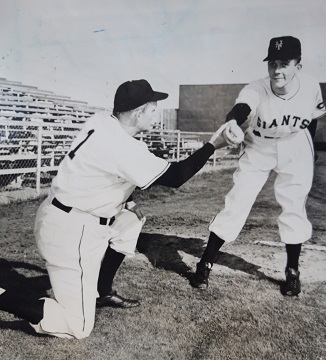
Spring training, New York Giants, 1952:
Dutch superstar pitcher Hannie Urbanus
and Giants manager Leo Durocher.
     Hannie Urbanus died Friday in The Netherlands at age 93. This is stunning to me because I thought he long ago had left us.
     He was my first baseball hero. 
     In fact, he was the only baseball player I knew of until we came to the United States in early 1956.
     Of course, that name will be foreign to you ... unless you are -- or were -- Dutch, and only then if you were a sports fan, or more specifically a honkbal fan. That's the Dutch word for baseball.
     Hannie Urbanus was the superstar of the sport in our home country, a right-handed pitcher for the OVVO team in Amsterdam. They were the Dutch  Yankees, the perennial 1950s champions.
      He was good enough to warrant a month-long spring-training stay with the 1952 New York Giants, the reigning National League champions. It was more of an exhibition appearance rather than a tryout. When he returned to Holland, he resumed leading his team to championships and as the No. 1 pitcher for the national team.
      Baseball was far from a major sport in The Netherlands in the late 1940s and early 1950s when we lived there. Soccer (voetbal) was the  sport most people cared about, although other sports that were popular included cycling, swimming, speed skating, basketball, track and field, field hockey, and an odd mixed-gender sport called korfbal -- a derivative of basketball, without dribbling --  in which Holland was the world's best. 
      Here is how I learned about Hannie Urbanus and baseball:      
    In 1955 (the year before we left), the Blue Band margarine company in Holland sponsored a series of small publications -- 10 books in all -- titled 40 Sporten en Spelen in Woord en Beeld (40 Sports and Games in Words and Images). 

      Here was history, highlights, photos, rules of all these sports. It was great for a kid who was absorbed in it all and loved to read. Soccer was the main emphasis, of course, and there were only two relatively small sections on honkbal/baseball. 
      Still didn't understand the game much because we'd never seen it played, even though home base for Hannie Urbanus and his OVVO team was in Amsterdam.
       To collect the books, and the paste-in photos, I suppose, we had to buy lots and lots of Blue Band margarine. And we did.
       Those books, bound together in a neat folder, came with us to the U.S., and they're right here -- barely holding together; they're fragile  -- on a shelf to my left as I type this.
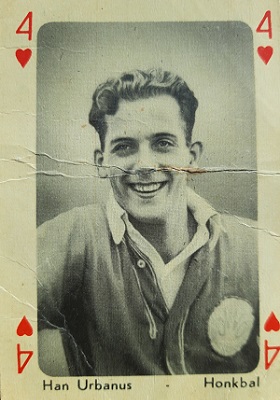
       And here was Hannie Urbanus' photo from that book (which also is online now). 
      Seeing notice of his death today sent me on a Google search for Hannie Urbanus. Here, from www.knbsb.nl, is the headline on the best story -- really his life's story -- that I found: 
        honkbal icoon, heuvel legende, en hall of famer han urbanus overleden 
        Translated: Baseball icon, hill legend and Hall of Famer Han Urbanus passed away 
---
     Here is the first portion of that story:
 
IN MEMORIAM
... Han Urbanus ...
(1927 - 2021) ...
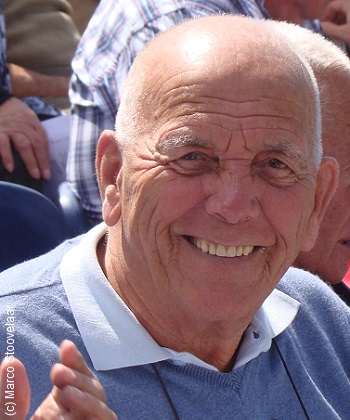
(© Photo: Marco Stoovelaar)

Han Urbanus , who played in the Dutch big league in four decades, pitched eleven no-hitters and played for the National Team for 17 years, passed away on Friday (February 5) at the age of 93. With the Netherlands National Baseball Team , Han Urbanus won seven consecutive European titles. Urbanus also participated in Major League spring training with New York Giants, was a member of the Dutch Hall of Fame, and was a living legend and Dutch baseball icon.
 
   Consider some of his feats: 
     -- Eleven no-hitter, from 1954 through 1961  (take that, Nolan Ryan). That included nine for OVVO and a couple in the rivalry national-team games with neighbor Belgium. Twice (1954, 1956) he pitched two no-hitters in one season.
     -- He was selected the Dutch major league's "Best Pitcher" five times (1953-55, 1957-58), and set a league record for strikeouts (213) in 1955, a record that stood until 1980. He was the league MVP three times (1954-55, 1961).
     -- He also played second base and shortstop at times for OVVO and the national team, and was a solid hitter with home-run power. In 1959, he was the league's Best Hitter with a .348 average.
      -- He played in 64 international games, a record at the time of his retirement. 
      He played in the highest division for four decades (1947-70) and his 24 seasons was a long-standing record.
... On the left a unique playing card with the portrait of Han Urbanus ...
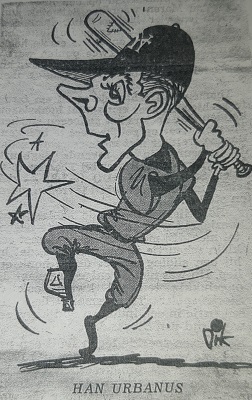
... On the right a caricature made by the famous draftsman ...
... Dik Bruijnesteijn, which was used in newspapers ...


---
     In 1952, at age 24, he received a unique invitation -- the first European player to take part in one of America's major-league spring training camps. It was the Giants' camp in Phoenix that included BobbyThomson (whose famous pennant-winning home run was the previous October), Wes Westrum, Alvin Dark, Sal Maglie, Monte Irvin, Hoyt Wilhem, Jim Hearn, Larry Jansen ... and a young Willie Mays.
    The manager was Leo "The Lip" Durocher. Frank Shellenback was the pitching coach.
      From the story:  
 A year earlier, Urbanus had been interviewed by Albert Balink, the publisher and editor of 'The Knickerbocker,'  a Dutch/American magazine for Dutch immigrants in America. It was Balink who arranged the trip to promote and stimulate baseball in Europe. 
      When Urbanus received the invitation in February, he worked as an assistant accountant at an Amsterdam office. His employer immediately gave him the opportunity to travel to America. ... In an interview in Het Parool at the time, Urbanus said: "I just wonder if I will be able to keep up with the level. And if they ask to remain as a professional, I refuse firmly.'' He was described as 'a calm and jovial man of 24 years old.' "
... Han Urbanus receives instructions from ...
... New York Giants Pitching Coach ...
... Frank Shellenback ...
    When Urbanus returned a month later on March 15, he brought back an instructional video and in the weeks and months that followed he traveled across the country to lecture on pitching, what he had learned and what it's like to participate in a professional training camp. All these lectures were organized by clubs or the union in canteens or rented halls that were packed with many baseball enthusiasts. In an article in the Algemeen Dagblad, Urbanus said: “To my great surprise, I have experienced that in America people throw completely differently. Besides, I learned that the pitchers are completely focused on pitching and not hitting themselves. '' Urbanus also wrote many articles about pitching and the correct way to throw a ball in Baseball News.
---
    And then there was the Urbanus tie-in to Texas. 
    His grandson Nick Urbanus, who was a star in the Dutch leagues playing for the Amsterdam Pirates, signed with the Texas Rangers' organization in 2011 and was a middle infielder in the rookie leagues and Class A for four seasons.  But he never hit much here, and returned to play in Holland.
      Throughout his life, Hannie was a constant -- and revered -- presence at any baseball gathering of note in The Netherlands, and also in Europe. He remained visible almost to the end, always the ambassador for the game.
       And always a Dutch hero, including one baseball fan in Fort Worth. Hannie preceded even Mickey Mantle.

Tuesday, January 12, 2021

So long ago, but still so sweet

       The dates January 7 and January 12 are special to our family, and will be for as long as we're here. 

     Those dates, in 1956, were monumental for us.

     January 7, a Saturday, we were on the boat sailing into New York City -- immigrants to the United States.

     January 12, a Thursday, the train pulled into Union Station in Shreveport, Louisiana, at 7 a.m. The sun was just coming up, and for us, the Van Thyn family of four, it really was a new day.

     New day, new country, new life. Forever grateful.

     It was, as I recall, a bright day. It was clear, the high was 58; the low the night before and that night was right at freezing (32). (Guarantee you it was colder in Amsterdam, and probably snowy.)

      At 8 years old, I don't recall being intimidated or terrified, but "unsettled" might best describe it. Same for Dad and Mom, and little Elsa (who was 4). Just trying to figure out what was going on and how to adapt, what to do next.
    For us, it was totally different. Shreveport was different. It wasn't Amsterdam, that's for sure.

      The only Dutch we could speak was at our house; no one else could understand us. We had to learn to speak and understand English; that was a challenge. It took a while, and for Mom and Dad,  months of lessons helped. Don't know how Elsa did it so easily -- she wasn't in school yet, like I was --  but she did ... and even now she remembers more Dutch than I do.

      Now we had a President (Dwight D. Eisenhower) instead of a Queen (Juliana). "Ike" would be re-elected later that year, again beating Democratic nominee Adlai Stevenson, just as in 1952. 

      We had a Congress, not a Parliament. We had a Louisiana governor (Robert Kennon, although five days later Earl K. Long -- the crazy man -- would be elected to his second full term, beating New Orleans mayor Chep Morrison.)

      Elvis, with his rock 'n roll and his hips and his sideburns, was the big show in entertainment and on The Ed Sullivan Show

      It was Elvis' biggest year to date -- he was everywhere -- and that March he would end his useful and popular association with the Louisiana Hayride in Shreveport. 

      But seeing him on television? Not us.

     TV? A phone? We never had those in The Netherlands. 

    But Elsa remembers that Mom and Dad brought about $200 with them -- converted from guilders -- and one of the first U.S. purchases was a television (black-and-white, of course; a color TV was a decade away for us). They thought the TV might help us learn English more quickly, and maybe that is how Elsa learned it.

     Don't think we had a phone until we moved to Sunset Acres on July 4, 1957. It was a party line at first -- that wasn't fun -- and the number was 64122 (soon to be ME1-4122, ME for Melrose, if I remember correctly). 

     Instead of streetcars, trams -- Dad had been a tram conductor in Amsterdam all my life (1947-55) -- we now traveled by bus and the memorable trolleys.

      No car for a few months; Dad had a tough time getting a driver's license in Holland (the tests were difficult; the people giving them very strict), and it would be a few months before he got a license -- and a (company) car -- in Shreveport.

     James C. Gardner, at age 31, was the youngest mayor in Shreveport history. His four-year term (1954-58) interrupted the two long stays (1946-70) of Clyde E. Fant in that job.

     Shreveport, like all the South, was so segregated, two separate worlds that rarely mixed. That was very different for the Van Thyns; I don't remember race being any kind of consideration in The Netherlands. Maybe I was too young to notice. 

    Instead of going to the outdoor market, to which we walked with Mom a few blocks from our tiny, cold, two-story house just about every day in Amsterdam, we now walked a few blocks in Shreveport to a grocery store (A&P). The shelves and bins were full of items we'd never seen, and many of our favorite Dutch items were only a memory.

     I knew nothing about American sports (yeah, just refrain from any smart remarks here). I only knew voetbal, Dutch soccer. And I loved it.

     Not until 1954 did soccer become a professional sport in Holland; until then, teams were semipro or amateur.

      Didn't take long to learn that U.S. sports were serious business. But it took me a few months to find my favorite team ... and the New York Yankees weren't even the defending World Series champions then.

     For the only time in history, the Brooklyn Dodgers were, having beaten the Yankees in the 1955 World Series -- the only time that happened in the seven Yankees-Brooklyn Dodgers World Series matchups. By that October (1956), the result was more acceptable; it was the first of 11 times I've experienced the Yankees winning the Series (plus eight times they lost it).

    Which brings another memory. Although Mom, Dad and I were not far along in reading or speaking English, I know we already were subscribing to the afternoon newspaper (Shreveport Journal) because I distinctly remember coming home from school and seeing the result of the (Monday) October 8 World Series game -- Game 5 -- that same day. The headline said Yankees pitcher Don Larsen had pitched the first perfect game in Series history. Perfect game? What was that? 

      (Games in those days began at noon, Eastern time; so 11 a.m. Shreveport time. This game took 2 hours, 6 minutes, so it ended at 1:06 p.m., plenty of time for the Journal to get the whole story into its city/home edition.)

     In American sports, the Cleveland Browns were the reigning NFL champions, the powerhouse franchise -- led by QB Otto Graham and coach Paul Brown -- that had played in seven consecutive NFL title games, every year since they had joined the league.

      Oklahoma was king of college football, the Bud Wilkinson-coached dynasty in the middle of its record 47-game winning streak.

      San Francisco -- the Dons -- was the NCAA basketball champions, about to win its  second consecutive title led by a shot-blocking big guy, Bill Russell, and defensive expert guard K.C. Jones.

       The Boston Celtics had never won an NBA championship (but they soon would win 11 with Russell at center). The reigning NBA champs were the Syracuse Nationals; the Philadelphia Warriors won in 1956.

       The NHL champions were the Detroit Red Wings. But in 1956, the dynastic Montreal Canadiens would rule again.

        The big names in golf were Sam Snead, Ben Hogan (of Fort Worth), and Byron Nelson (who was about to retire). But Hogan's star was beginning to fade; in 1955, he had been runner-up in the Masters (to Dr. Cary Middlecoff) and the U.S. Open (in a playoff loss to little-heralded Jack Fleck in one of golf's greatest upsets). 

      Arnold Palmer was the 1954 U.S. Amateur champion who had turned pro and, in 1955, played in his first Masters (finished 10th), made the U.S. Open cut for the first time and finished 21st. Jack Nicklaus was about to turn 16, a chubby kid in Ohio with a lot of golfing promise.

      And, back to baseball ... the Shreveport Sports were the reigning Texas League champions. Knowing their manager, Mel McGaha, and their ballpark were in my future. 

     I had never heard of any of them. But I knew about  Abe Lenstra, Faas Wilkes, Wim Van Est, Kees Broekman, Jan Klaasens and Coen Dillen.

      Sunset Acres was a fairly new neighborhood in southwest Shreveport; the elementary school was in its second year. My future best friend, Casey Baker, and my future classmates, were in the third grade, and -- beginning on the afternoon of January 12 -- so was I, at Line Avenue Elementary across town. Good memories there, too.

     (For my Woodlawn connections: In January 1956, Lee Hedges was an assistant coach at Fair Park High. Jack Rowan, eight days before we arrived, had resigned as head coach at Byrd High. Three months later, Hedges -- at age 26 -- was named the Byrd head coach, a job for which he had not applied. Meanwhile, A.L. Williams was preparing for his senior season as a Louisiana Tech halfback, and Jerry Adams also was a senior at Tech, his college time interrupted by service time, his football career limited by a very damaged knee. But those young men -- Hedges, Williams, Adams -- learned a lot about football and leading/teaching young people and in a few years, many Woodlawn Knights would benefit greatly.)

     For us, Sunset Acres -- and owning a home -- was not even a thought. Could not have imagined Oak Terrace Junior High (where my path to keeping stats for athletic teams and newspapering began), "Camelot" at Woodlawn, going to college (Louisiana Tech), a journalism degree, a start at The Shreveport Times, the Journal and a career full of other newspapers.

     Shreveport was home for me for 30 years -- Sunset Acres for a glorious 10-year period -- and more than 50 years for Mom and Dad, including 40-plus in the house in South Broadmoor.

     For me, there was Beatrice and Jason, then Rachel, then in-law kids and four spectactular grandchildren, a helluva lot of mistakes, misdeeds and moves, too many great times to count but blessed to remember. Fort Worth became the greatest place in the world to live, and specifically, Trinity Terrace.

     It all began January 12, 1956. It was a bright day, and it was clear. But clearly we couldn't look too far ahead.  

---

Two related blog pieces (from 2012):

https://www.blogger.com/blog/post/edit/5125402567351329247/1373025344885949427

https://www.blogger.com/blog/post/edit/5125402567351329247/8935378780711618213


Thursday, December 31, 2020

What a year it's been ... (un)forgettable


      We are all more than happy to bid the year 2020 farewell. Go away. 
      It has been a year we'd all like to forget. But, loss of memory excepted -- and we hope that's not anyone's fate -- it will stick with us forever.
     Been here 73-plus years, and many years had moments we suffered, but overall nothing like this.
     C'mon, 2021 ... and a vaccine that will make the pandemic -- the COVID-19 horror -- a (sorry) thing of the past.
     So many families have been touched by this, many tragically. We've had our cases -- our son, our son-in-law -- and they weren't severe, but they were worrisome. (They are OK now.)
     Personally, there was that little heart problem in May. Well, not so little (a triple bypass). But I am fine now (I think). Thanks for asking, and thanks for caring.
     It left plenty of time for reflection, for gratitude (as written in my daily gratitude journal), for the blessings I and my family have had ... and plenty of time to read and research.
     Spent much of the year working on ON TRACK, the book pieced together on the updated history of high school outdoor track and field in Louisiana. 
     So, hours of looking back in newspaper files online and searching the Internet and Facebook for names and records, hours of typing in all the results from Jerry Byrd Sr.'s 2004 book being updated, researching for and then writing sketches on teams and individuals, and then -- trial-and-error, mostly error -- formatting pages (346 of them).
     It was, on and off, a two-year project, but the bulk of the work came from June to November. Still not done entirely; still making corrections and updating, and hoping that someone will publish the book (at an affordable cost). So far, no luck, other than a do-it-myself method.
     Sports history and records always have been a hobby, or maybe -- as my roommate of 44 years suggests often -- an obsession.
     (If one has obsessive-compulsive tendencies, and I might, it's not always a positive. Caused us and others trouble and pain, and I apologize -- again.)
     Had to laugh when a sportswriter friend, mentioning the book, referred to me as "a track enthusiast." Well, not exactly.
     I'm OK with the sport -- my Dad loved it -- and I covered it some, but I always preferred baseball, basketball, soccer and football (not necessarily in that order).
     Anyway, the Louisiana track and field high school records, results and history needed updating ... and so it's done. Hopefully, 2021 will mean my work needs updating. 
     I know the book won't have wide appeal or even have moderate sales (if and when it's printed), but getting it done was important to me.
---
     Speaking of sports ...
     It is amazing how much was achieved for much of 2020 despite the pandemic. There was a long pause beginning near the last portion of basketball season, then so darned many postponements/cancellations ... most of them necessary and the safe choices. 
     Dang, what a scheduling hassle this has been (and still is).
     But through much travail and many stops-and-starts, games were played, and championships decided.
LSU's national champions: If this had been the 
last game  of 2020, that would have been fine.
 
 
   One championship made my year: On January 13, LSU whipped Clemson to win the College Football Playoff championship and complete the perfect season. 
      It was the greatest LSU team ever, one of the greatest, period. Not much in my sports world tops that.
     (Confession: I did not watch that game live. Recorded it, watched it late at night, not knowing the result. In fact, I did not watch many of LSU's games last season live.)
     What I found early last football season (2019) was that watching games as they were happening -- for any of "my" teams -- was causing too much stress. I could feel the tenseness in my body.  
     (What I didn't know then was that my heart arteries were severly blocked. Somehow I survived -- even watching recorded version of the games and taking many too-long daily walks).
     Better now, but I still don't watch all that many sports events live. My roommate does not care to watch (or care about the results at all), or have it on TV live, when she's in the room. So if I watch, it is mid-to-late evening -- sometimes live but usually recorded and games are long finished.
     Keeping up with scores on the phone or computer as games are being played still is tense enough for me. 
     Hate watching my teams lose or even play badly or sloppily in victories. And not many of those teams did all that well in 2020; my baseball team, in fact, underachieved and -- oh, gosh -- choked much of the season. 
     Here is something else: I don't like the thought of being old-school or old-fashioned, not don't like idea of "it was a lot better in 'our day,' " but when it comes to sports these days, I am ... well, old school.
     I don't like many of today's trends in sports (this is a separate blog).  Way too much money involved, in every way. Games take far too long. Rules are altered regularly. Hence, I don't enjoy watching all that much.
     Still very interested, but it's not my life as it was when I was younger. And it's no longer my work (but I loved it).
      What made sports in 2020 so odd, most of all, were the "bubbles," and even more, no fans in the stands, or a limited amount of fans. Awful. (But ticket prices, when tickets are available ... out of sight.) 
---
     We all suffered too many losses, of people, in 2020. So much suffering, so much sadness.
     Reviewing the year, it is unbelievable how many nationally known and my personal connections, in some way, we lost. More than I can remember in any one calendar year. 
     Here at our facility, we lost 47 residents  (though only one that we know of from coronavirus complications). Especially cruel was the loss of an outgoing, funny, delightful, at times bawdy 86-year-old woman to Lou Gehrig's Disease, ALS. Oh, Carol. She didn't have to suffer too long, but it hurt us.
      We lost friends, pals and neighbors -- too many to name.
      Losses in the sports world were profound. Kobe Bryant (and his daughter) so early in the year, so tragically. Baseball was rocked by seven Hall of Famers lost -- Bob Gibson, Lou Brock, Tom Seaver, Al Kaline, "Little" Joe Morgan, Phil Niekro, Whitey Ford. And other greats, such as Dick Allen and Johnny Antonelli, Jimmy Wynn ("The Toy  Cannon") ... Joe Morgan's cohort with the early Houston Astros.
     So many Yankees connections: Don Larsen, Phil Linz, Lindy McDaniel, Horace Clarke, Damaso Garcia, Jay Johnstone, Jimmy Wynn, (general manager) Bob Watson, Hank Steinbrenner.
     And our old Shreveport Sports or Braves: Jay Hankins, Dan Pfister, Oscar Brown, Remy "Angel" Hermoso.
     On a personal level, sadness about two newspaper sports department buddies named Steve -- Oakey (leukemia) and Schroats (massive heart attack). They were my good friends who helped make me a better journalist and better person. Miss those guys, and always will.
---
   It was a horrible year for politics, for social issues. Think most people would agree, unless they were not paying attention. This great divide in our country -- maybe in the world -- isn't likely to subside; we are all so dug in to our beliefs.
     It is so difficult to see and hear -- on TV, on Facebook and Twitter -- the harsh and empty rhetoric, the name-calling, the blaming, the conspiracy theories, the excuses, the blind belief.
     Have to say that it has caused me to break with some people. I think about my late friend Dr./Coach James Farrar's logic about friends and acquaintances, and where that line is.
     Everyone is entitled to their opinions. What is unacceptable to me is when I am told what to think or how to act. I try not to reciprocate. You live your life and believe what you want; I will do the same. Don't cross my line; I'll try not to cross yours.
     (I did cross the line with one political post this year, and was told by a half dozen people they didn't want that ... at all. It was not repeated.)
     If you posted something online or to me directly that I found objectionable, it likely means we no longer are connected. That is kind of sad, but too bad.
     Among my goals are to be civil, not use foul language -- another reason not to watch sports events live -- and not be directly critical personally of people I respect. If you find any of my language foul in the blogs or online, let me know. 
     The biggest goals for 2021 are to be the best I can be, keep exercising (strength-training and yoga here or at the YMCA, daily walks, although I have to cut back because of the wear and tear on my legs and feet), and just be nice and helpful to people. Sports, politics and social issues will take care of themselves; I have no control over them (but I do have opinions). 
     Beatrice and I wish you a Happy New Year, but mostly we wish you a healthy new year. Stay safe.