Tuesday, January 8, 2019

He ran into history, and lived a life

      He was one of our "Cinderella" Knights, a significant one who made a run into history.
      For me, James Rice was the older kid who lived in the next block on Amherst Street in Sunset Acres, a nice guy, always friendly. And he could run fast.
      He was one of my heroes, like so many on those first two Woodlawn Knights football teams. But we especially loved our guys (and gals) from Sunset Acres.
      So it was with some sorrow when the well-after-the-fact news came -- from a couple of sources -- that James Dewayne Rice died October 23, 2018, at a nursing home in Shreveport, age 74.
      Had not seen an obit in the paper. What we did see, confirmation of his passing, was a "findagrave" post.
      James Rice -- football halfback and safety (even at 130 pounds), track sprinter, hard-working and dedicated in athletics and as a longtime hotel/motel employee and manager, responsible older brother, husband, father, grandfather ... friend.
      Another loss from "The Team Named Desire." Don't like those. That team, as a whole, was among the biggest winners we have ever known.
      And it is with some surprise to learn that James' life wasn't a Cinderella story, that what followed after the "Camelot" chapters was an often mixed journey.
      As with many of us, most of us, there was success and struggle. Happiness, and sad times. 
      Turmoil at home in his early life. Love, a lengthy marriage (to Phoebe), and divorce. Two children (a daughter and a son who is a Notre Dame graduate), and then estrangement. Good jobs, steady ones, and then failure. Several moves -- to points east. One grandson, and although there was distance, monthly financial aid almost to the end.
      In the last few years, there was dementia/Alzheimer's, Parkinson's, diabetes, alcohol, a move back to Shreveport, a place to live and with two women (his younger sister and her best friend) looking after him, stays in hospitals and nursing homes ... and the final decline.
      But our memories, and those of good friends, are sweet.
      "He was very reserved, quiet, and very smart," said Jerry Downing, one of his closest friends in the Sunset Acres years, a teammate on many athletics teams.
      "He was, to me, the golden boy," said Andra Wilson, who in high school dated James steadily for a year and then on-and-off after that. "He was supposed to have had a successful life, not only financially.
     "He was disciplined, made excellent grades ... worked a  parttime [filling station] job."
      Johnny Maxwell, a longtime hotel/restaurant operator in Ruston (and other places), was one of James' benefactors, and his longtime boss. 
     "I thought a lot of James," said Maxwell, 81, still a Ruston resident. "He was a good guy, a kind guy; he would do anything for anybody if he could.
     "I loved him like a brother. I tried to help him along."
     Connie Reed Roge' literally loved him like a brother. She was his youngest sister (nine years younger), a premature baby (1 1/4 pounds at birth), and so there was a bond.
     In Sunset Acres, their mother worked, the stepfather was in-and-out and difficult, and James often was in charge of the four younger children (whose last name was Reed).
     "He took care of all of us, babysat us all the time," Connie recalled. 
     She mentioned that the teenage James, while Mom worked, liked talking on the phone to his girlfriend, perhaps a little longer than what was acceptable.
     "Don't tell Mama, don't tell Mama," he instructed his siblings. But to be sure that would not happen, he promised to make oatmeal cookies for them. A bribe.
     He had the recipe, perhaps from home ec classes, and kept the recipe for years. "He could cook," Connie recalled.
     When their mother died in 1969, Connie was 16, James was working in Ruston, and he helped her move in with an aunt and checked on her often.
      "We were always close," Connie said, "but after a while, he moved away. So we kept in touch by phone, but didn't see each other much because of the distance."
      Her payback to him would come decades later.
---
     When we knew him, he had gone through Sunset Acres Elementary, then Midway Junior High, a sophomore year at Fair Park High and on to Woodlawn when it opened in the fall of 1960.
     Which brings us to football.   
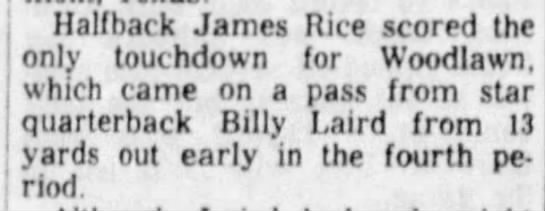
     On October 19, 1960, junior halfback James Rice -- small, thin and fast -- made history: He ran 57 yards for the first varsity touchdown in Woodlawn history.
     After the Knights had been shut out in their first four games, James hit the end zone -- and he did it against the school that would become our arch-rival, Byrd, and against a Byrd team that was ranked No. 1 in the state and would go unbeaten that regular season. I won't bother to give you the score of that game, but Woodlawn had 6 points.
     (Bobby Glasgow, a sophomore that year, will tell you that he scored the first Woodlawn touchdown -- and he did ... but for the B-team a week earlier. It was a varsity game, but only for Haughton.)
      James had been a B-team back for Fair Park in 1959, then came to Woodlawn with a rag-tag bunch of players -- a few seniors, but a lot of juniors (transfers from Byrd, Fair Park and Greenwood) and sophomores fresh out of junior high.
     Wrote about that team in the first year of my blog, almost 6 1/2 years ago: http://nvanthyn.blogspot.com/2012/08/the-team-named-desire.html
     James started two seasons for Woodlawn -- the awful first season (0-9 record), the second (his senior year) a glorious, astounding district championship -- a 9-2 regular-season record in which they kept winning games with fourth-quarter heroics. The Knights' first playoff game followed.
     That very small physical team -- Rice at 140 by his senior year had lots of company in the "lightweight" category; an offensive guard weighed 145, a tackle 165. Only one starter, a tackle, had any real size (for then) -- 195 pounds.
     This was a quick, supremely conditioned, mentally tough -- and talented -- team. The Team Named Desire. The "Cinderella" Knights. A Cinderella story.
      There were a half dozen future college players -- some all-conference ones -- on this team. Not James (too small), but he was one of the top stars. Check the clippings. And he scored the final touchdown of the season -- in the state playoff game. 
      Downing was the 160-pound center on those teams (and the starting catcher in baseball), and always James' friend. He lived two blocks away on Sunnybrook, across from the well-known scout hut on the Sunset Acres Elementary grounds.
      "He was in my first wedding," Downing said, "and we each delivered newspapers, we had newspaper routes. We would go near the A&P store in the Sunset shopping center early in the mornings to pick up our papers, and vendors would leave us honeybuns and chocolate milk. The store manager was OK with that, as long as we cleaned up the area. We were barely teenagers.
     "We played on a lot of teams together. Everyone knew he was a fast runner."
     And in high school, they often joined with [end] Ted Bounds for, well, some joy rides in Ted's Rambler.
     Downing, too, was at Louisiana Tech at the same time as Rice, and "we had a great time playing flag football.
     "What a great loss, and I hope to see him again on the other side. ..."
      Ronnie Mercer, at 135 pounds, was James' partner at safety in football and also a good friend through the La. Tech years.
      "When we were in Ruston, we lived in a four-plex and James and Phoebe were our next-door neighbors," Mercer recalled. "I don't think I ever saw him angry, which was a complement to the angry person I was.
     "He deserves to be written about. He was a man of tremendous heart."
     Mercer remembered one football incident at State Fair Stadium (now Independence Stadium)
      "Don't remember who we were playing, but we were on defense and James made a tackle and it knocked him goofy," Mercer said. "He actually went and lined up in the other team's huddle. I don't think anyone noticed until they broke the huddle to run the play. Then one of the referees noticed. But I guess he was going to run the offensive play for the other team."
      In the long run, Woodlawn football was a memorable experience for James Rice, for all of us 1960s kids. The long run of his life -- a little more than 57 years after that 57-yard run -- was a bigger test.       
---
      College was in his plans, but money was short. His stepfather promised to pay to start his education ... if James would work at his filling station that summer. But the deal fell through, and helped was needed.
      It came from then-Woodlawn counselor Mary Higginbotham, who had Louisiana Tech and Ruston connections (and a year went to work at Tech).
     Mrs. Higginbotham called her friend Johnny Maxwell, recent new owner/operator of the Holiday Inn near the Tech campus, and asked if he could find James a job and a place to live.
     "I can do that," Maxwell told her. Some of us remember James working at the Holiday Inn during his college years and then becoming a fulltime employee, first as restaurant manager.
     He met Phoebe, married and soon they started a family.
     After some years, it was time to move on. After a job for a food company in Jackson, Miss., James knew Maxwell had bought the Holiday Inn in Oxford, Miss., and asked if he had a job for him there. He did: manager.
     He was a neat dresser and he learned to do the maintenance job required to keep a hotel/motel in top shape.
     From there, it was on to another hotel managing job in Augusta, Georgia -- home of the Masters golf tournament. One year Maxwell took his son and grandson to the tournament, and James arranged tickets and a place for them to stay.
     After the divorce, as Maxwell recalled, "he went off the radar for a number of years" and moved to Meridian, Mississippi. 
     Some years later, Connie got word that there were gaps in James' managing his life.
      She and husband Harold went to Meridian, packed up his belongings and brought him back to Shreveport. Contact with his ex-wife and children ended, but his grandson remained in his thoughts.
---
     He loved going to church, loved the dog "Lil' Man" he was given, took him for walks every day at the Southern Hills recreation park. He worked in gardens and tended to roses he planted.         
     Over the past couple of weeks, Connie and Shirley Weaver have put together memories of James for the memorial, which will happen two days before what would have been his 75th birthday.
     "I am glad that he did not suffer long," said Connie of the last part of James' life. 
     "He was such a kind, loving person," said Shirley, "... He was loved by many." 
      And in the final year, some old friends -- Maxwell, some of James' working employees, and a few Woodlawn buddies -- came to visit him.
      Long-ago girlfriend Andra Wilson, reflecting on James' final years, said the stories she heard "have kept me aware; I have had nightmares ... James was kind of a naive guy, but he was sweet."
      As Connie worked to arrange a memorial, she said, "Talking to all of ya'll [James' old friends] has helped me with closure about James."
      Because he loved the song The Rose, the Conway Twitty version, that will be part of his memorial.   
       He will be -- he is -- fondly remembered by many of us. He not only ran into history, he ran into a place in our hearts and memories.
---
     A memorial for James Rice (WHS Class of '62) is scheduled Saturday, January 19, 1 p.m., 11055 General Patton Avenue, Shreveport (Connie Roge's house). Please contact Connie at 318-453-4902 or 318-687-6369 if you plan to attend, and share your thoughts at the memorial.


Monday, December 10, 2018

"Fame" for Lee Arthur Smith, the big country kid

     To begin -- and paraphrasing John Denver's great song -- thank God for this country boy.
     Do not have a personal connection to Lee Arthur Smith, except one face-to-face interview in 1975 and one phone interview in 1987. Have not talked to him otherwise.
     But we are so proud of and so happy for the big country boy from Castor, Louisiana -- or next-door Jamestown, if you want to extend his home territory.
     Lee Smith's election to the Baseball Hall of Fame, many believe, is long overdue. If they had let me have the only vote, it would have happened years ago.
     But as of Sunday, it is reality, and we had two immediate reactions:
     (1) Love it. He is one of our favorites, he "belongs" to North Louisiana.
     (2) Wonder what Jerome Holtzman would have thought today?
     (Many baseball fans, and almost every baseball writer, know the name Jerome Holtzman. There is a personal story here, centered on Lee Smith. Read on.)
     The tall and then-lanky baseball and basketball star from Castor High School I interviewed for a Sunday sports story in The Shreveport Times (April 20, 1975) grew into an imposing, thick hard-throwing right-handed pitcher -- one of the top relievers/closers in baseball history.
     The Times and Shreveport Journal were always his home-area newspapers, even after he left for fame in Chicago, Boston, St. Louis and other major-league stops. 
     And the personal connection: That part of Bienville Parish is familiar to us. My wife, Beatrice, grew up in Jamestown -- where Lee was born and, in young adulthood, resided in a huge new home.
     Little did I know when I made the visit to Castor in 1975 how connected to that area I soon would be, how many visits to Jamestown were headed. Nor did we know where Lee Smith was headed.
     In The Times story in 1975, a "pullout" quote from Lee read: "I like playing basketball ... more than baseball. But if I get a good enough offer in baseball, I'll sign."      
     Seven weeks after the story ran, Lee Arthur was picked in the second round of the Major League Baseball draft by the Chicago Cubs, the 28th pick overall. The Cubs scout who recommended him -- and soon signed him -- was a baseball legend, Buck O'Neil.
     But he did not give up basketball. The next couple of times I saw him was when he was a member of the Northwestern State University basketball team playing against Centenary (he played some as a reserve 6-foot-5 forward) in the 1976-77 season.
     Saw him again in 1978 and '79 when he came to SPAR Stadium in Shreveport as a pitcher (a starting pitcher, incidentally) for the visiting Midland Cubs (Texas League).
     By 1980, his sixth pro season, Lee made it to the majors.
     For 18 consecutive seasons (16 full seasons), he pitched in the big leagues. So that was 1,022 regular-season games -- only six starts (five in 1982, none thereafter) -- and four postseason games (two with the Cubs in 1984, two with the Red Sox in 1988).
     When he retired -- at age 40 in 1998, after 12 minor-league games -- he was the alltime leader in MLB saves (478). 
      He since has been surpassed, by Mariano Rivera (652) and Trevor Hoffman (601). But, gosh, that's pretty nice company.
      Which is why members of the "Today's Game" Hall of Fame committee selected Lee for the Hall (along with White Sox/Orioles designated hitter Harold Baines, a "marginal" choice in our view).    
      And what's fitting is that next July 21 in Cooperstown, Lee Arthur Smith will be inducted into Baseball's Hall of Fame on the same day as Mariano.
     Although he wound up pitching for eight major-league teams, it is with the Cubs that Lee is most associated. So we borrow from the bleedcubbieblue.com web site: 
     "Lee Smith was a dominant Cubs closer from 1980 until he was traded away after the 1987 season, including three 30-save seasons and being the closer on the Cubs' 1984 
National League East championship team."
     Which bring us to the Jerome Holtzman part of this story.
---
     One December day in 1987, for about five minutes, it was me vs. Jerome Holtzman debating the merits of relief pitcher Lee Arthur Smith.
     He was one of America's greatest sportswriters, baseball writers. Me? A nobody from Shreveport covering major-league baseball winter meetings [for The Times] at the Dallas Anatole.
     It was the only MLB winter meetings I ever covered; Mr. Holtzman probably covered more than 50, and everything important in the sport for that long.
     It was the day Lee Smith was traded from the Chicago Cubs to the Boston Red Sox. Mr. Holtzman was delighted; I was aghast at his delight.
     We were both in the room when the trade was announced. Dammit, I didn't like his reaction, and he came to realize that. As if it mattered, or he cared one little bit.  
     Please don't disparage the big kid from Castor.
     Jerome Holtzman, for five-plus decades, covered the Cubs and White Sox, usually for a half-season each, and here -- from Wikipedia -- is how highly regarded he was:
     "His influence and viewpoints made him something of a legend among newspapermen. Southern humorist Lewis Grizzard, who was sports editor of the [Chicago] Sun-Times for part of Holtzman's career, called him 'the dean of American baseball writers,' and went on to say, 'He never smiled, but he had the keys to Cooperstown. No major leaguer ever got into the Hall of Fame if Holtzman didn't want him there. He had tremendous sources. He was writing about the possibility of a baseball players union and a baseball players strike long before anyone else.' "
     OK, but by December 1987, Mr. Holtzman was not at all a Lee Smith fan. And I was.
      Holtzman never forgave Lee for a large failure in the 1984 National League Championship Series and, what's more, a difficult 1987 season.
      In the 1984 NL Championship Series, the Cubs -- with a 2-1 games lead in the best-of-five series, and one victory from breaking the 1945 curse -- lost Game 4 to San Diego  when Lee gave up a walkoff home run to Steve Garvey. The Padres then won Game 5 and went to the World Series.  
     From bleedcubbieblue.com again:     
     Smith had a rough year in his final year with the Cubs in 1987, with 12 blown saves and at times was booed off the mound. At the end of that season, it was felt that the Cubs needed to move on from him and he was traded to the Red Sox for Al Nipper and Calvin Schiraldi, one of the worst deals in recent Cubs history. Smith would go on to post six more 30-save seasons and three of more than 40, although he pitched in just one more postseason ..." 
     Mr. Holtzman's negative views on Lee, as I remember it, had to do with Lee's blown saves, ballooning weight and sore knees -- items referenced in my column from the '87 winter meetings.
     But when new Cubs director of baseball operations Jim Frey was asked about that, he praised Lee, even after he had traded him (at Lee's request, incidentally).
     "Wait, I've been one of his biggest defenders when some others in Chicago weren't," Frey is quoted in my column. "He almost never refuses the ball, he gets up and throws every day, he can work several days in a row, he's reliable, and he's not an old man. This guy is a horse, and he's been a horse.
     "We know we're giving up one of the premier stoppers. ..."
     My column includes numerous quotes from Lee. I do not remember this, but obviously I talked to him by phone that day. He made it clear that he was ready for a change of scenery from Chicago, and he was upbeat -- as he always was.        
---
      Here is an irony to Jerome Holtzman's view of Lee Smith then: One of Holtzman's greatest contributions to baseball is that he was the creator of the save statistic. He came up with that in 1959, and it was adopted as an official statistic beginning in the 1969 season, the first official new stats category since the RBI (run batted in) in 1920.
     So, maybe Lee Smith owes Mr. Holtzman thanks, no matter what the man thought in 1987.
     And when he retired from newspapers in 1999, Mr. Holtzman was named official history of Major League Baseball, a position he held until his death (stroke) in mid-July 2008.
     But, gosh, I wish he had been easier on Lee that December day in 1987.
---
      After Lee's playing career, he was a minor-league pitching instructor for a long while, including the San Francisco Giants' chain, which put him in Shreveport to work with the Captains during the 1990s.
      So the accompanying photo was taken at Fair Grounds Field. 
       It was fitting because Shreveport was the "big city" for the country boy from Castor (and Jamestown).  
       And now we can say that we were fans of this Baseball Hall of Famer for decades.
---
       Posted this on Facebook today, repeating it here ...
       Many, many stories written about Lee Smith over the years. This is the best story -- July 1987, Shreveport Journal, by Teddy Allen and John James Marshall, a first-place national award-winning story, a great read.
      http://www.designatedwriters.com/classic/lee-arthur-smith/?fbclid=IwAR0AyNyoevMRfex29ojdGrgi5Isys0duqi4ssv0NgIeGklZSZlbm9Ur6Lk8
---
 

Thursday, December 6, 2018

"Fast Eddie:" A world of trouble ... a sad ending

     He was one of those kids we knew in the late 1950s -- a rough-edged, tough young guy. And then, where did he go?
     It is a sad story, a horrible one, really. Ended tragically. Two weeks ago, we got a reminder.
     Someone contacted me looking for information on this man, provided some background (not all of it correct), sent a photo, and asked, "Is this 'Fast' Eddie Smith?"
     Instant recognition. Yes. Yes, it is/was Eddie Smith.
     The photo -- from a Woodlawn High School yearbook -- was the kid we remembered ... from our neighborhood and our schools (Sunset Acres Elementary, Oak Terrace Junior High and Woodlawn). 
     We had been on the same kids' baseball team one year, I was certain of that. Read on, you'll see why I remember.
     The information sent said he was a 1965 graduate of Woodlawn, but, no, actually he was in the Class of '66. So a year behind us in school -- for eight years. 
     What was correct was this: In 1983, a man named Willie Eddie Smith was murdered in Shreveport.
     Intriguing. And, of course, I thought: This might make for an interesting blog. Time to do some research.
     Did not remember this happening, although it must have been in the papers. To find out, to be reminded 35 years later, was a bit of a shock.  
     We were in Shreveport in 1983, working as part of a terrific, talented, fun-loving sports department at the Journal. The big story in sports for us that year was second-year pro Hal Sutton's emergence as the top money winner on the PGA Tour and the PGA Championship wire-to-wire winner that August. 
     By then, Eddie Smith -- from Sunset Acres -- had been dead for 2 1/2 months. 
     Shot to death May 23 in an argument related to a card game (poker).   
     The "Fast Eddie" nickname, referenced in a newspaper story a week after Willie Edward Smith's obituary in The Shreveport Times, was a hint to the fast, wild, sordid life of the victim.
     Just how wild we learned by tracking down two people: (1) a Smith family member -- Eddie's nephew, a son of his oldest brother -- and (2) one of our school buddies.
     "Eddie stayed in trouble," said the nephew, R. Lewis  Smith. "Some people just find trouble wherever they go, and that was Eddie. And the trouble got worse and worse through his life."
     Until he met a fast death.
---
     Details of the end (taken from stories in The Times): Shot three times, in the head and the abdomen, and also beaten in the face.
     He had been the lone white man in a group of five at 2911 Portland, Apartment A, located in the Queensborough area (close to the State Fairgrounds).
      Much like Sunset Acres, Queensborough had been a comfortable, working-class, almost all-white residential neighborhood, but by 1983, it had become more mixed-race, lower-income, and the streets were meaner.
     The shooting, said the July 6 story which reported that the triggerman -- Jack King, then 34 -- had pleaded guilty, followed an argument over (what else?) money.
     King was allowed to take a lesser plea of manslaughter -- rather than second-degree murder -- in agreement to a maximum sentence of 21 years in prison.
     After the Shreveport police investigation, King was arrested within two days after the shooting. 
     That day and over the next week, four people -- three men (one King's roommate) and one 20-year-old woman -- also were arrested and charged as accessories after the fact, meaning they witnessed the act, then helped clean blood from the apartment and dispose of the body. (Two of the "accessories" lived in the apartment.)
      Early the next morning after the shooting, Eddie's body was found in the rear seat of his compact foreign car [a red Plymouth Barracuda] on Hardy Street (some nine blocks from the Portland apartment).
       At the time of the murder, King also had been charged with armed robbery and aggravated burglary in another case. But that was dismissed in September 1983.
       The four "accessories" cases ultimately were dismissed, one by that July, the others late the next year.
       Guess the murder sentence was enough for the courts, and that with King in prison, the "accessories" were given leniency.
      No leniency for Eddie. But while his death "was a hard time for all of us," said nephew Lewis Smith, "it wasn't surprising.
     "He always ran with the wrong crowd. It was a downward spiral that Eddie went through for years and years."
 ---      
     In the stories in The Times, Eddie is listed as living in Keithville -- just south of Shreveport. But his obituary said he lived in Shreveport and his nephew said he resided at the  home that had been the family's for years -- 2867 Hollywood, the northeast part of Sunset Acres (the "other" side of the canal from us, about 11 blocks from our house, 10 blocks from the elementary school).
     That is where we remember him from the late 1950s.
     Willie Edward was born late in 1947, the "baby" of his family -- with a much older father (Robert Calhoun "Shorty" Smith) and mother Margaret Gould Smith, and two brothers who were almost a generation older -- Robert by 17 years, Jerry by 14. 
     The family dynamics were problematic.
     "He never got along with his father, my grandfather," said  Lewis Smith. 
     There was little connection with the brothers, who had long moved away from home by Eddie's teenage years.
     The tie with the mother was stronger, for many years. But the relationship soured as trouble mounted, and finally fell  apart.  
     Dennis Storey was a Sunset Acres friend, in the same grade as Eddie throughout school days, also a Woodlawn '66 graduate. He was a frequent visitor to the Smith home, and felt that Eddie "was an 'accident' child.
     "He was a spoiled kid," Storey remembered. "The way he talked to his Dad ... If I had talked to my Dad that way, he'd have whooped my ass." 
     "Shorty" Smith was a painter, and Eddie worked with his father some in those years. "I thought he would end up as a painter, too," said Storey. Did not happen; the obituary listed him as a plumber.
---
     Our brief tie with Eddie Smith was on a St. James Episcopal Church-sponsored midget league baseball team (ages 10-12) in either the summer of 1959 or 1960. He was a compact-built kid, a catcher, one of the better players on a team with little talent and few victories. 
     But here is the distinct memory ...
     Late in the season, on a game-ending play, an opposing runner crashed into Eddie at home plate and flattened him. He was hurt.
      In fact, he was hurt badly enough that the coach and concerned parents took him to a hospital. Internal injuries caused swelling and shock, and the vivid memory is that Eddie's body overnight had to be packed in ice.
     That incident perhaps was a sign of woes to come.
     He recovered, but he did not play again that summer. Don't recall him playing baseball again.
     But Storey said he remembered Eddie playing running back for our junior-high team: "He was a helluva football player ... he'd just as soon run over you as look at you." Another friend recalled Eddie running track one junior-high year. (I don't recall him in either sport, but I don't doubt it.)
     By high school, he was a different guy. He had the look, frankly, of a hood, a thug. The hair was slicked back, not a total ducktail -- so hood-looking in those days of the crewcut or flattop that our faculty much preferred -- but close.
     A memory from school: Eddie swaggered his way around.
     "His demeanor was that he wanted to be the tough guy," said Storey. "I did not run around with him by then. I thought he would eventually run into trouble. 
     "He was hanging around the wrong people, riding motorcycles. And I think he got in a gang."
    Storey, retired after 32 years of working in traffic engineering for the City of Shreveport and now living in Blanchard, recalled a chance meeting many years later at a convenience-store stop in Bossier City. In the parking lot, he noticed a familiar -- but changed -- figure.
     "He looked like a gang member," he said of Eddie. "Black leather jacket, the motorcycle ('choppers' they called them), beard, mustache, he was -- as they called it -- 'flying the colors' for the gang.
      "I talked to him, but I knew I didn't want to stay around long. It was obvious he was gang-related and dope-related."
     Mike Flores (Woodlawn Class of '65) was another neighborhood resident who lived closeby and said, "I remember Eddie Smith's name better than I remember Eddie the person. As I recall, he was on the periphery of all my groups."
     Flores said it had been decades and he had no knowledge of Eddie after high school.
     "My memory is that he ran with a rougher crowd," Mike said. "Maybe his associates caught up with him in the end."
     For sure, Eddie Smith was a black-cloud person, accidents waiting to happen. 
---
     Lewis Smith, 63, a Shreveport resident who is a certified public accountant and registered financial advisor, said that writing about Eddie now would not be a problem for the family. "We all know the story," he said.
     The trail of trouble was long, and Lewis offered some details. So did our check with the Caddo Parish Clerk of Courts office.
     • An altercation with the Shreveport police in which he was a holdout inside a house, then was shot and had a severe stomach wound.              
     • A conviction for possession/distribution of methamphetamines Dec. 7, 1972, and a sentence of two years hard labor at the federal prison in Oakdale, La.
     • A couple of motorcycle wrecks. On one, he hit a median curve going 70-80 miles an hour ("he was totally reckless," said Lewis), causing a shattered jawbone and a total reconstruction of his jaw. Lewis: "He kind of mumbled after that." 
      • A conviction for receiving stolen goods, Jan. 10, 1983, a guilty plea, a fine of $500 and costs or 50 days in the Caddo Parish jail.
       A little more than four months later, the end.
       Lewis, who had been a funeral director for Rose-Neath before becoming a CPA, knew some of the people who made the arrangements for Eddie's service and burial (Lewis was one of the pallbearers).
     For the final decade of his life, family members occasionally would see Eddie. Lewis said his younger brother Charles Wayne also was a plumber and at times crossed paths with Eddie at work.
     ."He [Eddie] was always on the fringe of the family," Lewis said. "He might show up for holidays, but he was not really part of it."
     And even the mother, who had tried to maintain a relationship, gave up.
     "She settled up with Eddie several years before [his death," Lewis said, "and did not have much to do with him. She was tired of financially bailing him out and supporting him."
      The death "was hard to Memaw to accept, it was a grueling time for her. But it also put her at peace. It put a lot of things to rest."
---
      There is no redeeming message in Eddie Smith's story. It is an example that even in an idyllic neighborhood and schools of our youth not everything turned out well in our Camelot. 
       It is, though, a heartbreaking story -- one of several from our area.
       "It wasn't that Eddie did not have good examples in his household," Lewis Smith said, recalling his grandparents' efforts. "Memaw could not understand what happened to him.
       "He could not change, or he didn't want to. Other people go through rehab, and some make changes. Some don't. He didn't even try."


Wednesday, December 5, 2018

One of the most colorful all-time Yankees is ... Brown

     (Note: Wrote this for "Designated Writers," the web site of two longtime sportswriting types with Shreveport ties, Teddy Allen and John James Marshall. So I was a "Designated Contributor," and the intro was written by Teddy.)
---

     Nico Van Thyn (former boss and mentor of your DW co-founders) and his forever wife Bea live in a nice retirement spot in Fort Worth. One of his fellow retirement teammates is … a recognizable name. For a New York Yankees fan such as Nico is, it’s like living next door to a boyhood baseball card. He wrote this in July and I read it with joy then and … forgot to post it. Because I am selfish. Unlike former Yankees star infielder and American League President Bobby Brown. The picture is from 2016 at the 70th annual Yankees Old Timers Game; Dr. Brown is in the middle, flanked by Don “Perfect Game” Larsen on the left as you look at the picture and first baseman Eddie Robinson, still the oldest living Yankee at 97).
 --- 
     One of the real treats for me here at Trinity Terrace is that Dr. Bobby Brown -- Yankees star third baseman from 1947-54 (with two years interrupted by the U.S. Army and the Korean War), American League president (1984-94) and well-known Fort Worth cardiologist for 25 years -- lives here.
     We see him at breakfast every morning, Bea more than me because don't go down for breakfast too often, but I speak to him in the dining room (he is there almost the same time every night, sitting in or near the same area, by himself).
     I have sat with him several mornings at breakfast, and here are some stories and opinions from Dr. Brown ...
     Dr. Brown mentioned that [the Rangers'] Joey Gallo has something like 200 strikeouts already. I told him that Aaron Judge has 132 and asked what he thought the difference was in today's game.
     He talked about the big swings and lack of sacrifice with two strikes, how emphasis used to be on just making contact. Said he struck out 88 times. I asked, “That was your season high?” His reply: “That was for my career.”
---
     He said players asked longtime Yankees third-base coach Frank Crosetti — “a great guy” — for advice. “ 'Until you get two strikes,' ” Cro told them, “'swing from your ass.' That was our hitting coach.” He was laughing. So was I.
---
     I was telling Dr. Brown about the YouTube video John W. Marshall had sent me about one of baseball’s best umpire-manager arguments: umpire Jerry Crawford and Cubs manager Don Zimmer. (Look it up; it was quite a scene).
     The mention of Zimmer brought a couple of Dr. Brown stories. They were friends -- Zimmer was a young player late in Dr. Brown’s career, and then they had the late Yankees’ connection when Zimmer was Joe Torre’s bench coach.
     When he was the Cubs’ manager, Zimmer lived on the 60th floor of Chicago's Sears Tower (then the tallest building in the U.S.). He was asked why so high.
     “If the ballclub is going bad, and I feel like I want to jump out the window,” he answered, “I don’t want to be merely wounded.”
---
     Zimmer’s daughter was an airline stewardess. When they asked Zim if she looked like him, he replied, “Good God, I hope not. If she does, she is in trouble.”
---
     Dr. Brown said Lefty Gomez, long one of the Yankees’ pitching aces and known for his humorous personality, had a ball hit back to him one day with runners on base, and he kind of froze, then threw the ball to second baseman Tony Lazzeri, who had no play anywhere. After the game, Gomez was asked why he threw the ball to Lazzeri. He replied: “He’s the smartest guy on our team, so I figured he would know what to do with it.”
---
     Gomez married an actress, June O’Dea, and the talk was that the marriage would not last 30 days. (I looked it up and early on, it was a quite contentious marriage). But when they reached their 55th wedding anniversary, Lefty observed that, “Well, I guess we beat that 30-day mark.”
---
     Dr. Brown said he invited Gomez to Fort Worth to speak one day at Shady Oaks CC (where Ben Hogan hung out). Picked him up at airport and they drove past the zoo. It was a very hot day and they heard a loud noise.
     “What was that?” Gomez asked. 
     “Those are the lions,” Dr. Brown told him.
     Another roar. “Must be too hot for them,” Gomez observed. 
     “You know,” Dr. Brown answered, “it gets pretty hot in Africa, too.”
---
     Dr. Brown loved Whitey Ford, said he is “a wonderful guy” and he told this story about Ford’s rookie season (1950) ...
     Said Ford came to the majors at the All-Star Game break and he immediately was sensational, something like 10-2 in mid-September when the Yankees were fighting Detroit for the American League pennant and barely had a lead. Three-game series, first two games were split, and Ford was the starter for the third game with first place on the line.
     “We were worried about it,” Dr. Brown said, “and we did not know what to expect from him in a big game.”
     Ford’s mound opponent was Dizzy Trout (I looked this up, and Dr. Brown was correct about most things in his recollection of the game).
     In the middle innings, the Yankees had the lead and Ford was cruising. When he was about to face the Tigers’ catcher — Bob Swift, Dr. Brown said — Ford signaled to Dr. Brown at third base and gave him a “come here” wave. Dr. Brown thought, “Oh, oh, he’s about to let the pressure get to him.”  
     Dr. Brown trotted to the mound. “What’s that guy’s name?” Whitey asked him. Dr. Brown gave him the name.
     “You know, he looks fatter than he did when he batted last time,” Whitey said.
     “I knew then that this kid was going to be all right, and so were we,” Dr. Brown said. “He was not going to get shook up.”
---
     He has lots of Yogi stories. Here are a couple of quick ones: 
     Yogi was being introduced as a Houston Astros’ coach in 1985, and at the same time, the Astros had signed a reserve outfielder. When the player was being introduced, his statistics were cited, and the year before he had something like 19 RBI.
     Afterward, Yogi said to this outfielder: “Did they say that you drove in 19 runs last season?” “Yes,” the young man replied. “I drove in 22 one day in Newark,” Yogi told him.
     “And that’s true,” Dr. Brown confirmed. “I was on that Newark team with him, and it was a doubleheader and every time Yogi came to the plate, there were men on base, and he drove them in, so … 22 RBIs in one day.”
     Yogi was at the New York Giants’ press conference when they announced the signing of Paul Giel, a terrific all-around athlete at the University of Minnesota who chose to play baseball as a pitcher (he later was the athletic director at Minnesota).
     It was the off-season and Yogi, who lived across the river, went to Toots Shor’s for the press conference … “he didn’t have anything else to do,” Dr. Brown said, laughing.
     Afterward, Yogi saw Giel and said, “Did they say you are a right-hander?” Yes, Giel confirmed.
     “I murder right-handers,” Yogi told him.
---
     I have asked him about various Yankees’ players — Gil McDougald (who platooned with him at third base a couple of years), Vic Raschi, Allie Reynolds, Billy Martin, Mantle.
     On Raschi: “If we got to the seventh inning and we had the lead with him on the mound, the game was over. Every pitch he threw from then on was faster than the one before. He was not going to get beat.”
     On Reynolds, like me, he thinks he belongs in the Baseball Hall of Fame. “The biggest crime in baseball,” he said of his omission.
     “When that Big Indian came in late in game [he often was used as the closer], he did not mess around. It was bang, bang, bang … strike one, strike two, strike three. You’re in the clubhouse.”
     On Martin: “He was impossible. Crazy. You never knew what he was going to do off the field. If they could have put him in a cage right after a game ended and then let him out right before the game the next day, they would have been all right.”
     About Mantle: “Just a great talent. But his brain didn’t work that well.”
---
     On Casey Stengel: “I would watch him in the dugout and listen to him," Dr. Brown said. "A guy would go up and swing at the first pitch and Casey would say, “Why does he do that? Why doesn’t he wait and see what this guy is throwing?” Next guy up would take the first strike, “Why doesn’t he swing the bat? The pitch is right in there, that’s a good ball to hit.
     Dr. Brown: “You never knew what he was going to say.”
     I asked if he thought Stengel was a great manager. He was evasive, or diplomatic with his answer. “Well, he had great players,” he said, smiling. “Casey always said, ‘I couldn’t have done it without my players,’ and he was right.”
     I asked him how players felt about being platooned by Stengel. “Well, they didn’t mind,” he said. “We had such great teams, we always had 4-5 guys on the bench who were just as good as the guys on the field. … We had guys who really were better in big games — DiMaggio, Tommy Henrich, Yogi, Johnny Mize, Gene Woodling, me,” (and he didn’t even mention players such as Hank Bauer, McDougald, Martin and, obviously, Mantle.)
     I asked if he ever had contract battles with George Weiss, who was a penny-pinching general manager for the filthy rich Yankees. 
     “I did,” he said. “But they didn’t last long. I had an advantage. I was a medical student and they knew (in the early 1950s) that I eventually was going to have a career in medicine. So I would tell him [Weiss], ‘Look, I don’t need to be playing baseball. If I don’t play, the sooner I can get my medical studies done and go into practice.’ So he would raise the offer some and we would settle on a figure.”
---
     About Steinbrenner:
     “A total [bleep],” he said quickly, shaking his head at the thought. “Really, I did not have much to do with him, or him with me.”
     “If he was dealing with a baseball executive who had not been a player, he would say, ‘That guy never played. He doesn’t know anything about the game.’ If he was dealing with a former player or a manager or GM, he would say, “He doesn’t know anything about running a business.
     “He did not know what to do with me — I was a former player and I had my medical practice for all those years. So he left me alone.”
     But, “He loved my wife; she was a really good-looking woman. So we would see him in New York City, and he would acknowledge me, but he always gave her a big hug and he would pay a lot of attention to her. I would just be standing there watching him, thinking, ‘What a guy.’ ”
     He said when Buck Showalter was the Yankees’ manager, Steinbrenner would demand that Buck could not leave the ballpark without talking to him. "Sometimes it would be 2:30 in the morning, and Buck is still there," Dr. Brown recalled.
     “I told Buck -- who came here, Dallas-Fort Worth, often because he had a kid at SMU -- you can’t keep doing this. There are a lot of guys in hospitals with coronary problems because they worked too many hours.’
     "… And the first chance Buck got to leave the Yankees, he took it.”
---
     A final story: Dr. Brown's Rangers’ tickets are in row 12, seats 1-2-3-4, in the section just to the first-base side. He was offered tickets behind home plate, but he knows that the scouts like to sit there — they find seats that are empty — and he does not like to ask them to move.
     The man who has seats in the row in the front of Dr. Brown operates a business and they visit a couple of times a season. The man at times brings customers or friends. One night before a game, Dr. Brown was sitting in his seat and  one of the customers or friends noticed a scout sitting down the way wearing a huge ring. He speculated it was a World Series ring, and Dr. Brown confirmed that.
     “Think he’d let me see it,” the guy said. Dr. Brown told him he probably would.
     The scout was Gene “Stick” Michael of the Yankees.
     So Dr. Brown waved to Michael and indicated that the man wanted to see the ring. Michael came over and complied, and the man was oohing and aahing about the ring.
     “He’s got one, too,” Michael said, pointing to Dr. Brown.
     The man was incredulous, and asked Dr. Brown to see it. His 1949 ring — which I have seen him wearing — isn’t nearly as fancy as you can imagine Michael’s was. The man  looked at Dr. Brown and asked, “Who are you?”
     Dr. Brown's answer. "Babe ... Ruth."