Saturday, January 26, 2013

Dad's stories are unreal ... and too real

        I spent time with my dad this week. It was long overdue.
        He told stories, stories a Holocaust survivor could tell, stories -- honestly -- which I did not remember hearing before.
         I saw them on tape this week, a tape he did 16 years ago as part of the Shoah Foundation testimonies by Holocaust survivors.
        I had seen bits and pieces over the years, but never was I able to watch the whole 2 1/2 hours. I know I should have. But it was too raw for me before, too emotional.
        Same with my mother's tape for the Shoah Foundation. But I'd seen many talks and interviews she'd given in her 25-year role as a Holocaust educator in Shreveport-Bossier, North Louisiana and beyond.
         She was acclaimed, and rightfully so. Her presentation was compelling, riveting ... awesome coming from this little woman. But my dad, who didn't speak English as well and didn't talk much publicly, told better stories in private -- in my opinion. I've written that before.
        This taped interview -- one of some 20,000 done in the United States and some 52,000 worldwide (56 countries, 32 languages, according to the University of Southern California Shoah Foundation web site) -- confirms that.
         I am writing this piece at this time because Centenary College on Monday will have its annual Van Thyn Memorial Lecture, part of the endowed chair established there in honor of my parents.  It was a great honor for them, and it is for our family.
        A year ago, almost to the day, Centenary had an all-day showing of my parents' testimony tapes.
        I intend to watch my mother's testimony, too, in the near future. But this week it was good to visit with the man our grandkids came to know as "Opa." 
---
      Interviewer: Why don't you describe how you arrived to the station, and what happened from that moment on.
       Dad, shaking his head and taking in the question: "Boy, that is something. [Pause]
       "We got off the train, and the SS guards came out with dogs and everything. They told us to leave our suitcases and stuff lying over there. We can get it later, they say, and you know it was all in German, and German was not the main language for us. So the half we didn't understand what they were saying.
      "They were hitting [people] already, and we were sent to barracks. And we saw the children and the women on the side. It was like a dream. I don't know if you'd say it was a dream, but it was something ..."
---
       For those who don't know, my parents each spent about three years in Auschwitz, perhaps the most notorious of the German concentration camps. Each lost all of their immediate families; each lost their first spouse.
       They never hesitated to talk about being Holocaust survivors; some survivors couldn't deal with that.
       Privately, my mother suffered great periods of guilt and depression. I'm sure Dad had some deep wounds, but he was always even-keeled -- and fairly unemotional -- in discussing those harrowing experiences.
       So it was on this tape. No tears, no anger. Only a few times, when something affected him deeply, he softly said, "That was something ..." or "that was bad."
       The testimonies were taped Oct. 9-10, 1996, in the living room of my parents' home in South Broadmoor. They sat in the "throne" chair with the portrait of an old Jewish rabbi with a big white beard hanging nearby ... the chair and the portrait are now in our apartment living room.
        Both parents' testimonies took five segments.  The interviewer was Renee Firestone, herself a Survivor who is, to this day, a well-known Holocaust speaker in the Los Angeles area with her own interesting blog ... http://eng495renee.blogspot.com/
        She guides Dad from his childhood, his life with his parents (Nathan and Sara) and his two brothers (Hyman, two years older, and Jonas, 12 years younger) through the pre-war years and then the lead-up to his being picked up by the Germans.  
        One touching, and interesting, part is about the number on his arm: 70726. It, not his name, became his identity to the Germans. Of course, this number is what so many people noticed later in his life; it was large -- he says that -- and prominent, and so much a symbol.
---
      More on his arrival at Birkenau ...
      Interviewer: What did you think, why were the women and the children on the side?
      Dad: "No idea. No idea. We were talking, 'What is here?' What did we know about concentration camps at that time? We had heard and read from it before the war, what happened in Germany, maar [but] you no realize that happened today to you yourself."
---
       This is not meant as a slight to my mother, but my father's background and experience had him much more prepared -- if that's possible -- for what was to happen in the camps.
        My mother often said she was "very spoiled and very overprotected" as a child and naive as a young woman. She'd rarely been out of Amsterdam, she'd worked only as a seamstress.
        My father left home at age 17 to learn the diamond-cutting trade in Antwerp, not to return to live in Amsterdam until 10 years later after he married my mother (he wanted to live in Antwerp; she didn't).
        You listen to him tell of the many jobs he had -- before the camps, during the camps (cutting trees, in the coal mines, railroad worker, in the streets, in the tailor shop, concrete carpenter) and afterward when he found he couldn't sit inside and be a diamond cutter.
         And his route to and from Auschwitz -- to Belgium, to France, to Germany, to Poland and through several work camps around Auschwitz, to Romania, to Odessa, Russia, back to Paris and then Antwerp and Amsterdam again and a job as a street-car conducter, then driver. That's how I first remember him.
          Then to the United States and a job as a pipeyard foreman ... a job entirely foreign to him (pun intended).
---
          Dad: "Eight people tried to escape from the camp, and they catch them. That was the second or third time that they did that. And they hang them, and the whole camp had to look how they hang. They had to stay there for six or eight hours, and they hang them. It was an example for the Germans to let [us] see how they handled the people."
        Interviewer: What did you think?
        Dad: "What do you think? They scare you to death. You know they used things to let you see that you were scared."
---
         The tape is rolling and I'm taking notes, and it's not easy. It's nostalgic hearing that voice again, and watching him calmly giving the details. He's not animated, and he's sharp.
          He was 76 then; he would live another 12 years. There are specific dates and specific places, and as I fact-checked some of the places (to get the spelling), his memory is accurate.
          To the end -- Aug. 27, 2008 -- his mind, and his stories, didn't waver.
---
        Dad: "Now I was picked up in Auschwitz one time. I had 25 [lashes] on my behind. We were walking in a field and I stole two tomatoes, and somebody catch me. Back in the camp, I had 25 on my behind with a rubber hose. If one man did it, it was bad, but two men was much worse. I was all black and blue; they had a special chair to do that [whipping]."
---
         Bea comes back into the apartment from a workout, and hears Dad on the tape. She chokes up. "My heart jumped a little hearing that voice again," she says.
          Bea has watched his testimony several times; she watched it with Dad. She had questions, and he always had answers. I have written that one regret is that I cannot ask my Dad more questions about this, and other matters. But at least by watching this tape, I made some discoveries.   
---
       Dad: "I had still my belt. We had to take a shower every day. Not hot, but a cold shower. ... My shoes they'd stolen already, long time before. Thus I took a shower, and I had no clothes, and they stole my belt, too. And I was crying like a baby. That was the only thing that I got from my own nog [still]."
---
        Anyone who met Dad can tell you that he could be hard to understand. He had his own version of English, with Dutch words mixed in often, and he had a thick accent that maybe only Dutchmen could figure out.
         Here's what I noticed when we went back to Holland in 1991 (my first trip back): After many years in the U.S., he mixed in English words with the Dutch. Even his old friends back there had to laugh at that.
---
          When the satellite camp where he was imprisoned was liberated by the Russian Army, dad and others stayed there for nearly two weeks.
          Dad: "Where could we go? We didn't know where to go. We no spoke the language. We don't know where to go. Where do you have to go? You never been there before in your life."  
---
           At times in the interview, Ms. Firestone can't follow Dad's story. She's distracted because he jumps 10 years ahead or takes a side route while telling a story. So her questions take a circular route. Honestly, I get lost, too, and I listened to him for 61 years.
            It's funny, but also difficult if you're trying to piece together the whole story.
---
          Coming back to Amsterdam for the first time after the war ...
          Dad:  "... I came into Amsterdam on Saturday night, and I don't know where to go. That was bad. You know I come to a town where I was born and raised on a Saturday night, about 9 o'clock, 10 o'clock, and a man said, 'Where are you going?' I say, 'I ... don't ... know.' "
---
         Can't tell you how many times this week, while watching the tape, I said to Bea, "That's incredible." Or "he was incredible" ... "That's amazing." And "he was quite a guy." 
          There were some tears, especially when he talks about his family, and the loss, and he really can't go on, or doesn't, because -- Bea and I believe -- it was just too painful for him, and either he or Renee change the course of the interview.
          I miss him; I really do. I was never respectful enough, caused him too much grief. But, fortunately not anything like the kind of grief he'd experienced in the 1940s.
          There is enough material here for countless blog pieces. Because several people have suggested to me when I previously wrote about my parents and the Holocaust that I write more on them, that's what I intend to do over the next few months. 
          Dad's stories from that tape should be a part of this blog for his grandkids and great-grandkids and his many friends to see.
---        
         A day or two after returning to Amsterdam ...
         Dad:  "Then I went to see my old neighborhood over there, and that was something. ...  THAT was bad. That was real bad, you know. The first night I stay in my own bed weer [again]. That was bad. Nobody around. You know that was a bad time for me. ... "
     
Next: No. 70726 was a permanent reminder
 

Wednesday, January 23, 2013

Few have won as much, or as long, as "Corky"

      At every stop in my career, there have been outstanding coaches/people, most of them in Louisiana, where I spent 30 years.
      I've written about some in the past year, and I will again. But today's focus is on the Jacksonville, Fla., area, where I encountered some remarkable coaches in seven years there.
     That was in the late 1980s/early 1990s, and Charles "Corky" Rogers was already well on his way to being a legendary coach.
     There's no doubt now.
     After 41 seasons as a head football coach -- the first 17 (1972-88) at his alma mater, Lee High School, the last 24 at the prestigious Bolles School, Corky's teams have won 423 games, 73 of them in the playoffs, and 10 state titles. All are Florida state records. 
     
Corky Rogers (Bolles photo)
He might hold another -- more dubious -- record. Last January, Corky thought he was going to have shoulder surgery. Instead, tests showed heart problems. The result: Blockage in seven arteries, and immediate septuple heart bypass surgery. Septuple -- look that one up.

      He was 68 then. He wasn't just worried about his future as a football coach; he was worried about his future, period.
      But he made it back, with hard work -- the kind he's always demanded from his players and coaches, and himself. The kind it took when, in 1988, his left leg was badly damaged in a hit-and-run accident with a drunk driver. He coached that season on crutches and endured a dozen surgeries for the injuries. 
      It's obvious from photos I've seen in doing Internet research that he's a lot slimmer than in recent years, and it's obvious from what Bolles did this past season that he hasn't lost his touch as a coach.
      Because the Bulldogs made it back, too -- to a state championship game. For the 13th time since Corky became their coach.
      They didn't win the Florida Class 4A title last month, losing to Miami Washington 35-7 in a rematch of the 2011 state final when Bolles rallied for a 33-25 victory. It was only the third time a Rogers-coached Bolles team had lost in the championship game.
      Will Corky, who turned 69 on Dec. 19, be back for another try? I'm a long way away, and I haven't been in Jacksonville in 18 years, so I don't have that answer. But I would bet he hasn't lost his competitive urge.
---
A younger Corky Rogers
(St. Augustine Record photo)
      I first met Corky Rogers in the fall of 1988, not long after I became prep sports editor of the Florida Times-Union. It was clear that he was an outgoing, personable, media-savvy coach totally invested in his school -- really his school -- his program, his staff and his kids.     

      In the early 1960s, he had been a star football and baseball player for Lee -- one of Jacksonville's three old-line public high schools for whites (with Jackson and Landon). He was a key player when Lee won a 1960 Florida state football championship and a 1961 state baseball title.
      From 1963 to '66, he played wide receiver and cornerback for Georgia Tech under famed coach Bobby Dodd, winding up his college career in the Gator Bowl at home in Jacksonville. He was good enough to get a shot at making the Baltimore Colts.
      He had come back to Lee to coach, taking over as head coach in 1972 at age 28. He had taken the Rebels to 10 consecutive state playoff appearances, with his best teams in the mid-1980s featuring future Florida State/Green Bay Packers stars LeRoy Butler and Edgar Bennett.
       And then, after my first football season in Jacksonville, Corky shook up the prep world there. 
       He made a move from the public school system to the private-school world -- to Bolles, the best-known and arguably most celebrated of some classy private schools in town.
       Plus, he took an assistant coach (Wayne Belger, who had been his first QB at Lee ) with him.
       Perhaps you could term it a controversial move. There was concern that Bolles would "recruit" kids; perhaps it always had. Certainly, private schools search the area for potential students who can enroll as early as kindergarten or grade school.
       Bolles, founded in 1933 as a boys all-military school, had evolved as a coeducational school, with boarding students and top-notch facilities -- certainly the best football facility among Jacksonville high schools. Its nice main campus, on San Jose Boulevard near the St. Johns River heading into downtown, and most everything about the school had the auru of "upper class."
       In athletics, it was known mostly for state-championship level teams in basketball and baseball (Chipper Jones was MLB's No. 1 draft choice out of there in 1990) and especially swimming (a dozen Olympic stars). But football had been only so-so ... until Corky arrived.
       Didn't take him long to build a great program. He brought in a staff that has been stable for most of his 24 years there and athletes from all over, many going on to play college ball and several in the NFL.
        In all his time at Bolles, Rogers' teams have missed the state playoffs once (1992).
        He's always used the simple but tricky Wing-T offense, teaching it with precision and unyielding repitition. He's been a hard-driving, intense perfectionist, but also an approachable, affable guy away from the field. Seeing the available interviews and videos on the Internet, and remembering my talks with him some 20 years ago, he's always believed nothing substitutes for hard work -- like his idol, his father, taught him.
        Back to his record, the 423 victories. It's tied for fifth-most among high school football coaches all-time. Interestingly, the four guys ahead of him -- one of them is John T. Curtis Jr. of Louisiana's John Curtis School (in the New Orleans suburbs) -- and one guy tied with Corky are active coaches. 
        I didn't have anything to do with the other guys. But I do know this about Corky Rogers. He's remarkable.        


Saturday, January 19, 2013

The marbles played baseball

     I haven't lost my marbles, really. They're at my daughter's house.
     My real marbles, the ones that entertained me for hours when I was a kid in Sunset Acres. They were my prized possessions. 
     We all have imaginations as kids -- I watch my grandkids, ages 5, 3 and 1, and I'm already amazed -- and we have our games, and my marbles spurred my imagination.
     This might seem hard to believe, but they played baseball and they ran track, and they even competed in field events. Tried them for football and basketball, but that didn't work (see below).
     My marbles, and my baseball games with them, helped me learn to keep the basic baseball statistics.
     (That would serve me well for the next 55 years; near the end of my newspaper career, one of my tasks often was updating Texas Rangers' statistics for the next day's paper.)
     I am writing this because Glen Gordon, my longtime trumpet-playing next-door neighbor who is one of my blog readers, suggested it. He remembered the baseball games with the marbles.   
     I had learned to score games in 1958 when I was 11 -- I still have the little Rawlings scorebook in which I scored 12 Saturday afternoon major-league TV games in 1958-59 -- and so I kept the play-by-play scores of my marbles games, too.
     I did this on the remnants of yearly calendars from the previous year which my dad would bring home from work every January. It was about 4x5 inches, and each page had lined rules -- perfect for the inning-by-inning scoresheet.
     Here was my room: bunk bed pushed against the left wall, pushed into the corner; desk pushed against the back wall under the window; chest of drawers on the front wall next to the closet; all carpet except in front of the closet; lots of open space in the middle.
     Perfect for a baseball stadium.
---
     I had hundreds of marbles. I arranged them -- bunched them -- in six "teams" by colors -- yellow for the home team (Sunset Acres), blue, green, bumblebees, cat eyes, solids. 
     Each of the yellow marbles had a name -- for one of the neighborhood kids or my schoolmates. Do you think I was partial to this particular team?
     I used my baseball bats as the outfield "fence." It took, as I remember, five bats to go from left field to right. There were several natural gaps -- the holes in the post of my bed and  spots around my desk -- and those were the home-run gaps.
     I designated three spots for doubles, one small spot for the occasional triple, and if the "ball" -- a miniature white marble -- ended up short of the fence, it was a single. But if it hit an outfielder on the fly, that was a flyout.
     The bases were four checkers. The infielders and pitcher were in place; they could make plays on "ground balls." Look, you've got to imagine this scene with me.   
     The teams were arranged on either side of home plate, just as in a dugout. I sat on the carpet, on the third-base side, and leaned over to "pitch" the ball toward the plate left-handed, held the batter in my right hand. A right-handed batter pulling the ball? Didn't happen.  
     I had a six-team league; I worked up a round-robin schedule (yes, Jerry Barnes, this schedule worked.) The teams were Sunset Acres, Dalles, Housten, Fort Worth, Monroe and Alexandria -- a mixture of the Texas League and Louisiana cities. How did that come about? I have no idea.
     And I kept the stats for each game, then compiled them.
     Don't know if Glen Gordon ever came to my room to see my baseball stadium, maybe I just told him about it. I know for sure that Casey Baker was a witness.
     Because it was Casey -- I think we were in sixth grade -- who saw my scoresheets and pointed out to me that Dalles should be spelled Dallas and Housten should be spelled Houston. (I was not quite ready for journalism.)
     So I spent hours and hours playing baseball inside, each time putting the marbles back in place -- fairly neatly -- under my bed. It would aggravate me when my mother would have visitors with small kids when I wasn't home, and she invariably would allow the kids to go into my room and mess up the marbles all to hell. It would aggravate me a great deal.
     My younger sister knew better than to mess with them, or me.
---
     Of course, we loved going outside to play. There were thousands of football, basketball and baseball games, and street track meets, and other games. But on many rainy and cold days, you had to be inventive inside. There were only two (and then three) TV stations, and little programming for kids after mid-afternoon.
     It got boring beating my sister in Monopoly. I won every time we ever played -- gee, the breaks never went her way. She did win a couple of times at jacks, though.
     Marbles weren't the only way to play baseball. My parents found me an All-Star Baseball game, a tabletop game that was invented by Ethan Allen, a 1920s/1930s major-league outfielder and longtime Yale University baseball coach. It involved a spinner and player disks (Hall of Famers and 1950s major leaguers). http://baseballgames.dreamhosters.com/CadacoASB.htm
     Again, I adapted the disks to "localize" them -- pasting over names of schoolmates
-- and spent hours playing games and keeping score.
     The marbles, too, were good for track meets. I learned how to score meets when I became a manager for the sport in junior high, and we had an oval rug in the living room that was just right for a track meet.
     I could use it to push along the marbles for running events, varying the distances to match the events -- 100, 220, 440, 880, mile, 2-mile, relays. I invented ways to have field events -- lagging the marbles a certain distance, or flipping them over a stack of checkers for jumping events.             
     Football? Didn't like the electronic football games of those days -- the players always went in all different directions, including in circles -- and the kicking tee was cheesy. Tried it a few times, and said no more.
     Here's what I did. Had a cigar box, and made little slips of paper -- maybe 400 slips of paper -- with all sorts of plays: 1-yard run, 6-yard loss, 10-yard pass, TD pass, incomplete pass, intercepted pass, intercepted pass for touchdown, etc. Had a separate box for punts (varying distances) and for PAT plays. Had a time clock, and designated certain amounts of time for running plays, passing plays, kicks. Kept a play-by-play. Again, it entertained me for hours.
     Another football version: Two decks of cards -- aces were 14 points, kings 13, queen of hearts 12, sevens were 7, sixes were 6, three of hearts a field goal, two of hearts a safety. Put down four quarters for each team.
     The Tucker boys, Johnny and Terry, and I put together a six-team league -- we each controlled two "franchises." We made up schedules for each team, picked names from a road map (I think we used Michigan to select the team names -- Huron and Stanton are the only two I remember). We must've played 50 seasons, with the top two teams in the league going to the state playoffs each year. We recorded all the results on paper, too.
     Basketball? I had my little hoop that went on the door in my room and my miniature ball, and inspired by games I heard on the radio, I was always Kentucky -- oh, forgive me, please -- or the local team, Centenary. Played my games by myself and did the play-by-play narration.
     But the baseball marbles were my favorite. And, yes, I did play-by-play on those, too.
---
     I write this, and I think of today's kids (well, adults, too) and the video games. You can get them for just about any sport. My son Jason has NCAA Football, and golf (The Masters), and World Cup Soccer, and I have watched him play for hours in his superb "media room" with the large screen. We especially like the Holland vs. Germany soccer matchups.
     One Thanksgiving, Jason and our son-in-law, Russell, tangled in NCAA Football, and I left it with them at about 1:30 a.m. I think it was about 4 a.m. when they decided they might need some sleep.
     As I've told many people, I am thankful I had to invent my own games. Given the video games of today back then, I might still be locked in that little room in Sunset Acres, never having gotten past fifth grade because of my video-game addiction.                  


Wednesday, January 16, 2013

Heeeeeeeeeere’s Johnny! ... forever

        One of my biggest thrills, non-sports and non-family related, happened Thursday, June 23, 1983 -- the evening we saw The Tonight Show Starring Johnny Carson.
     And Johnny -- not a guest host -- was there that night. For me, he (not Elvis) is The King.
My favorite Carson character: Carnac The
Magnificent, and Ed McMahon's hermitcally
 sealed envelopes containing "the answers."
He was, and is, my favorite entertainer, a thought I share with probably millions.
     Bea and I made it to the NBC Studios in Burbank, Calif. -- Studio One, to be exact, where Johnny's Tonight Show was taped most weekday evenings at about 5 o'clock for some 20 years. Tickets were free, although you had to stand in line for a good hour to receive them.
      By the time we got in that studio and saw the familiar set -- it was much smaller than I could have imagined -- and waited for Ed McMahon to come out and do his warmup act, I was soooo nervous.
       In a way, our night with Carson was sports-related. We were in the Los Angeles area for the Associated Press Sports Editors convention -- the first of five consecutive I attended as executive sports editor of the old, now-gone Shreveport Journal.
        This was the year before the Los Angeles Summer Olympics, so we got a preview of many of the Olympics sites, including visits to USC (the LA Coliseum) and UCLA (Pauley Pavilion). But among the attractions the convention offered, a chance to see The Tonight Show was No. 1 on my list.
         It was a long, busy day. While I attended the convention seminars, Bea went with a spouses' group on a bus tour to visit the Hearst Mansion, Rodeo Drive and Beverly Hills. She then left the tour and took a cab ride -- an expensive and wild cab ride, she remembers -- to the NBC Studios.
          I had the tickets. She got there about 10 minutes before it was time to go in the studio; I was (go ahead and laugh) in near-panic mode.
         She'll vouch for this. By the time, Doc Severinsen and the band -- that terrific band -- struck up The Tonight Show theme song (you know it) and Ed began his introductory spiel, my palms were sweaty. Bea says I must've been as nervous then as I was when Rachel was born.
         Then: Heeeeeeeeeere’s Johnny! and the curtains parted. The King got his usual standing ovation.
          What a moment. For me, it was like walking into the old Yankee Stadium for the first time in August 1967. One of those "I can't believe I'm here" moments.
---
           I've watched thousands of Carson monologues, but only one in person. What do I remember about it? Nothing. But I guarantee you I laughed as hard as anyone.
         I do remember the guests on the show that night: Pete Fountain and Jim Fowler. I looked this up -- it was one of 56 Tonight Show appearances for Fountain, the famed clarinetist from New Orleans; 40 for Fowler, who for years brought a variety of animals/critters (as did Joan Embery).
        There was also a sketch (I had to look this up, too): "Commercial Actors School."
        But the star of the show was a bear cub Fowler brought. First, the cub began drinking from Ed McMahon's cup, prompting Carson to crack, "That bear will hibernate for a year." Then, given a bottle of milk, the cub made his way all around Carson's desk, lying in front of it on his back, then climbing on the desk itself and again prone on his back, all the while drinking from the bottle.
          It was hysterical -- imagine Carson's reactions -- and so funny that the scene made one of the "Favorite Moments" tapes. We were part of history.
 ---     
The last show, and a good-bye
(photo from dvdtalk.com)  
     He's been gone from television for almost 20 years,
dead for eight years (Jan. 23, 2005, a sad, sad day), and yet, he's still right here with us.
         I've got the four-volume Johnny Carson "His Favorite Moments" tapes sitting a few feet away. There are thousands of Carson-related links on the Internet, on YouTube.
        Anytime I need laughs I can look up a Carson moment. If you added up the hours I've spent watching Carson, it probably covers two full years of my life.
         Two scenes in particular will bring great laughter every time:
          (1) The 1965 Ed Ames tomahawk throw, splitting the drawn character's crotch and drawing one of the loudest, longest laughs in TV history (my mother, who absolutely loved Carson, saw this when it happened).
         (2) Johnny, appearing dressed as Willie Nelson and joining a surprised Julio Iglesias to sing To All the Girls I've Loved Before (and Johnny sang it well, straight-faced the whole time while Julio is cracking up).
        I could make a long list of favorite moments, but there's not time nor space right now.
         But, oh so many laughs, so many great lines, so many quirks -- fidgeting with the tie, the blank stare when a joke bombed, the golf swing at the end of the monologue, "how hot was it? or "how cold was it." So many characters: Floyd R. Turbo, American; Art Fern, the "Tea Time Movie" host; and, yes, Carnac the Magnificent.
          Absolutely loved all the Carnac sketches, the whole routine. I could do a blog just on them (and maybe I will).
---
        I've had this piece in mind -- and on my possible blogs list -- for months. What brings it to the forefront is a two-hour PBS documentary on Johnny I saw for the first time last week, although it first appeared last May, in the American Masters series (see link at bottom).
         It is the most thorough, the most honest look at Carson's life and career I've seen -- all the highlights (most of which we've known about) and the lowlights (there were some revelations for me). Much of this material probably has been public for years, in books and on television, but I hadn't come across it.
         If you're a Carson fan, and you haven't seen it, you should.
         You know about the positives, and how the private, aloof Mr. Carson could be, as opposed to his public persona. Not as well-known: Johnny could be vindictive and hold grudges  -- against Joan Rivers, his longtime guest host, after she bolted for her own competing show without telling him; he never spoke to her again; against his former attorney, Henry "Bombastic" Bushkin; against NBC chairman Fred Silverman (with the threat of Johnny leaving when he was by far NBC's most lucrative show and most popular performer, he wound up with an unprecedented contract).
         It was Johnny, not Ed (as they joked so often on the show), who had the big drinking problem. Johnny's four marriages/three divorces were  well-publicized and fodder for jokes (even his own). Not as well-known: His difficult relationship with his mother and his three sons.
         The documentary, for which 45 people were interviewed, near the end includes scenes from my favorite two Carson shows -- the final two. I have watched them repeatedly, and will again.
         The final show, May 22, 1992, was one of the most poignant, bittersweet shows I've seen. Done before an audience of family, friends and staff, it's a series of highlights leading to that final minute or two and the last: "I bid you a very heartfelt good night."                   
         It was the next-to-last show that I conside the most
Bette Midler's emotional farewell song:
One More for My Baby ... and then tears
special television hour: Johnny, Ed, Doc, with guest stars Robin Williams (at his maniacal best) and Bette Midler, whose performance made the show. She sang I'll Be Seeing You and then joined Johnny for a chorus of Here's That Rainy Day.
      My favorite number, though, is her parody You Made Me Watch You -- a takeoff on You Made Me Love You.  Best line: "... and when I can't sleep, I count your wives at night."
       She ends with a mournful One More for My Baby, leaving her and Johnny and the audience, and millions at home, in tears. A couple of minutes later, Johnny signed off ... for good. We seldom saw him again.
         But it brings to mind another fond Carson memory, his Kennedy Center Honors induction in December 1993. The final tribute was the University of Nebraska band marching through the audience playing the school's fight song and winding up on stage, then playing The Tonight Show theme ... with Doc Severinsen appearing to finish it off on his trumpet. http://www.youtube.com/watch?v=Npyut2CUdLM
         The documentary ends with the credits and what I (and my friend Mark Finley, and many others) think is the best Carnac the Magnificent joke of all:
          Carnac, putting the envelope to his brow and ascertaining the answer: "Sis-boom-bah."
          The question: "Describe the sound made when a sheep explodes."
          Followed by Johnny and Ed laughing longer and louder than any other of the million Carson moments I've seen.
           Carson always made us laugh. He always will.
---

Monday, January 7, 2013

Losing is for ... losers

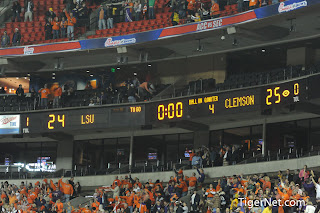
Not a pretty sigh for LSU fans (photo: TigerNet.com)
     I've thought a lot about losses this past week, but not important ones like losing family or good friends or acquaintances. No, this was about my football teams losing.
      One night the Dallas Cowboys' season ended with a loss to the hated Redskins. Didn't have more than 24 hours to stew about that before LSU coughed up the Chick-Fil-A Bowl to Clemson.
      My mood swung from "disgusted" and "disappointed" immediately after the games to "bitter" -- thank you, Phil Rogers -- in mid-week to "reluctant acceptance" by Friday. I think I'm at the "that's life" stage now.
        Note that "crushed" was not one of those moods. (Read on.)
         The Cowboys, no big surprise. Never felt they were a playoff-caliber team, and I have no confidence in the owner/general manager/absolute joke and not much in the "I'm going to make a big mistake when you most need me" quarterback.
        As I said many times this fall, this is Murphy's Law's franchise ... whatever it takes to lose, the Cowboys will do. Poor free-agent signings, injuries to key players, incredible (and sad) off-the-field incidents, bad bounces.
        In the 1980s, Jerry Byrd at the Shreveport Journal used to laugh and loudly proclaim that the Cowboys were "losers, losers, losers." It wasn't that way in the early to mid-1990s, but since then ...
        (I could write a whole blog on the Cowboys, but I won't. Don't want to waste your time, or mine.)
        LSU's loss was more of a surprise, but not a big one. Clemson thoroughly outplayed LSU for most of the game and, let's face it, LSU was very fortunate to win several games this season (Auburn, Texas A&M, Ole Miss, Arkansas, even Towson). Close escapes -- even, luck? -- have been the trademark of Les Miles' entire coaching stay at LSU. Talent, too, which is why Miles has a terrific record.
          Take it the other way, and the Tigers -- with a play or two more -- could've beaten Alabama and certainly Clemson.
           Anyhow, it didn't end well, and the LSU offensive play-calling left us befuddled once again, and so afterward, one of my Facebook friends -- and he knows who he is, and so do his friends -- posted that he had been an LSU fan a long time, but he was burning all his LSU clothes and memorabilia and he wanted Les Miles and his staff gone.
             And that's what triggered this blog piece. I've had this writing this in mind for a while. Because if you're a fan -- of teams and individual athletes -- you will remember the losses that did fall into the "crushed" category.
---
           I have seen the Yankees lose the World Series eight times (not counting '55 -- the one Pete Alfano and Brooklyn loved -- before we came to the United States). I have seen them lose in the bottom of the ninth inning twice (1960, Bill Mazeroski, and 2001, Mariano Rivera's blown save at Arizona). That's "crushed."
           I have seen them lose in the AL playoffs 11 times, including blowing a 3-0 lead in the 2004 ALCS to some team. Seen them swept four times (Dodgers, 1963; Reds, 1976; Royals, 1980; Tigers last year). Seen them lose to inferior teams more times than I want to remember.
            I have seen the Cowboys lose in the playoffs 24 times, starting with the last-chance interception vs. Green Bay at the Cotton Bowl (1966 season), the Ice Bowl and Bart Starr's sneak (Jerry Kramer false-started) in 1967, the two Super Bowl losses to the Steelers in the '70s (at least Terry Bradshaw was the winning QB), The Catch by the 49ers' Dwight Clark in 1981, three losses to the Redskins, Tony Romo's bobbled PAT in Seattle. Heartbreakers, all.
             Super Bowl V -- the Blunder Bowl -- deserves its own paragraph. A superior Cowboys team gave away the game to the Colts, with help from umpire Jack Fette. Craig Morton threw the two fourth-quarter interceptions, the last one by Colts LB Mike Curtis to set up Jim O'Brien's winning field goal with 0:05 remaining. Most awful Cowboys' loss, period.
             Louisiana Tech's two great comebacks in football this season, against Texas A&M and Utah State, only to fall short at the end. Tech's men losing to heavily favored Oklahoma in the NCAA basketball tournament in 1985 when Waymon Tisdale's winning shot bounced on the rim three or four times before going in. Tech's women losing the 1994 national championship game in the final second when North Carolina threw in an improbable 3-point shot.
               LSU's semifinal losses in each of its last three men's Final Four appearances, twice to Indiana ("disgusting" considering the coach of the other team).
              The Dallas Mavericks blowing a 2-0 NBA Finals series lead and a 15-point lead in Game 3 against the Miami Heat in 2006. I was a Lakers' fan in the 1960s and early 1970s -- because I was a Jerry West fan -- and they kept losing the NBA Finals to the Celtics and then Knicks, sometimes in incredible fashion.
               Right now, our Mavericks are working on a 10-game streak of overtime losses. Painful to watch, or not watch.
              Centenary basketball: Robert Parish (No. 00) missing two free throws with 0:00 on the clock and the Gents losing by one point to nationally ranked Houston at the Gold Dome.
              Greg Norman -- Bea and I were fans -- blowing his six-shot lead in the '96 Masters. Thirty years earlier, Arnie blowing a seven-shot lead and losing to Billy Casper in the U.S. Open. Some tough losses by Shreveport's Hal Sutton and then by Shreveport's David Toms three years ago at The Players Championship.
                 Muhammad Ali getting knocked down in the 15th round and then losing -- for the first time as a pro -- to Joe Frazier in their first "Fight of the Century" on March 8, 1971, maybe the most exciting sports event I've ever seen.
               How about the Team USA's first-ever Olympics basketball loss -- the absolute robbery in Munich, 1972?
              I saw Woodlawn lose a state championship football game, in the rain with Terry Bradshaw at quarterback. Saw Woodlawn lose a state championship basketball game, with Robert Parish at center. Woodlawn also lost four times in the state football semifinals, and one other time in the boys basketball finals.
              The most "crushing" loss of all for me: West Germany 2, Holland 1, in the 1974 World Cup soccer championship game. We had the best team, one of the greatest teams ever.
              But just to get crushed even more, Holland lost the 1978 World Cup final to Argentina, in  overtime, in their stadium, with a frenetic home-country crowd. Our Dutch team played with honor.
              To complete the triple play of World Cup title-game failures, there was the 1-0 overtime loss to Spain in 2010 ... on the day of my mother's memorial service. OK, we didn't have the best team that day, but I was very proud of our team throughout that whole tournament.
---
            And so, back to LSU football. Was there ever a more crushing loss than at Tennessee in 1959 when -- the week after Billy Cannon's famous punt return on Halloween night against Ole Miss -- he was stopped short on a two-point conversion late in the game.
            LSU, the defending national champion ranked No. 1 and winner of 19 games in a row, outgained Tennessee 334-112 and led in first downs 19-9, but missed a couple of short field-goal tries. The Vols won 14-13.
            That's "crushed."
            All those losses to Ole Miss in the '60s, including 37-3 in 1963 and the two games when Archie Manning flat-out beat the Tigers (including the only loss in 1969). In fact, any loss to Ole Miss.
          The last-minute 78-yard pass by Texas A&M in 1970; we saw it again in Nick Saban's last game, last play as LSU coach -- Iowa's 65-yard pass to win the Capital One Bowl in Orlando.
           The two triple-overtime losses, to Kentucky and Arkansas, by the 2007 team that still won the national championship. The two passes totaling 81 yards in the final minute by Arkansas for the touchdown and PAT kick with 9 seconds remaining in Little Rock at 2002 that kept LSU from clinching the SEC West title. The 69-yard drive by Arkansas for the touchdown and PAT kick with 21 seconds remaining in Little Rock in 2010, another one-point Tigers loss.
         The five fourth-quarter interceptions -- three returned for touchdowns -- by Auburn to wipe out LSU's 23-9 lead in 1992. LSU could have snapped Auburn's 14-game winning streak.
          Was anything worse than Ole Miss' 21-0 Sugar Bowl win in the 1959 "replay" game? Yes, Alabama's 21-0 win last year in the BCS Championship Game -- also a "replay" from the regular-season LSU victory.
           I have seen LSU lose 17 postseason football games. You think the loss to Clemson was that bad?        
           So there you have my Legacy of Losing (I can match it with a Legacy of Winning; that's another blog soon.) I assure you this: The losses still feel terrible. That will never change as long as I'm a fan.
            I'm not much of a good loser, and I don't want to be.
       

Monday, December 31, 2012

Gratitude for an old year, and a new one

          As I start this blog, there are seven hours left in this year. It is an hour-and-a-half until kickoff of the LSU-Clemson game, the Chick-Fil-A Bowl in Atlanta -- and appropriate finish for my sports year.
           I am also on the last page of my 2012 calendar, which -- as mentioned in a previous blog -- I used to write a daily gratitude. My wife encouraged that, and the other day, she asked if I was going to continue in 2013.
          And I am. Plan to do it in a different format -- such as a notebook -- but the idea is to stop daily and make note of something, or someone, that impacted life that day, or maybe that week.
          So my last gratitude of 2012 is for ... my gratitude journal. I'm saving it because Bea says it'll be fun to look at it again, say, three years from now. OK.
          In short, though, there is so much for which to be grateful, mostly family and friends. Facebook has its advies and disadvies -- as my close friend John W. Marshall III coined it years ago -- but the connection with old friends is, for the most part, a plus.
          One of the great pleasures of the past year was seeing old friends, some of them for the first time in many, many years. Can't express to you how good that feels. Going to Bea's high school reunion in Ringgold, La. -- where I knew only a few people but one of them was one of Louisiana's top basketball players of the early 1960s -- was a good day.
          Saw a lot of old familiar faces, too, in a more somber situation -- the visitation and then funeral service for our great friend, Dr. James C. Farrar ... Coach Farrar. He touched us all in a positive way.
          These days there are always too many old friends listed in the obits, and too many funerals.
           Our toughest days this year were Feb. 23 -- the day Bea's only brother, Howard (my age, two years younger than Bea) -- died (not unexpectedly) and Feb. 27, the day he was buried in central Texas.
 ---
            As the year closes, we're into a new phase, as I wrote last week. This is the ninth day of my retirement, not that I'm counting the days. And I'm bored.
            No, just kidding. It's a good life.
Our "big three": Kaden, Jacob and Josie
            Nothing boring about having my three grandkids together, which happens only a couple of times a year. It was -- as I put on a Facebook post Saturday -- a loud, busy afternoon in our little apartment. These three -- Josie, 5; Jacob, 3 (almost 4); and Kaden, 1 (almost 2) -- are lively, but they got along beautifully.
             If every day was as good as Saturday, Bea and I would be content. She adds, "also exhausted."
             So people have suggested I will be bored, and have asked, "What will you do with your time?"  Do not worry, I have told them, there is plenty to do.
            I have eight books sitting to my left that need reading; they have been sitting there for two years. I have an electronic picture frame that needs putting together, and the pictures on my computer that need organizing, so that the frame can function. Because my daughter is an avid scrapbooker, I could do scrapbooks -- many scrapbooks -- with the hundreds of career clippings, photos and memorabilia I have collected for 50-plus years.
            I have my daily walks -- through the TCU campus and around the nearby neighborhoods, looking for money that's been left on the streets and in drivethroughs and parking lots (it's a lucrative business, at times).
            If it's too cold or too wet, the walks are on the boring treadmill (but the workouts are more intense). Really should do that more often if I want to maintain the 155-pound level for which I am. Because we pay more attention to what we eat -- and cut out a lot of the sweet and white stuff (cake, ice cream, cookies, mashed potatoes, white bread) -- I lost 20 pounds about two years ago. Still, I could do better when it comes to sweets.
             We plan to travel some. We'd like to see Chicago and San Francisco and Boston and New York City again (the new Yankee Stadium sounds good, if someone will give me a ticket), and one goal for me is to make it to Cooperstown when Derek Jeter and Mariano Rivera go into the Baseball Hall of Fame. Never been to Cooperstown.
               But our immediate travel goal is another trip to my home country, The Netherlands. Maybe in late April/early May when the tulips bloom. We're thinking of taking a river cruise so we can see a lot of the country. We'll see.
                Travel takes time, and money, and energy. We have the time. The money and energy ... hmmm. When we went back to Hawaii -- where we lived in 1980-81 when I worked for The Honolulu Advertiser -- we never did get over the jet lag. Still trying to get over it.
              And, of course, we'll be going to Knoxville, Tenn., a couple of times a year, hopefully, because that's where Josie, Rachel and Russell are. Plus, there will be plenty of trips to "new" McKinney, an hour away to see Jacob, Kaden, Ann and Jason.
              Also, what will keep me going is this ... the blog. Started it in late January a year ago, and it's been fun. It's a personal blog, my memoirs, I suppose, and a way to recall the events and thank people that have been important in my life.
               Sometimes it's a way to get on the soapbox and express my feelings. Of course, a lot of it is about sports and newspapers/journalism because that's what I know, that's who I am. Broke a personal rule and delved into politics a couple of times, and that irritated some people -- to say the least -- but so be it.
              Mostly, though, it's been fun to see the reaction and the feedback. It's been well-received and I thank you. How's that for gratitude?
              Happy New Year to each of you.


Sunday, December 23, 2012

One word: Retired

    "And so it has come to this. I am one of the lucky people in the world. I found something that I always wanted to do, and I have enjoyed every single minute of it."
---
     Borrowed the quote above from the last Tonight Show appearance by my favorite all-time television performer, Johnny Carson, in May 1993. Today it fits for me.
     My sportswriting career is finished. I am done.
     No more comebacks, even parttime ones. I thought I was done in May 2011, when I was part of the fifth layoff at the Fort Worth Star-Telegram in 3 1/2 years.
    I said then that my fulltime career was over. And it was.
     But because I wanted to cover high school football in the fall of 2011 and again this fall, and because there also was parttime work available inside -- on the desk, in newspaper parlance -- I worked four months at The Dallas Morning News and almost all this calendar year back at the Star-Telegram.
      One or two nights a week -- sometimes three nights -- wasn't a bad deal. Little pressure, and good people around. And the papers paid me.
     Covering high school football these past two seasons, at some fabulous facilities and some ordinary ones, was a blast. Texas high school football -- Friday Night Lights -- is as good it gets, if you love covering the preps ... and I always have.
      My last desk shift was last Monday, a tough five-hour grind right to the deadline. Edited my last story, wrote my last cutline, my last headline. Done. See you.
The last media credential
of my career.
      My last act, my last game, Saturday afternoon, the Class 5A Division II state championship game -- Cedar Hill vs. Katy -- at the fabulous Cowboys Stadium. Wow. What a finish. I wrote the story, and I checked out of a career.
       And I'm happy; I'm satisfied. There was a little sadness this past week, but not much. I've had enough.
---
      Several people the past few weeks have suggested I would be calling next fall asking to cover games again. Several have said I will miss working, will miss the newspaper business.
    No, no and no.
    I told Bea early this year that this would be my final year, my final set of games. I don't see as well, I don't hear as well, I don't sleep well after I work, I get tired more easily. 
     Covering high school football, as much fun as it was, is more difficult these days. The games are so fast-paced, the scores are so much higher, there are tweets to post, and stats to compile and enter into the computer, and there is -- always -- a deadline to meet. 
      I found I could still do it, and I still worked at it as hard as ever. Got there early, explored the stadiums and met people, and stayed late. Did two stories: (1) a version for the next day's newspaper; (2) a longer, more detailed -- with quotes -- for the paper's web site. Happy to do it. Loved the action.
       Glad to be done. Lots for which to be grateful. I'm certainly blessed.
---
       Can't say that I loved every single minute of my career; sounds good, but I don't believe that was true even for Johnny Carson. 
       In almost 50 years -- from the time I first walked into The Shreveport Times sports department when I had just turned 16 -- there were lots of tough times. Most were self-inflicted.
      I went from job to job because I got tired of some people and misbehaved, and they got tired of me. I was told to move on more times than I could have ever imagined. But if you believe that most everything happens for a good reason -- and Beatrice has convinced me this is true -- I found that change can be good.
       We went from Louisiana to Hawaii back to Louisiana, to Florida, to Tennessee and finally to Texas. I worked for seven daily newspapers, one college, and three pro baseball teams -- some great jobs ... and some jobs.
        I was never enamored with upper management in the newspaper field, never one to totally follow the rules. But I will say that upper management at the Shreveport Journal and The Honolulu Advertiser were the best and, with few exceptions, management in the sports departments where I worked was wonderful.
          Lots of people helped me along the way. Don't even want to start to name names; just too many people, and I don't want to slight anyone. Some people saved my career; I hope they know who they are. Most people enhanced it. I tried to learn something from everyone; I hope I passed on some knowledge/advice.
        I had some management roles; some were easier than others because I was working with great people. Shreveport Journal sports for much of the 1980s was the best group, the most fun; the Star-Telegram -- I arrived late in 2001 -- was the best section in which I was involved ... at least for the first half-dozen years. 
         There's lots of thanks all around, but the biggest thanks go to my home folks. My parents ... I miss them. Mostly, though, Beatrice -- who supported me through lots of great times and difficult ones; I can always say I married well -- and my incredible kids, Jason and Rachel, who put up with much more than they should have.
         There's more I want to express, and I'll do that in a couple of days. I've got time. I'm retired.         
      

Friday, December 21, 2012

A coach who should be Fame-ous

Woodlawn was so fortunate to have these two men
as its first head football coaches: A.L. Williams
and Lee Hedges (The Shreveport Times photo). 
   Getting right to what I want to say ...
    (1) A.L. Williams has been one of my best coaching friends -- a great friend, period -- for more than 50 years. If you read my previous blog on him, you already know that.
    (2) He should be chosen for the Louisiana Sports Hall of Fame. He's been on the ballot for several years, but he hasn't been picked. Maybe there's some debate on his credentials, but not in my opinion, of course because ... I'm biased (see point No. 1).
    (3) He should have been chosen for the Louisiana High School Sports Hall of Fame years and years ago. They have been selecting people for 35 years. How in the hell they have overlooked him is a damn travesty. 

    The list of athletes, coaches and administrators for that Hall of Fame is a long one -- and there are many, many people who have been selected with far, far less credentials than A.L. Williams. How have they missed him this long?
    I haven't discussed these Hall of Fame matters with him, because I know he's too self-effacing to promote himself for these honors. So I don't mind doing the promoting.
     He helped win a state football championship in Louisiana's top class as a player; he scored the last five touchdowns for Fair Park's 1952 champions, the only football title in the school's 84-year history.
      He coached a state championship team (Woodlawn, 1968, the Joe Ferguson-led 14-0 Knights). He was part of high school coaching staffs at Woodlawn that won 111 games and seven district titles in a 13-year period (8.5 wins a year). His head coaching record there was 64-25, with district titles in each of his first four seasons.
      He was the track/field coach in his early years at Woodlawn, and in the spring of 1966, nurtured a national record-setting javelin thrower who had to be careful with a sprained right elbow. Terry Bradshaw didn't ruin his arm that spring, but got his first taste of national attention (and had a memorable best javelin effort of 244 feet, 11 inches).
     He was a star running back/defensive back and record punt-return man at Louisiana Tech, led the Bulldogs in scoring three years in a row. He was a part of two conference championship teams; the 1955 team, whose only loss was by one point, is considered one of the school's greatest.
     He was a star track man, too, part of relay teams whose school records stood for a decade, and also a long jumper/triple jumper. He is in the Louisiana Tech Athletic Hall of Fame.
    He was a college head coach for 12 seasons -- eight at Northwestern State, four at Louisiana Tech. His team played for the Division I-AA national championship at Tech. He was an innovator; one of the first in Louisiana to go to almost all-out passing game.
     And I believe this: He did it the right way; he tried to play by the rules. He made it fun for the coaches, and the players, and the parents, and the fans.
     He very much bought into the philosophy/teaching of two of his mentors, Joe Aillet (Louisiana Tech) and Lee Hedges (Woodlawn), and the coaches who had guided him at Fair Park -- F.H. Prendergast, Roy Wilson and Clem Henderson.
---
    If A.L. Williams is nominated for the Louisiana Sports Hall of Fame just as a college coach, I can see where he might not qualify. The final record was 66-65-1.
     Those of us who know realize that he came into a Northwestern situation where his first two years there -- the first as an assistant -- were 1-10 seasons. So he rebuilt that program, developed a bunch of NFL talent (Bobby Hebert, Mark Duper, Joe Delaney, Sidney Thornton, Petey Perot, Gary Reasons, Victor Oatis) and made it a respectable program.
       He also had to rebuild much of the Tech program his first year (1983), but by the next season, the Bulldogs were playing in the I-AA national title game. Still, consecutive records of 10-5, 8-3 and 6-4-1 weren't enough to satisfy some of the Tech folks, and he chose to leave after the 1986 season rather than -- as had been suggested -- fire some of his assistant coaches.
       One of those coaches was Billy Laird, the offensive coordinator/play-caller who was being criticized (but probably not to his face). Laird had been Woodlawn's first star quarterback, close to Coach Williams since 1960, and on his staff for seven years. No way was A.L. about to let Billy, or others go; he took the fall himself.

       Dr. Pat Garrett was chairman of Tech's athletic council then and what he said when Williams' resignation was announced still rings true with me.
       "His worth to Louisiana Tech cannot be measured," Garrett said. "He was asked to come here and return stability and integrity to the football program, and he's done that in Tech fashion. And he's done it with style and class and often under adverse conditions. A.L. Williams is a winner."
 ---
        Look, A.L. has his opinions, his views on how things should be run -- especially how athletic programs should be run. He'll speak his mind, although almost always tactfully.

       For years, he was critical of the administration and some boosters at Louisiana Tech because he felt that Joe Aillet -- a man and coach he (and many others) revered -- had not been treated respectfully enough in his final years at the university.
       His coaching/teaching style was thorough and generally low-key -- if you saw players being abused or you heard profanity on the field, in practice or in games, by anyone, it was rare.

       But I have seen A.L. lose his cool. In fact, I've experienced it.
       We didn't always share the same view; he once got on me fiercely about a column I'd written and I'm sure there were other times when he held back. (Of course, John James Marshall says that people disagreeing with me is a long list.)
      People have been critical of A.L. to me directly, or I have heard it second-hand. I listened to those opinions and took them in. Didn't say I agreed. Because I know the man pretty well; I know where he's coming from; I believe I know his values.
      And if you ask me (and no one did), I will say that for all he did -- as an athlete and a coach, as a leader and a contributor -- he's a Hall of Famer.   
     I haven't been on the Louisiana Sports Hall of Fame selection committee since I left the state in 1988. I know there are great candidates every year. But I know one person I'd choose if I had a ballot next August.
     As for the Louisiana High School Sports Hall of Fame and whoever makes those selections, people ... how have you missed A.L. Williams all these years?        
    Don't mean to be overdramatic, but that might be the biggest oversight in the history of Louisiana athletics.