Showing posts with label Shreveport Captains. Show all posts

Monday, August 1, 2022

That's the old ballgame, Shreveport -- a book for sale!

           Happy to announce That's the old ballgame, Shreveport has been published, and is now for sale.

      I have the first three copies -- they arrived today -- and can tell you that the type is large enough for easy reading.
       It is 231 pages of Shreveport and North Louisiana pro baseball history. Many photos and capsules on the players and officials significant to the teams that represented Shreveport, the city's ballparks, and the area players who played pro ball -- in the majors and minor leagues.
---
       When people suggest that writing this book has been "a labor of love," they are correct.
       Loved doing it, the writing and even moreso the research. Proofreading was a task. To the final read, there were corrections to make.
       And, yes, it was a labor. Putting together the book -- formatting it -- took the first seven months of 2022. No technical wizardry here; let's say that the Publisher and Word programs often were more in charge than the formatter.
       But with lots of help, it is done. Thankfully.
       Going back even further, the project began four years as a series of chapters on my blog, Once A Knight. But much material was updated and corrected, and there are many more photos than in the blog series.
        While finishing up in the past couple of months, three of the 1959-61 Shreveport Sports passed away -- Dave Wickersham, Frank Cipriani and the popular Leo Posada. Sad, but all were in their 80s. We updated their player capsules.  
       So many great names in this book, many great memories ... and the issues that led to the demise of pro ball in the city. 
---      
       Two ways to buy the book:
       (1) You can buy the book on Amazon ($35 per copy, plus shipping costs);
       (2) Preferably, you can buy the book from me. Let me know, and I will order it and then send it to you (send $35 and your mailing address).
       (To be honest, we benefit more if you order through me. Amazon Publishing, which printed the book, gets a greater share with a direct order.)
       But who's counting?
       Here is the link to the Amazon order page, if that's the way you want to go:       https://www.amazon.com/dp/1791838391
       Hope you will be interested in the book. 

Monday, August 12, 2019

That's the old ballgame Shreveport, chapter 30 -- A personal journey

    Chapter 30
      A personal journey
The writer, as Shreveport Journal executive sports editor, covering a Shreveport Captains game at the old, roofless
 SPAR Stadium in 1982. (Photo by Louis DeLuca, Dallas Times-Herald
     Baseball was my first American sports love, and it still is.
     From the time we first saw them, we loved the Shreveport Sports. Then we loved the Shreveport Captains.
     Over about a 40-year period -- boyhood to middle age -- those were our teams. 
     The Gassers and all those previous team nicknames? Too soon.
     The Swamp Dragons and the independent teams that followed? Too late. By the time they came along, we had left town. Soon, so had professional baseball.
     Too bad, and kind of sad.
     The players who represented professional baseball in our hometown,  who wore those white home uniforms with "Sports" or "Captains" across the front or the (usually) gray road uniforms with "Shreveport," those were our boys of summer (young men actually, although some were close to 40).
     And the ballparks, those were our home parks. Countless hours spent at each of those places.
     First, Texas League Park-turned-Braves Field-turned SPAR Stadium -- never "beautiful," but functional through the 1950s and '60s and a decaying facility in the 1970s that was a near-wreck into the mid-1980s. 
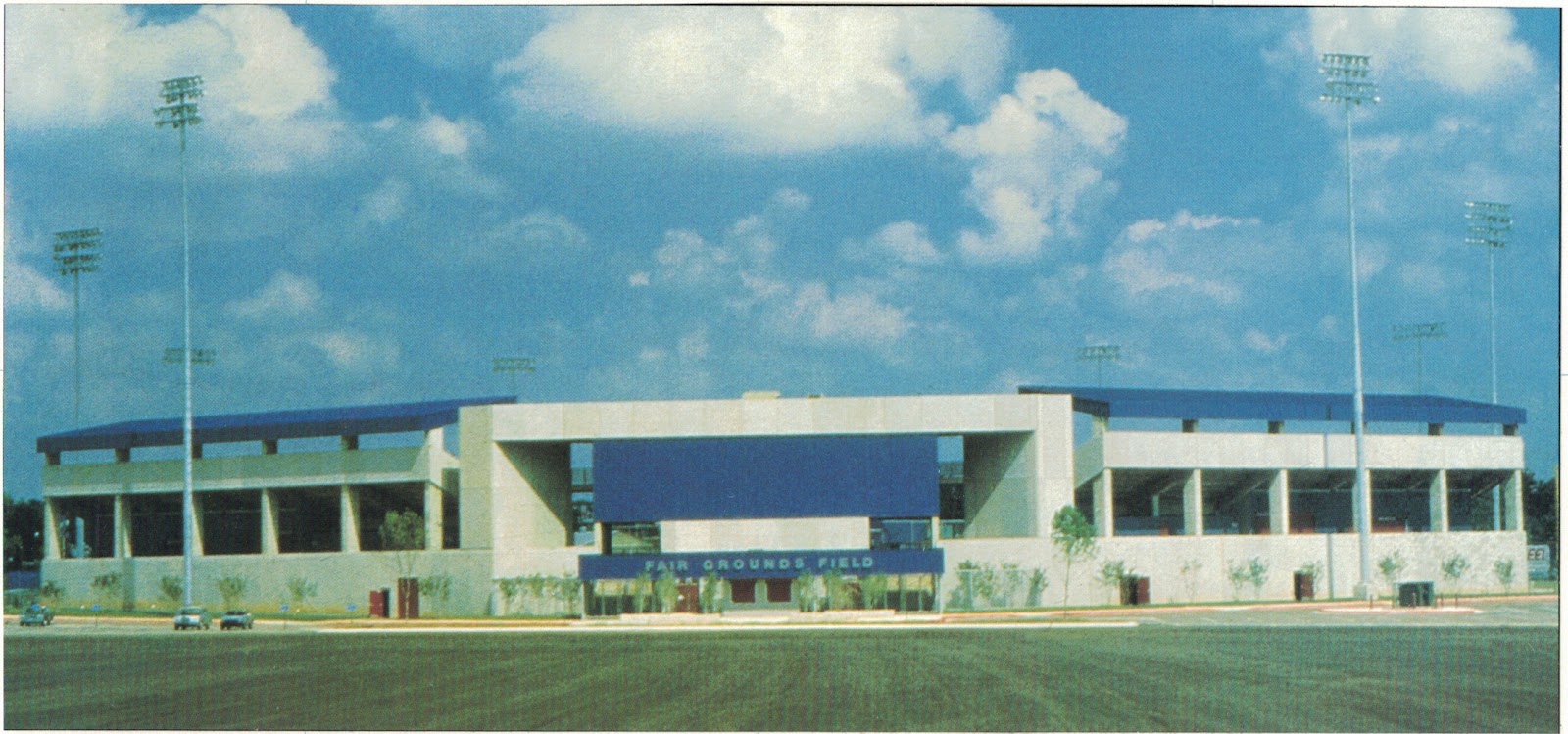
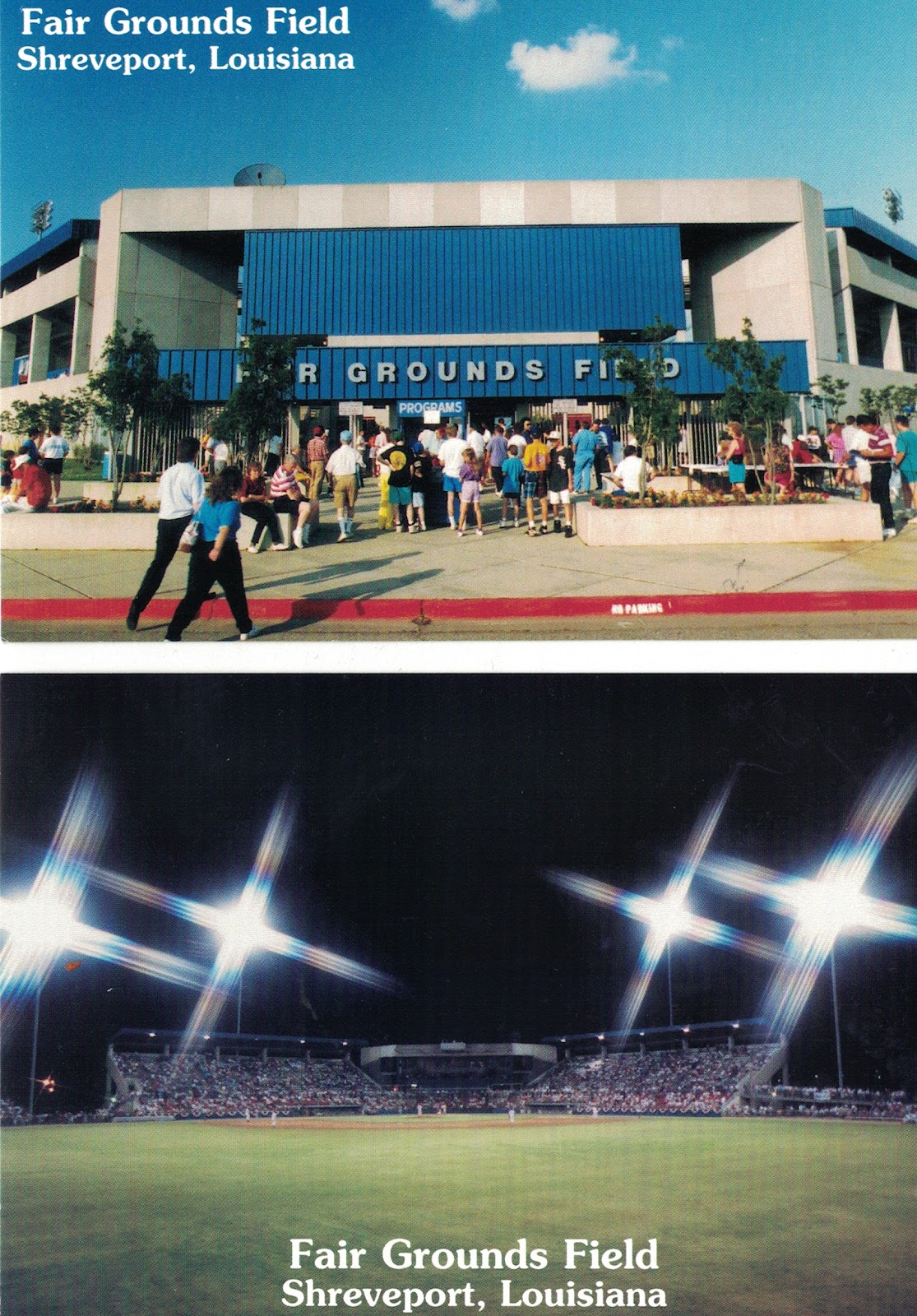
     Then, the new concrete Fair Grounds Field, so nice at its opening in 1986, so visible from Interstate 20. And for 17 years, home of Shreveport's Texas League team. For another nine, home of independent-league teams.
     And then gone ... a pro baseball void in Shreveport-Bossier that soon enough will be a decade long.
A ballpark still standing by I-20, but -- honestly -- an eyesore, even from a distance. Can it be put back into playing shape? Doubtful. Too expensive, too much negativity.
Maybe someday ... a fix, or a new ballpark. Difficult to see it in the near future.
     But once upon a time, following those Shreveport teams was a magical journey for us, and a totally unexpected one. Because before 1956, baseball indeed was a foreign subject for me.
 ---
     We came across the Atlantic Ocean on a boat as 1955 became 1956, and the hottest topics that first year in the U.S. were Elvis Presley, Mickey Mantle, Ike and, for us, the Mickey Mouse Club. 
     To think, the Brooklyn Dodgers -- for the only time in their history -- were the defending World Series champions. Did not realize then how much misery the New York Yankees had dealt them over the years.
     But Dodgers, World Series, Mantle, Yankees? All new to me. Baseball? Did not know the second thing about it.
     The first thing: It was a game that in the old country, The Netherlands, was called honkbal. A minor sport there. We had read (in Dutch) about it, but never seen a game.
     The kids on the elementary school grounds here, though, played baseball at recess and speedball -- same game, rubber ball (a bit bigger than a hardball). So, after rudimentary introductions to speaking, reading and writing English, came some of the basics of the game.
     Found out a couple of things pretty quickly: 
     (1) Hitting a ball with a wooden bat was not all that easy, especially when -- as Bill McIntyre would write in The Shreveport Times a few times in future years -- pitches were fired in anger; 
     (2) If you lined up in the catcher's position, without benefit of a mask, and got too close, the wooden bat could hit you in the face. A few weeks into the experience that meant a severe black eye, but luckily no further damage.          
     Slowly that first spring and early summer, we would begin hearing about the Shreveport Sports. A professional baseball team in our city, and Dad's company had tickets for games at the stadium. His bosses, hearing of the son's sports interests, suggested we take the tickets and go to a game.
     We lived close enough to the ballpark in the old Allendale neighborhood that -- without benefit of a car -- we could walk, and be there in about 20 minutes. Down Jordan Street to a right on Southern Avenue, then across the railroad tracks toward downtown, and soon enough, a few blocks away, you could see the stadium light poles behind the fence in right field.
     Can close my eyes and see that scene, and remember the thrill. It was almost -- not quite, but almost -- like going to Olympic Stadium in Amsterdam (also within walking distance of our little house there).
     Hello, Texas League Park, 1956.
     Recall going in the front gate and then seeing the ballfield and the stands, the Sports in their home white uniforms, the Dallas Eagles in the visiting grays. The date -- researched this in The Times files -- was July 8, the only Sunday game the Eagles played in Shreveport to that point in the '56 season.
     And I know, I remember, it was the Eagles as the visiting team.
     Do not think, however, that I was aware of how special a season 1956 would be in Shreveport, or how special one player -- home-run hitting phenom Ken Guettler -- was that season.
     By that Sunday, Guettler had hit 33 home runs -- past the halfway mark of the Texas League record (55). 
     He did not hit one that Sunday, but he would make history, earn his forever place in Shreveport baseball lore -- and make the cover of this book.
     We sat in the upper grandstand, Dad and I, two of the 1,319 paid for the game. We were about 10 rows up just to the right of home plate, but enough so we could see into the home-team dugout on the third-base side. In Shreveport, the home team side was always on the third-base side.
     No one was more enchanted by baseball than I was that day. It was instant love.
     Maybe it was the first inning -- Dallas scored three runs, then Shreveport scored five. (The Eagles ended up winning 8-6, but that did not matter much to us then.)
      Could not always figure out exactly what was happening in the game (although it was easier to learn than American football), but I loved the pitcher-batter battles, I loved the speed of the baserunners, loved the mixture of white-and-gray uniforms -- and loved the red and blue trim of the Sports' colors (especially the two-tone hat) with the "S" logo.
     Along with the Sports, I found another favorite team because they were on television a lot -- once we got a TV -- and in the news. The pinstriped home uniforms were unique, eye-catching. Lots of interest, I discovered, in the Yankees and especially the center fielder, No. 7. It would be Mickey Mantle's greatest season, so it was natural to become a fan of the player and the team.
     Think we went to one more Sports game that summer, but by the next year, Dad's company had box-seat tickets, so we went often -- although attendance had fallen off dramatically -- and I remember Dad proudly leaning over the railing on the third-base side to scoop up a couple of foul-ball grounders. Never an autograph seeker, I took those baseballs and used them on the playground.)
     By the next year, I had a Shreveport Sports cap and a yellow-and-blue Sports T-shirt.
     It was disconcerting to learn that there would be no Sports in 1958; the ballclub left town. Did not really understand the reasoning then -- a ban on integrated games was a huge issue -- but was delighted when the Sports' franchise came back to life in 1959 ... in the Southern Association.
     So, it was the 1959-61 Sports -- a Kansas City Athletics' farm team -- with which we most identified. Found a player who, other than Mantle, became a personal favorite -- a 19-year-old second baseman, Lou Klimchock, "Baby Lou" to the Shreveport media. 
     He was terrific that season and he wore uniform No. 4 for the Sports. And for the four years in which I played at baseball -- not well, at all -- my uniform was No. 4. (Also liked the Yankees' No. 4, Lou Gehrig, subject of the first book I read in America.)
     Those Sports players -- Peden, Posada, Grunwald, Slider, Ward, Hankins, Hunt, McManus, Howser, Wickersham, Spicer, Pfister, Blemker, Black, Davis and Davis, Parks ... I could go on and on -- were magic for me. Followed their career paths in their years after Shreveport.
     Tough to see the ballclub leave again after 1961. But the ballpark became a close friend -- as a scorekeeper for high school, American Legion and recreational ballgames, and sometimes P.A. announcer, too.
     When pro ball returned in 1968, I was a college junior and one of our Louisiana Tech friends, basketball-baseball star George Stone, started the '68 season pitching for the Shreveport Braves (in the Atlanta Braves' organization). As he commuted to home games, we came with him several times in the early season.
     He was on his way to the major leagues; that year, in fact. I was on the way to a sportswriting career.
     That summer, 1968, among the assignments as a Times intern a half-dozen times was coverage of Shreveport Braves' games (with that came the official scorer role). The next summer it was a fulltime position -- and frequent Braves/Captains stories and columns for almost the next two decades.
     From that standpoint, it was less being a fan and more being a reporter. But still, it was -- as it had always been -- a point of pride in seeing Shreveport in the standings (yes, it was in bold in the newspapers). It looked especially good at the top of those standings.
     However, I always felt like a jinx for Shreveport teams. In the years I lived there (1956-1988), there were this many league championship teams: zero.   
     In the four years before we arrived, the Sports won two Texas League playoff championships (1952, 1955) and one regular-season championship (1954). Two years after I left for good, the Captains won the first of back-to-back championships (1990-91), and then they won again in '95.
     Oh, well.
     Another point of pride was identifying former Shreveport players and/or managers as they moved on, many to the major leagues, some as big stars. For a short time in their lives, they were our guys.
It was tough, but understandable, to see the demise of pro baseball in Shreveport starting in the year 2000 when the ballclub -- mostly locally owned for some 25 years -- was sold to corporate interests. Personally, the independent-league teams that followed were not of much interest for someone living out of state.
But the game endures, without a team in Shreveport. So do memories.
And so does the love for a baseball past in a place that meant so much to us.

Tuesday, June 25, 2019

The Captains' alumni: Where are they now?

    In addition to those ex-Shreveport Captains who have remained active in Organized Baseball (listed in chapters 21 and 23 of That's the old ballgame Shreveport, here is an update on some of the managers (chapter 20) and players from the Shreveport teams in the mid-1980s, '90s and into the 2000s.
 ---
MANAGERS

 
   FRANK CACCIATORE -- After a decade in the Philadelphia Phillies' organization, the last several years as hitting coach for the Class AA team in Reading, Pa., he was let go following the 2018 season.


    DUANE ESPY -- After 16 years as a coach and manager in the Colorado Rockies' organization, including the big-league team's hitting coach in 2017-18, he was let go after the 2018 season.


    BILL EVERS -- After almost two decades in the Tampa Bay Rays' organization, he joined the Minensota Twins' coaching staff (under first-year manager Rocco Baldelli) for the 2019 season, working with catchers.


     BILL HAYES -- The Giants' minor-league catching coordinator in 2018, he returned to managing with Class A San Jose in 2019.


   SHANE TURNER -- In his 22nd year in the San Francisco Giants' organization, the last four as director of player development.


     RON WOTUS -- In his 20th year on the San Francisco Giants' coaching staff, his third year as third-base coach.
    

PLAYERS
     TROY BROHAWN (LHP, 1996-97) -- After his pro career, he has coached baseball in high school and from 2015 to 2019 as head coach at Salisbury (Md.) University.


NATE BUMP (RHP, 1999) -- Lives
in the West Chester, Pa., area and
works for Johnson and Johnson in
the sports medicine field.


JAY CANIZARO (2B, 1995, 1997-8) -- Vice-president of an oil and gas
business in the Houston area.

ROYCE CLAYTON (SS, 1991) -- In 2019, he was baseball coach at Oaks Christian School in Westlake Village, Calif., near Los Angeles.

     DENNIS COOK (LHP, 1987) -- After his pro career, he went to Sweden -- his mother's parents were from there -- and coached the Swedish national team, and he also had coached in Germany and Italy. He and his family reside in Austin, Texas.

     DEE DIXON (OF, 1987-89) --  After baseball, he established the Andrew Dixon Foundation to teach baseball and life skills to youngsters in his native Jamaica.

    GEORGE FERRAN (RHP, 1985-86) -- A resident of Billingham, Wash., in 2014-15 and 2018, he was pitching coach for the Everett (Wash.) Merchants.


JOE FONTENOT (RHP, 1997) -- In July 2014, he was named baseball
coach at Loganville (Ga.) Christian Academy.


DEAN FREELAND (RHP, 1986-89) -- After baseball, he returned to earn his degree at University of Wisconsin. For more than a decade has co-owned and operated a company that manages therapy services, and for five years has been head softball coach at Cambridge (Wisc.) High School.


JASON GRILLI (RHP, 1998) -- Born in Detroit when his father pitched for the Tigers, he now resides in Pittsburgh, where he had some of the best years of his MLB career as a reliever.

ERIC GUNDERSON (RHP, 1988-90) -- He returned to the area where he grew up -- Portland, Ore. -- and for several years was the baseball coach at Jesuit High. He lived across the river in Camas, Wash.


STEVE HOSEY (OF, 1991) -- He has lived in Fresno, Calif., for more than 30 years and has a real estate business, is director of Parent Engagement and Training for Family Leadership, Inc., and a leader in his church.


BOB HOWRY (RHP, 1986-87) -- In 2018-19, he was the baseball coach
at Phoenix Northwest Christian School.


KEVIN JOSEPH (RHP, 1999-2001) -- In 2018 and 2019, he was pitching coach for the independent-league (American Association) Texas AirHogs, who are based in Grand Prairie.


SCOTT LINEBRINK (RHP, 1998-99) -- Living in Austin, Texas, he is director of stewardship, Southwest region, for Water Mission, a North Charleston,S.C.-based Christian non-profit company that provides safe water and sanitation to at least 52 developing countries.


GREG LITTON (2B, 1986-88) -- After baseball, he settled back home in Pensacola, Fla., and has been a professional speaker.


DAMON MINOR (1B, 1998-99) -- In the off-season, he lives in Edmond, Okla., and is co-owner of a baseball academy where he gives hitting lessons and gives input to summer showcase teams.


DOUG MIRABELLI (C, 1994-96) -- Resides in Traverse City, Mich., where he has been a realtor for Coldwell Banker Schmidt for a decade.


RUSS ORTIZ (RHP, 1996-97) -- He resides in Mesa, Ariz., where he created and operates a golf apparel business.

JOHN PATTERSON (IF, 1991) -- Dealing in real estate in Scottsdale, Ariz.

JIM PENA, left (LHP, 1990-91) -- Located in Chandler and Scottsdale, Ariz., for years, he managed self-storage and U-Haul companies and was a Whataburger supervisor before relocating to Colorado Springs, Colo.

DANTE POWELL (CF, 1996) -- He had a six-year career as a personal trainer and for a time was lead instructor at a batting facility in Signal Hill, Calif.


CODY RANSOM (IF, 1999-2000) -- Lives in Gilbert, Ariz.,
and is owner/instructor of the AZ National Baseball Academy.


MIKE REMLINGER (LHP, 1987-90) -- Based in Phoenix, he is listed as a leadership and excellence coach.

ARMANDO RIOS (OF, 1996-97) -- The former LSU Tiger was back in his home area of Puerto Rico for eight years operating a charity foundation, and in 2019 is listed as a certified senior agent for Octagon, a sports and entertainment agency, in the Chicago area.


MACKEY SASSER (C, 1986) -- In 2019, he finished his 23rd
season as baseball coach and ninth as athletic director at
Wallace Community College in Dothan, Ala. 


BENJI SIMONTON (C, 1995-98) -- Personal trainer/bodybuilder, based in Livermore, Calif.

YORVIT TORREALBA (C, 1998-99, 2000) -- Lives in Parkland, Fla., where he moved his family from his native Venezuela after the 2009 kidnapping of his son and two brothers there. The son, Yorvis, is an outfielder who was drafted in the 20th round in June 2019 by the Colorado Rockies, where Yorvit once played. Yorvis helped lead Tampa University to the NCAA Division II national title.

KEITH WILLIAMS (OF, 1995 and 1997) -- In 2017, he was listed as a teacher at Gateway High School, an alternative education school in Clovis, Calif. He was inducted into the Bedford (Pa.) County Sports Hall of Fame in 2017 as the first major-league baseball player from that county. 

    
     TED WOOD (OF, 1989) -- In Atlanta, associate 
vice president, financial planning specialist
 for Morgan Stanley Wealth Management.


    CHAD ZERBE (LHP, 1999-2000) -- Runs a travel ball organization, Inland Valley Venom, and works with youngsters on fundamentals, primarily pitching. In 2019, he was in his third year as manager of the Redlands 909ers of the Australian Baseball Tour of (California) Redlands.

Monday, June 17, 2019

That's the old ballgame Shreveport, chapter 22 -- Building a ballpark, part II

  Chapter 22
Building a ballpark, Part II
Fair Grounds Field opened in April 1986, the realization of a long-awaited, long-debated ordeal and the revitalization of Shreveport's professional baseball franchise.
    Coincidentally, it touched off a decade of unprecedented success for Shreveport teams -- playoffs in 10 consecutive seasons and 11 of 12, three Texas League championships (1990, 1991, 1995) and a couple of other championship series appearances.
    In 15 seasons at Fair Grounds Field while the team was nicknamed Captains (it changed to Swamp Dragons after the 2000 season), it made the playoffs 13 times, missing only 1996 and 1998.
    Plus, there were record attendances as interest spiked and corporate-sponsored nights produced numerous sellout crowds.         
---
    After years of talk -- idle talk -- site proposals and funding debates, the breakthrough came in 1983. That season the Captains had the best overall record in the Texas League's regular season ... and the lowest attendance. Amid prospects that Bossier City also was interested in building a new ballpark and the Captains could move across the Red River came a viable Shreveport plan.
    John Hussey, in his second year as Shreveport mayor, told Captains' ownership that he would include funding for a ballpark on a large bond proposal for many improvements in the city. The plan, unveiled in September, had $3.5 million proposed for the stadium; the entire bond package was $80.3 million.
    A big plus was Louisiana State Fair officials offering land for a stadium on the east end of the Fairgrounds -- which had been mentioned as a possible site as early as 1977. The Nov. 8 announcement of the site came with a schematic drawing of the proposed facility -- 4,500 seats surrounding a skybox and press box area -- and was coupled with plans to tear down the long-standing auto-racing facility to create more area for the annual Fair's midway attractions and stadium parking.
    Proposition No. 7 -- the stadium complex -- was approved by Shreveport city voters on Nov. 19 by a margin of 1,669 of 29,349 total votes.
    Just less than a year later -- Nov. 15, 1984 -- ground was broken. It was 2.9 miles from SPAR Stadium ... but many miles away in perception.  
    The Captains agreed to pay $8,000 a year for rental to play the 1984 and 1985 seasons at the old ballpark, knowing the franchise would remain in Shreveport, at least for the foreseeable future.
Groundbreaking, Nov. 15, 1984: The Captains' board of directors -- (from left) Taylor Moore, Douglas Attaway,
John D. Caruthers, Loy Moore and Charlie Webb -- do the honors on the east side of the Louisiana State Fairgrounds.
(Captains photo)

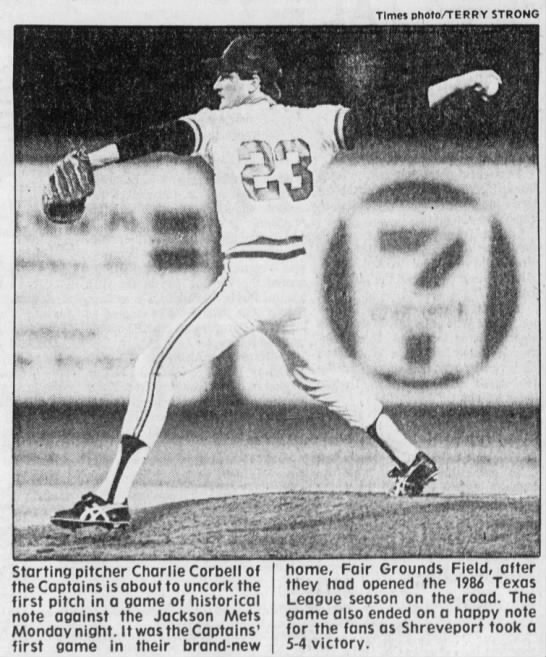
   Stadium debut: Fair Grounds Field's official opening night was April 14, 1986, when 7,213 fans overflowed the stadium (official capacity was listed as 5,200). The Captains rewarded them with a 5-4 victory against the Jackson Mets.
    Charlie Corbell threw the first official pitch in the stadium and pitched the first six innings for the Captains, but the winning pitcher was Scott Medvin, who relieved for one inning.
    The biggest draws in 1987 were the two nights that The Chicken -- baseball's top novelty act of the time, hatched by Ted Giannoulas -- visited for crowds of 7,471 and 7,012.
For the first time -- on Opening Night, 1986 -- the Shreveport Captains line up at Fair
Grounds Field. (Shreveport Journal photo)

      
    Top draw, though, was the Shreveport's major-league affiliate, the San Francisco Giants, who on June 1, 1989, came in for an exhibition against the Captains, and 7,958 fans paid to see it.
    The next season, 1990, the Captains attracted 6,803 for the final game of the first-half Eastern Division race, a championship showdown with the Tulsa Drillers.
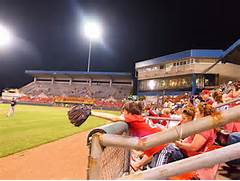
Captains' game nights at FGF (photos from Flicker)

From the air: Fair Grounds Field in 2000