Monday, December 26, 2016

Lambright, Part X: Away from football, a friend, and a logo

      (Part X)
       Maxie Lambright left more than a football legacy at Louisiana Tech University. He left a logo.
       That's right -- a logo. Some people will remember this; most probably don't know.
       Coach Lambright created, designed, the ubiquitous Tech logo still in use today: The state of Louisiana, with the large "T" stretched across the top.
       You see it on brochures, web sites, billboards, hats, clothing, whatever ... it is everywhere.
       "He came out of his office one day [early in 1968] and held out this drawing [on a napkin]," remembered Mary Richardson, who became the football coaches' secretary a few months after Lambright's arrival at Tech. "I asked him what it was.
       "He told me he thought it would be good to put on the football helmets the next season."
       The powers-that-be at Tech approved of it. The head of the university's art department, Raymond Nichols, applied the colors and finishing touches. Done.
       For the first time, in the 1968 season -- a sensational season that established Lambright's Tech program as a power -- the Bulldogs wore red helmets with the "T/state" logo.
       It's been that way ever since, until Tech last season introduced white helmets with the logo.
       It was the first time since the early 1960s, through Coach Joe Aillet's final season in 1966, the Tech helmet was white with a single red stripe down the middle.
       When Lambright came in, he switched to red helmets (no logo, no stripes) for the 1967 season. Plus, the Bulldogs that year often wore plain red jerseys (no stripes) -- not a good look. The next year they went back to the traditional jerseys -- white, red or blue -- with the bold three stripes on the shoulders. Haven't changed that look since.
---
       Lambright in the office, no football involved, was low-key and easy to be around. And he had his set of friends, some dating to his Southern Mississippi days.
       Mary Richardson and Flo Miskelley, who was Coach Aillet's secretary/administrative assistant from August 1965 until he retired in the spring of 1970 and then took over other duties, were Lambright fans.
       "He was absolutely the best boss in the world," said Mary Richardson. "He was happy-go-lucky. Strict on the [assistant] coaches, but with me and Flo, he was absolutely wonderful."  
       And he was a good sport. There was a photo -- used by sports information director Keith Prince in the football media guides several times over the years -- with Mary and Flo on either side of Maxie in front of a chalkboard with a play design (Xs and Os) and the coach with his palms turned up and a sheepish expression -- an "I don't know" pose.
       Mary said Lambright "ran a tight ship [with the coaches]," but at times they would play tricks on him.
       "He was good at what he did, and he was the most personable and kind person."
       Flo Miskelley said Aillet "was totally different" from Lambright. "There was never anybody like Coach Aillet," she said. "He was the perfect gentleman, so intelligent. Always super nice to me."
       It was no different with Lambright. She began working closely with him when he became the athletic director following Aillet's retirement at the end of the 1969-70 school year.
       "He was wonderful," she said of Lambright. "Very kind, very intelligent."
       And he came to trust her to continue to handle the game-tickets operation -- just as she had done for Aillet. And she did until she retired after 40 years in the athletic department; all by memory and on paper; she did not use computers.
       She also became Lambright's de facto athletic director.
       "He leaned pretty heavily on me, like with the budget," she explained. "He was so preoccupied with football for so many months, so [the entire athletic department budget] was a major adjustment for him, pretty difficult.
       "He wanted to take care of football, of course, but he had to be in charge of all the other sports, too -- and women's athletics was just beginning. But he was very careful to spread the money around."
---
       Lambright maintained his friendships from his years in Southern Mississippi. One man was already on the Tech campus when Maxie arrived in 1967.
       Rev. William Stokes, for years director of the Wesley Foundation at Tech, was a high school friend in McComb, Miss., in the early 1940s.
       "He was a fine person; he was the best dancer," remembered Rev. Stokes. "He was in our crowd in high school."
       A cousin visiting from Maryland, and also originally from McComb, asked Rev. Stokes if he saw much of Coach Lambright at Tech.
        "No, he was at one end of the campus and I was at the other end," he said, laughing.
        Rev. Stokes remains in Ruston and -- reportedly -- is past 90. "Let's not talk about age," he said, when asked. Kidded about it, he replied -- just to be sure -- "let's not talk about age."
---
        Another Lambright friend he saw each year when Southern Miss and Tech played in football and, when and if, USM came to Tech for basketball was longtime USM sports information director Ace Cleveland.
        Cleveland's son, Rick, became one of Mississippi's best sports writers/columnists, and he recalled that "Maxie and my dad were great friends. I knew him well. He introduced me to martinis when I was 17 years old.
        "I had the worst hangover in history for the next day's Southern Miss-La. Tech [football] game, which USM won, ruining a perfect [Tech] season [Terry] Bradshaw's senior year (1969).
        "He was a beauty. Highly intelligent. ... He ought to be in the [College Football] Hall of Fame. Can't believe he isn't."
         (Next: Maxie and the Southern Miss ties)
---

         From Tech longtime Tech team photographer Tom ("Temo") Morris: Here is a near complete series of Coach Lambright's logo design used through the years by the Bulldogs, starting with the original ...
No automatic alt text available.

Willie Roaf in 1992
Mid-2000s
Coach Derek Dooley's blue-trimmed T 2007
2013 after the University eliminated the White-T
Coach Holtz's introduction of the white helmet in 2015.
Patriotic logo introduced at North Texas in 2014 and used it since at appropriate games.
At Friday's Armed Forces Bowl.
 

Friday, December 23, 2016

Lambright, Part IX: Maxie and the media

      (Part IX)
      He was an outstanding football coach, no question. Maxie Lambright was far from a media star, and had no desire to be.
      He was -- honestly -- predictable and careful and, well, even dull. But never, to our knowledge, unwilling or uncooperative.
      It just wasn't a priority for him, and that was fine.
      Some coaches do well with the media and enjoy the tradeoff, some offer good material -- quotes, stories, barbs -- and merely tolerate it, some can be harsh, rude, curt or short and openly detest the time and effort it requires.
      Coach Lambright understood the media's role.
      "He was a dream to work with simply because he was so cooperative and allowed me to do my job," said Keith Prince, the sports information director at Louisiana Tech for 25 years, the first 10 (1969-78) with Lambright as the football coach and, for all but one of those years, also the athletic director.
      "In all the years, he was so cooperative and, with me, so gentle. I had so much admiration for him. He gave me such strong support. ... He was always in my corner if things came up."
Keith Prince
     Reporters knew that Lambright likely would not provide great insight to postgame analysis nor engage in much casual conversation.
     "From the media standpoint, he didn't cut them short," Prince said. "It seemed to me that he had less to say when we [Tech] won [games] than when we lost. He didn't want to seem like he was gloating, and that [the team] always had something to work on. He was cautious, and he was never derogatory to other teams. He always praised them.
      "It speaks of his character, his dignity, and his respect for other people."
      Prince knew Lambright so well that he could write stories with quotes from the coach, and that Lambright, when asked, would approve of them. 
      Part of the Lambright mantra, as we recall, was that the next game on the schedule was the most important game of the season.
      Larry White was a student assistant to Prince at Tech in the early 1970s, having returned from a stint in Vietnam. He would go on to cover Tech athletics for a brief time for the Ruston Daily Leader and the Shreveport Journal, then go into sports information with the Southland Conference, LSU, SMU and, for most of his career, the University of Alabama, where he was the SID for the final years of coach Paul "Bear" Bryant's career.
      Of Lambright, White said, "I remember him being so approachable and forthright in speaking with the media (of which there weren't many). I always felt his teams reflected his personality, on and off the field. He was a hard-nosed coach whose persona off the field was totally different. He was a true gentleman."
"Freeway Dave" Nitz
       Dave Nitz became the Tech play-by-play broadcaster for football, basketball and baseball in 1974, so he had five seasons with Lambright as football coach. But Nitz also worked in the Tech athletics ticket office and in sports information for a while.
      "He gave you something to do, and he expected you to do it, but he didn't look over your shoulder, he didn't make sure you had dotted the i's and crossed the t's," Nitz said. "But if it didn't go well, he wanted to know why. ... He was like that with the coaches, too.
      "He was a guy who let you do your job. I always respect that from anyone."
      Nitz got a dose of the Lambright wit related to a softball team that Nitz managed. When he came in after one weekend game and Lambright asked how the team had fared, Nitz replied it had won big. "You must've been playing the Little Sisters of the Poor," the coach cracked.
      Media people who dealt with him or occasionally traveled with him knew they'd have to carry the conversation or deal with mostly silence.
      Nitz, still doing Tech games 42 years later (I hesitate to call "Freeway Dave" a legend, although some do), also recalled driving Lambright to El Dorado, Ark. -- a 50-mile ride from Ruston -- to do a weekly Sunday television show during football season.
      "He didn't really want to do that," Nitz said of the show. But it was part of their job. The tough part was the interview.
      Nitz, as the William & Mary broadcaster in 1969-71, often had interviewed the football coach there, the very talkative, colorful Lou Holtz (now, of course, Nitz regularly talks with the current Tech coach, the son of the father, Skip Holtz).
      "If I asked Lou two questions [for a 30-minute show]," Nitz said, "that was one question too many."
      With Lambright he might have to ask 30 questions in 15 minutes. "Lots of 10-second answers," Nitz recalled. "I had to learn what to do [to interview him]."
      Longtime Ruston Daily Leader sports editor O.K. "Buddy" Davis recalled a similar traveling experience with Lambright on a ride back to Ruston from a mid-1970s game at Lamar in Beaumont, Texas.
      Assistant coach Mickey Slaughter, Davis said, had traveled to Beaumont with Lambright, and suggested after the game, "Buddy, why don't you ride back with Maxie? You will get some great insights on the game."

     "I am not exaggerating," Buddy recalled. "I bet Maxie didn't say four words the entire way back.
     "The following week, I go over to the fieldhouse and Mickey is grinning.
     "Well, O.K., how did everything go with you and Maxie?" Slaughter asked. "Did you get some good quotes?"
     I choose not to repeat Buddy's reply. But Slaughter and defensive coach Pat Collins enjoyed the laughs.
     (Next: Away from football, a friend)


Thursday, December 22, 2016

Lambright, Part VIII: The player, the family man

      (Part VIII)
      He wasn't just a football player and a coach. Maxie Lambright was a husband and father ... and "a softie." 
      Can't imagine the players he coached at Southern Mississippi and Louisiana Tech going along with "softie." But away from the game, that's the impression he left with many people.
      Born June 28, 1924, he grew up in Magnolia, Miss., a few miles south of McComb. He was the third child in the family; he had an older brother and sister.
      He was a star athlete at McComb High School, a quarterback in football, graduating in 1942. He joined the U.S. Navy during World War II, and became a Navy pilot.
      Post-war, he first attended LSU to play football, but another talented quarterback -- Y.A. Tittle -- was on campus. Tittle would become a big name in football ... but so did the young man who soon transferred close to home, to what was then called Mississippi Southern.
---
QB-safety at USM
     Here is some of what Lambright's "bio" on the USM M-Club Hall of Fame says about his playing career:
      "Lambright was a very intelligent football player and was truly a 'coach' on the field for coach Reed Green during the 1946, 1947 and 1948 seasons. With Lambright at the controls, Green knew he had a player outstanding at reading the defenses and knowing what play to call.
     "As a defensive back Lambright displayed the same skills he showed at quarterback, and while playing in the secondary made numerous contributions to the Southern Miss defense.
      "In 1946, Southern Miss was trying to restart its football program after World War II, and Lambright would be one of the important cogs in the rebuilding program. While seeing time at quarterback and defensive back that season he  helped the team to a 7-3 record.
      "[In 1948] Lambright would see the most playing time of his career and turn in a dazzling performance that included three interceptions as a defensive back and 204 yards passing from his quarterback position."
---
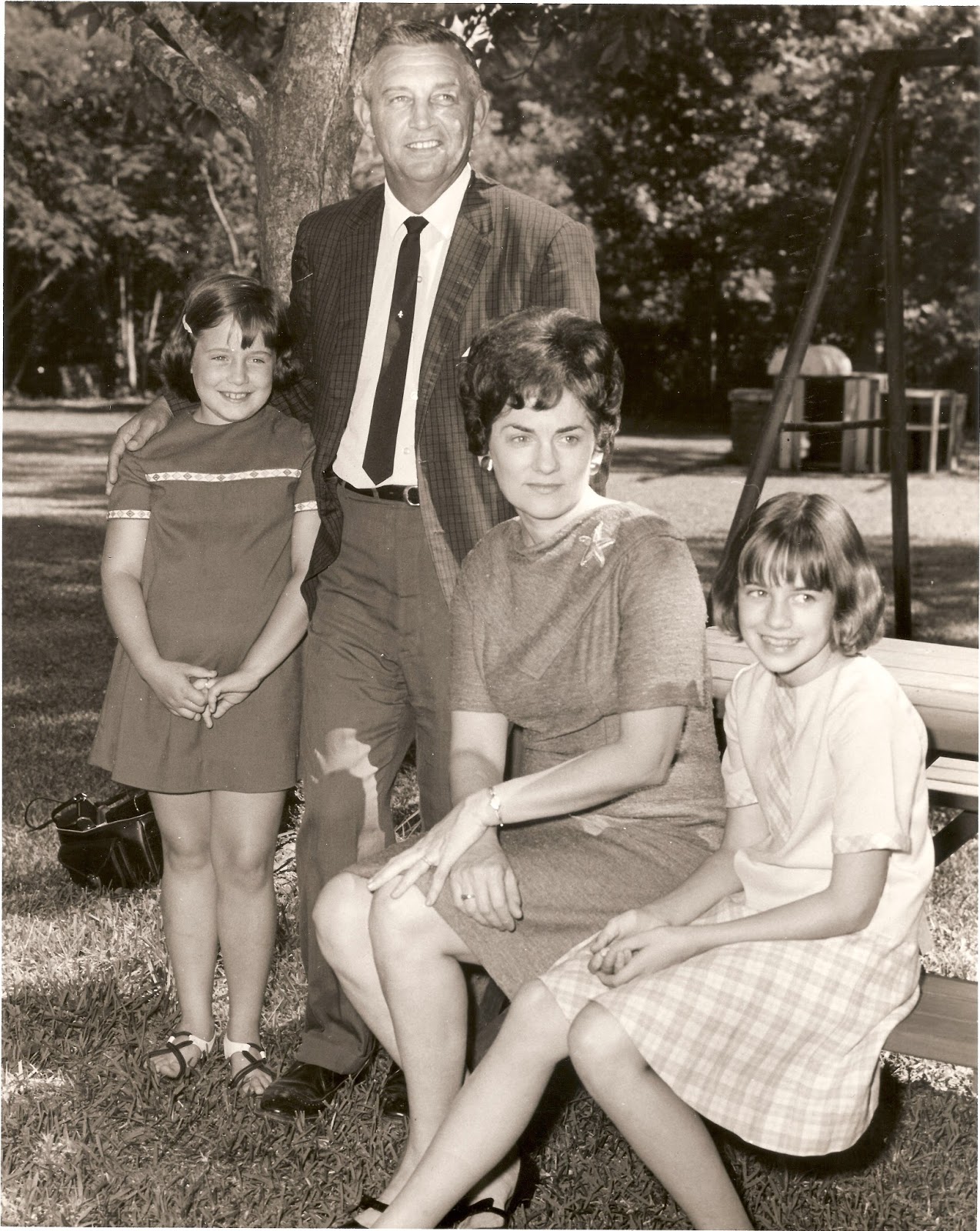
      While he was a player, he met his wife Geraldine Yarborough ("Gerry"), who was working on a graduate degree at USM. They were married for 30-plus years, and had two daughters.
      Linda was 13, an eighth-grader, and Lisa was 9, in third

The Lambright family, soon after
the move to Ruston
grade, when the family moved to Ruston -- and Louisiana Tech -- in 1967.
      "My Dad was pretty quick to get mad when we didn't do right," Linda recalled, a trait with which Coach Lambright's players could identify. But then, "He would spank us, and 10 minutes later, he'd be in our room apologizing."
      And the coach imparted athletic lessons.
      "I was on a swim team," Linda said, "and he would tell me, 'Swim so hard until it hurts.' " When she won five gold medals in a meet, "I realized that's what he was talking about.
      "He was a great dad," Linda added. "He made time for us when we went up there [to the Tech football offices]. And we always had a great time on family vacations in the summer."

The "soft" side of Coach Lambright (with Linda)
     "If we begged him enough about something," Linda said, "you could see him soften up. He was a softie about giving us what we wanted."
     Coach Lambright, the softie. Try that one on his football players.
---
     By the time Tech football was in the midst of its "golden era" with the coach -- 44-4 in four seasons (1971-74) -- Linda Lambright was a Tech student living in a campus dorm.

      And one all-conference player, a safety, would become more than a star. He would become the Lambrights' son-in-law.
      John Causey came out of the perennial powerhouse football program at Neville High (Monroe) -- still a power -- and followed his older brothers to Tech. Tom had been an All-America, all-conference end in the late 1950s; Walter a team captain and starting defensive end on Lambright's first two teams (1967-68) and a graduate assistant coach when John came on in 1969.
      But John was a walk-on; tall and thin, he had not developed physically as quickly as his brothers. However, he said he grew 40 pounds in the next few years, and by the spring of his second year at Tech, he was beginning to make his presence felt in the secondary.
      When he intercepted three passes in the spring game, he was walking off the field afterward when coach Lambright came up and said, "John, you did a great job. You don't have to worry about a scholarship while I'm here."
      And so, with the financial aid assured, he became a starter. In 1972, he intercepted 10 passes -- four in one game at Texas-Arlington -- and that school record was more than one-third of Tech's 29-interception season, still a school record.
      Plus, there was Linda.
      Sitting around between two-a-day practices early one fall and during a card-playing session, John was looking at Tech's media guide when he noticed the Lambright family photo and remarked, "Coach's daughter is pretty cute."
      As Causey remembered it, star linebacker Joe McNeely -- a "wild man" known as much for his fighting ability as his all-over-the-field tackling and coverage -- said, "I know her. I think I can get you a date with her."
      And wide receiver Pat Tilley, who would go on to star for the NFL St. Louis Cardinals, chimed in with, "You are chicken [bleep]; you're not going to date her."
      "We were all deathly afraid of Coach Lambright," Causey remembered.
Linda and John Causey
       But date her he did. Went to her dorm to meet her, and as the relationship developed, he would go to the Lambright home often over the next 2-3 years to watch TV in their den, and have meals. 
       Mrs. Lambright treated him graciously. And -- unbelievably -- Maxie never appeared.
      "I was scared to death," John recalled of the prospect. "Thankfully I never had to see Coach Lambright." 
      It speaks to the coach's integrity that he did not let the player-coach relationship cross with the personal-life dating relationship.
      "Guys would tease me," John said, " 'It's the Blue Max (the players' nickname for the coach), you better not do anything to upset him.' " But it wasn't a problem.
      And then the day after Causey's eligibility ended -- the final game of the '74 season (11-1 record, with the loss in the national Division II semifinals) -- he was at a holiday dinner at the Lambright home ... and Coach Lambright walked into the room.
      "John, you know how to play cards?" he asked. The answer was yes, "and he took me back to his den." A different relationship began, and he became family.
      "We became good friends," John said. "He was just a regular guy, so to speak. We started talking about football; he talked a lot about philosophy, he knew I wanted to coach.
      "I think he wanted to keep the pressure off me ... and him [while John played for Tech]," he said. "It was just as awkward for the coach to have a player dating his daughter as it was for me."
      "They got to be good buddies," Linda said. "It wasn't as hard for John as he thought it might be."
      Causey joined the Tech coaching staff in 1981 as secondary coach, replacing E.J. Lewis, a holdover from the Lambright staff who stayed on for one year apiece with the next two head coaches. John was on the Tech staff for six seasons (two with Billy Brewer, four with A.L. Williams).
      One other aspect: Lambright was inducted into the USM M-Club Hall of Fame in '74. Causey knew his coach had been a fine player -- and safety -- in college, "but he never talked about that. That's the kind of guy he was. He wasn't one to talk about what he'd done.            
      "We had a great relationship," John said. "I grew to love him even more."
      (Next: Maxie and the media)


Wednesday, December 21, 2016

Lambright, Part VII: An apology and a prayer

      (Part VII)
      Joe Raymond Peace was the best linebacker and a tri-captain on the first Louisiana Tech University football team (1967) with Maxie Lambright as head coach.
      Denny Duron -- my opinion -- was the biggest player success story in Tech's 12-year Lambright era, the "fill-in" quarterback who was the field and spiritual leader of the 1972 and '73 Bulldogs who had a combined 24-1 record.
      Both had unique connections to Lambright. Peace apologized to him. Duron prayed with him. Their stories follow.
---
Joe Raymond Peace,
then and now
      Peace has this distinction: He is the only one who played for Lambright at Tech and went on to become the Bulldogs' head coach (eight seasons, 1988-95).
      He is 71 now, and after 27 years of coaching football, working in real estate sales and living in Ruston.
      "I learned so much from Maxie and [then-assistant coach] Pat Collins," he says now. "Being in the coaching profession all those years, I came to realize how much I appreciated them."
      But it was not how he felt in 1967. He will tell you that he had an uneasy relationship in the one season he played for Maxie and his new staff.
      He had played three seasons for Coach Joe Aillet, a man he revered, as so many others did. Peace's father, Raymond, had played for Aillet right after the coach came to Tech in 1940 and again just after World War II. As Raymond built a long coaching career at Sicily Island, La., he maintained his ties with Coach Aillet.
      Plus, Joe Raymond's defensive coach at Tech in 1964-66 was George Doherty. So he was one of many who felt Doherty deserved the Tech head coaching job succeeding Aillet and he was one of the players who made that request to Tech president Dr. F. Jay Taylor.
      Didn't happen, of course, so Joe Raymond had to adjust to Lambright and staff.
      He had been an all-conference player as a junior, but did not play as well as a senior, and there was a rift when Lambright called in the captains to ask them about the quarterback competition between Phil Robertson and Terry Bradshaw.
      Lambright and Peace did not agree on the choice. The coach -- surprise -- prevailed. The season went on and Tech finished with a 3-7 record.
      Peace would embark on his coaching life just after graduation and eventually, from 1975 to '78 as an assistant (offensive line coach) to A.L. Williams at Northwestern State have to face Lambright's last four Tech teams.
      "No. 1, they were very, very talented," he said of opposing the Bulldogs. "They recruited players who could play in any league, as shown by the All-Americans and [future] pros they had. Gosh, it was difficult to play against them, compete against them.
      "They had people like [Mickey] Slaughter running the offense and Pat running the defense, talented people ahead of their time. But Maxie was the catalyst for all those talented coaches. He laid the groundwork and built the structure that made it work."
      And, after years of feeling a strain in his dealings with Lambright, he had the chance to make amends.
      "I went to Monroe to see a game at Wossman [High]," he said of a recruiting trip for Northwestern, "and Maxie was sitting in the stands all by himself. I said to myself, 'This is my chance."
      He went to greet Lambright and said, "Coach, I want to apologize. I wasn't a very good leader for you my senior year. I really appreciate what you did, and what you're doing [at Tech.]"
      Lambright, he said, replied, "Forget it. Let's just go on from here."
      "And from that time, we had a good relationship." 
      Lambright was quite a change from Aillet, who Peace said "was laid-back; he made his [coaching and teaching] points so quietly."
      Both coaches "had their way to get the most out of people."
      The most pertinent coaching factor he learned from Maxie was "his toughness. He was a tough guy. ... In that first year, he brought us toughness, and we needed that. Louisiana Tech football needed that.
      "There was accountability, and that paid off when they had [better] athletes. That's what made them so successful. It made a difference."
      Echoing what others mentioned, Peace said, "Maxie could be pretty darned stern. When he was pissed, we were frightened. And I knew when he was pissed."
      When Williams, a mid-1950s Tech star and one of Aillet's most successful coaching proteges and most enthusiastic admirers, moved from NSU to Tech in 1983, Peace came with him as an assistant and stayed on for Carl Torbush's one season as head coach. He then succeeded Torbush.
      In Peace's tenure, Tech made the jump from Division II to Division I independent and faced very competitive -- rugged -- schedules loaded with "money" road games at the "major" schools. That reflects in Peace's 40-44-4 record, but there were two very good seasons -- 8-3-1 in 1990, ending with a 34-34 tie against Maryland in the Independence bowl, and 8-1-2 in 1991 (only loss was the season opener).
      The '92 Bulldogs came as close as any team that season against national champion Alabama, losing 13-0.
      Years after leaving coaching, Peace reflects -- as he always has about Aillet -- on what Lambright had meant to him.
      "He touched my life," Peace said. "I didn't know it at the time. He helped me get better as a person."
---
The young Denny
      Denny Duron called Lambright "a great leader. There are two kids of leaders: (1) Those who lead and the way they lead, you say, 'wow' and (2) those who lead and inspire others to become great leaders. ... He had those [assistant coaches] on his staff that became great leaders, and so many of his players became great leaders."
      The Rev. Duron, who followed his father -- the founder of Shreveport's Evangel Christian Academy -- into the ministry, has been one of those leaders, as a pastor and as a football coach.
      Serving as chancellor of the Evangel schools (kindergarten through high school), and as a preacher (with wife DeAnza) for the Shreveport Community Church (affiliated with the Assemblies of God), he for most of three decades has helped coach the offense for a football program that has won 14 state championships and sent dozens of players to college football and the NFL. 
      At Louisiana Tech, he was the biggest winner at quarterback the school has ever had -- and Terry Bradshaw was far from the only QB star for the Bulldogs.
      And Duron, a good-but-not-great QB in high school at Captain Shreve in 1969, was not a QB his first two years at Tech, having moved to wide receiver.
      But there was no evident successor to Kenny Lantrip in the spring of 1972. The coaches watched Duron throw the ball in receiver warmups -- and decided he might be the answer.
      He was.
      It helped to have talent all around him -- running backs Roland Harper, Glen Berteau and Charles "Quick Six" McDaniel, receivers Roger Carr and Pat Tilley, tight end Mike Barber, a strong offensive line, and a defense led by lineman Fred Dean (Pro Football Hall of Fame) and linebacker Joe McNeely.
      Duron, though, was a clutch passer and a productive one -- 3,498 yards in two seasons.
      Tech went 12-0 in 1972 -- its only undefeated season in the "modern" era -- and shared a National Football Foundation NCAA Division II national title, and then went 12-1 in 1973 (lost at Eastern Michigan in the opener) and won the first official NCAA Division II playoff championship.
      Plus, with Denny as one of the leaders, spirituality/faith/religion was a hallmark of those Tech teams.  
      After Duron played briefly in the new World Football League with Birmingham, he went into coaching -- as the first head coach (1977-82) at Evangel University in Springfield, Mo.
      And the first person he called after he got the job: Maxie Lambright. "Coach, what advice do you have for me?" he asked.
      Lambright replied,  "Well, Denny, let your coaches coach." The explanation followed: "When I first was coaching, I tried to oversee everything." But when he went to Louisiana Tech, "I tried to give my young coaches the freedom to coach and tried to trust them."
      He was, said Duron, "never a leader who was intimidated by strong people. The fact is he was able to build a cohesive staff and keep them together."
      Duron adapted much of the Lambright philosophy and methods to his own coaching career. He particularly liked the way he ran his practices -- "way ahead of his time" -- and that individual and group drills were geared toward team-building.
      What he didn't try to copy was Lambright's wrath. He felt it a couple of times. Once involved football, the other involved prayer.
      Duron as a freshman had made the transition from QB to wide receiver and he was due to start his right game "wearing my hero's number 43 (1966-69 Tech receiving star Tommy Spinks)."
      In a walkthrough 24 hours before the game -- usually a quiet exercise for reviewing sets, personnel groupings and plays -- he heard "Coach Lambright screaming at somebody from the distance. He was absolutely ripping somebody."
      The closer Lambright came, Duron came to realize who the recipient: "It was me."
      The Bulldogs were working on a counter play in which the wide receiver would either block a linebacker or take the handoff from the QB. Lambright stopped the play, "grabbed me by the shirt and literally threw me off the field," said Duron, and insisted that Denny's roommate (for four years at Tech), Huey Kirby, move into the position.
      "Huey was 6-2, 225 pounds, built like a bodybuilder," Duron said, "and Maxie wanted more size at that spot in that formation. I couldn't have made those plays.
      "The next night Huey blocked masterfully and scored on a counter play."
      Lambright, he said, "would make those calls instinctively, and he would be right.
      "It was a great lesson in leadership. When I became a leader, I always kept that in mind. It was one of the many great lessons in life that I took from 'the Blue Max.' "
---
The Rev. Denny Duron
      The second piece of Lambright unhappiness with Duron came when Denny and Kirby -- among those who led the prayers at team meals -- were late arriving for a breakfast the day of a game. "Slaughter stopped me when we came in the room and said, 'Stay away from Coach Lambright. He is very unhappy with you.' From then on, we got to meals and meetings 10 minutes early."
      Lambright, said assistant coach Wallace Martin, who was the sponsor for Tech's Fellowship of Christian Athletes in the 1970s, "was very encouraging about FCA activities" and "wanted us (the coaches) to have a family life, wanted us to be with our families in church on Sunday mornings." So the coaches' work on Sundays in football season began after noon.
       Duron "loved coming back to Tech" in the late 1970s for summer football camps, and he said one year Martin told him he was concerned about Lambright. "I don't know if he's ever received Christ," Martin said. "I'm worried about him. You need to talk to him."
      "I told him I didn't want to do that," Denny said. "I was scared to death of Coach Lambright, although he'd always been so gracious and kind to me at Tech and afterward."
      "Believe me, he'll listen to you," Martin said. A reluctant Duron finally agreed, and soon went into Lambright's office and asked to meet him."
      "What can I do for you?" Lambright said.
      "Coach, we're worried about you," Denny said.
      Lambright asked, "Do I look that bad, Denny?"
      "No, coach, you look fine," he replied, "but I'd like to know if you've accepted Jesus Christ as your Savior? If you don't mind, I'd like to pray with you."
      With that, Coach Lambright "slipped out from behind the desk and fell on his knees beside me. And we prayed."
      It was, said the Rev. Duron, "the moment of moments for me. To pray with my hero, my coach. I had been so intimidated by him.
      "It was a special moment for me in my life."
      (Next: the player, the family man)      


Lambright, Part VI: Gaining the players' acceptance

       (Part VI)
       The adjustment to new head coach Maxie Lambright and his staff was a challenge for the Louisiana Tech football players in the spring and fall of 1967.
       They had been recruited by outgoing head coach Joe Aillet and his staff, they were accustomed to the calm manner and guidance of "The Smooth Man," and they were uncertain about the newcomer.
       Here are the thoughts of five Tech players who made the transition. The first three -- Jesse Carrigan, Glenn Murphy and Wayne "Butch" Williams -- were the first all-conference offensive linemen in the Lambright era.
---
       Jesse Carrigan (offensive tackle-guard, 1965-68, from Fair Park-Shreveport, now resides just outside Tampa, Fla., CEO and owner of Blue Head Tequila, LLC):
       "There was a little animosity when Coach Lambright came in. But he told us he was going to play the best guys. He definitely made changes from Coach Aillet.
       "Football was changing, and [Tech under Lambright] was very successful because he had Mickey Slaughter running the offense. Mickey had been in the school of business (same as Carrigan) a few years earlier and he had a 4.0 grade-point average. He was highly respected there.
       "[Lambright] was intense, but I thought he was well-mannered. He had some real intense assistants. I dealt mostly with [offensive line] Coach [Jimmy] Mize, and you couldn't have a better guy; he had a business manner.
       "Lambright had those assistants, but he was the general. He was hard and he was direct, but I don't remember him jumping on anybody, screaming at them, really bad. He did put together the right guys (staff).
       "I never had a problem with him on or off the field. You had to go to class, but you always had to do that. He treated me with courtesy."
---

       Glenn Murphy (offensive guard, 1964-68, from Bastrop, now resides in Alexandria, where he coached and officiated football for years):
       "Coach Lambright had a brilliant mind for football. ... He was one of the smartest men I ever knew, a special man.
       "[On offense], he would target an area and manipulate defenses to attack them. He altered blocking schemes, and that would open up the running game." [He cited an example of changes before the 1968 game at Southern Mississippi; Tech won 27-20 against a team it had lost to 58-7 the year before.]
       "Personally, I think I was like every other guy on the team -- I was scared of him. But I respected him; that's the key word: respect. I thought he cared a lot about us.
       "He was more of an in-your-face coach than Coach Aillet. But he encouraged you. He might be in your face, but it was, 'You can do this, son.'
       "Coach Aillet expected you to mature and learn on your own. Coach Lambright motivated you more directly."
---
       Wayne "Butch" Williams (offensive tackle, 1966-69, from Minden, where he returned to coach football and guide the 1972 baseball team to a state championship, then -- following the path of his father -- became a high school principal and later the superintendent of schools in Webster Parish):
       "I kind of started off on the wrong foot with him [Lambright], but he gave me a chance to play and I'm grateful for that. He brought in an excellent staff, hard workers, knowledgeable football people. Mickey [Slaughter] was one of the best around [offensive backfield coach]; he was such a big factor sitting in the press box calling plays.
       "They all had a purpose, and they knew what they were doing."
       Williams' father had been a close friend of George Doherty; he was the school principal when Doherty guided Minden to two state championships in the 1950s. So Butch was hoping Doherty would be the Tech head coach.
       "Coach Doherty was more of a 'three yards and a cloud of dust' offensive coach. The open [passing] game Lambright and his staff brought so much more to Tech.
       "I was not the greatest of his [Lambright's] fans, but he was not an enemy. He gave me a fair shake and I don't forget that.
       "Coach Aillet and Coach Lambright were totally different type people. I heard Coach Aillet curse once, maybe. They had a totally different way of doing things -- how they organized practices and games. You had to be there to understand.
       "Coach Aillet would be dealing with the offensive line and he'd say to me, pretty quietly, 'Now, Wayne -- he always called me Wayne -- don't you think you could have executed that block more efficiently?' Maxie was a lot more direct."
---
       Jim Willis (center, 1964-67, from Monroe-Neville High, now resides in the Houston area, founder and president of the Wildlife Habitat Foundation, dedicated to the restoration and upkeep of native prairie land, designed to protect and preserve the dwindling quail population):
       "I came to Tech to play for Coach Aillet, and I was excited to do that. 
       "Coach Lambright was a man of few words, but he said the most meaningful things with those few words. ... He had a way of letting you know he was there. I had a special relationship with him; he made me feel that I was the best player I could be at my position.
       "He was so dedicated. I'd see him coming out of the office late at night, on weekends. He put so much effort into the program.
       "I wish I'd had four more years with him."
---
       Mike Mowad (defensive nose guard, 1965-68, from Oakdale, graduate assistant coach at Tech in 1970, a precursor to a coaching career that ended with a 26-year head coaching stay at Breaux Bridge, 200 victories and a state championship in 2005):
       "Coach Aillet was more the intellectual type, reserved. He thought about the players after they finished playing, he was concerned about academics.
       "Coach Lambright brought in one of the finest staffs; that's what I really compliment him for. Like all successful head coaches, he let  his coaches coach. Mickey Slaughter was a phenomenal offensive coordinator, Pat Collins was a phenomenal defensive coordinator.
       "Maxie was very dedicated to Louisiana Tech, dedicated to the players. He showed a lot of compassion at times to coaches and players.
       "He was well-organized. He allowed his assistants to give a lot of input for the game plans.
       "I think with the black players coming in [starting in 1971), he had to change his philosophy some; he had to change things to fit the lifestyle of the players.
       "When I was a graduate assistant, I got to drive Coach Lambright a lot of places, like coaching clinics. He was like a lot of coaches, a completely different person off the field."
       (Next: Two key players, two stories)  


Tuesday, December 20, 2016

Lambright, Part V: two men, two styles

        (Part V)
      The men who knew both Joe Aillet and Maxie Lambright can draw the best comparisons of the most successful head football coaches in Louisiana Tech University history.
      Two assistants worked under both, defensive backfield coach E.J. Lewis and the late Jimmy Mize (offensive line).
      Four of Lambright's assistant coaches -- Mickey Slaughter (offensive backs/receivers), Pat Collins (defensive front), Wallace Martin (offensive line) and the late Pat "Gravy" Patterson (offensive line/ends) -- played at Tech in the Aillet years.
      And many of the Tech players on Lambright's first three teams, 1967-69, were recruited by Aillet's staff and began their college careers playing in Aillet's last two seasons (1965-66).
      Aillet and Lambright gave Tech a combined 38 years of mostly great success and stability. 
       In 38 seasons since then -- yes, it is exactly 38 -- there have been 10 head coaches (11 if you count Patterson's one game as the "interim" coach -- an 13-10 victory against arch-rival Northeast Louisiana to close an otherwise miserable 2-9 1979 season, the one after Lambright retired).
       So how did the two legends compare?
---
        "They were absolutely diametrically opposite," said Slaughter, who among those in Tech athletics was the first to know Lambright, his high school coach at Bolton (Alexandria).
Coach Joe Aillet
     "Coach Aillet was very polite, a very calm personality," Slaughter explained. "He was not easily upset, always in charge of his faculties. When he used a profanity, which was not very often, he said very softly and unless you were right next to him, no one else could hear it. And he was a deep thinker when it came to football."
      Lambright, said Slaughter, "was a volatile individual, with players and coaches. You did not want those cold blue eyes starting at you. When he had something to say to someone, he said it -- very directly."
      Lewis spent four seasons with Aillet and 12 with Lambright.
       "I was very fortunate to fit in with both of them," he said. "They were both great guys, both great coaches, good disciplinarians. ... Both good to work for."
      Martin, who came back to Tech in 1971 after a graduate assistant role at the University of Arkansas under coach Frank Broyles and then an assistant track coach/P.E. teaching job at Northeast Louisiana, said Lambright "demanded a lot from us. As long as you did your job, it was fine. He expected high production.
     "But if you didn't produce, you had to answer to him. When those blue eyes zoomed in on you, when he got to looking at you, you knew you were in trouble.
     "Overall, he was a joy to work for. Extremely fair and very understanding. I thoroughly enjoyed those years."
     The Aillet-Lambright comparison? "In some ways, they were a lot alike," Martin said. "They knew where they wanted to go, and knew how to get there. The kids they recruited were going to be good citizens. They both were committed to doing the best they could for the kids and for Louisiana Tech.
     "Coach Aillet was a lot more low-key. Maxie would get a little more excited about things."
---
Coach Maxie Lambright
     Lambright could be a tough disciplinarian. He was, as has been noted, hard on his coaches and if players broke team rules (arrived late for or missed meetings or practices, or in one case when facial hair was still a no-no in the early 1970s), he was willing to send them home or go into games without them. And that included some star players, future pros.
     It would take some persuasion -- begging is not quite right -- by assistant coaches to gain relief for the players.
     One example was that a player -- recruited by Aillet --  had a pre-dental curriculum that required lab classes which conflicted with football practices. Maxie insisted he not miss practice; the player wound up changing his major.
      "Coach Aillet would never have let him miss those labs," a fellow player said.
      And yet, coaches and players knew that second chances were a possibility with Lambright.
      Conversely, one person noted that "when Coach Aillet had it in for somebody, there was no redemption. He had a hard time forgiving. They were gone."
      A couple of my media friends would attest to that after they drew Coach Aillet's displeasure. No way would they want -- or dare -- to trade verbal or written exchanges with him, knowing he was one of the wisest individuals they would ever encounter.
      For the players who bridged the Aillet and Lambright years, however, the adjustment was often tough.
      (Next: Gaining the players' acceptance)

Monday, December 19, 2016

Lambright, Part IV: Choosing the next coach

       (Part IV)
       Maxie Lambright was an accomplished and qualified football coach when he was named head coach at Louisiana Tech University in March 1967.
       But who at Tech knew that exactly?
       So he was a surprise selection of sorts as Joe Aillet's successor. Among the few Tech people who knew who he was, though, were the five Bulldogs coaches who had been on the opposite sideline when their teams matched up with Southern Mississippi.
       They knew that Lambright was directing the offense that helped Southern Miss beat Tech in five of his eight years as a USM assistant coach.
       What the great majority of Tech's football players, all recruited by Aillet and his staff, knew was that he wasn't George Doherty. And Coach Doherty, the Tech defensive line/linebackers coach for 10 years, was who they wanted to be their next head coach.
       Coach Aillet wanted that, too, and so did the substantial base of ex-players and alumni and Tech friends who were Aillet loyalists.
       Maxie, unwittingly, came into a house divided.
Dr. F. Jay Taylor
       But he was Tech president Dr. F. Jay Taylor's pick, and that was that.
       It was, I dare say, the most high-profile decision -- and division -- of an unpublicized but not unknown clash of two strong-willed, powerful Tech personalities.
       Dr. Taylor and Coach Aillet.
       The young "new school" progressive Tech president and the very respected veteran athletic director/head coach who was one of the university's best ambassadors. 
       Aillet wasn't exactly "old school" because in athletics he always adjusted with the times and often was at the forefront of new developments. But he had run his football team and the department with much success for 2 1/2 decades, he was sure of his leadership, and he was a legend.
       There was a Dr. Taylor faction; there was a Coach Aillet faction (and some people caught in between). And there was quite a bit of jealousy.
       Both were top-notch educators, effective speakers, both polished and polite. But not agreeable with each other's roles.
       Jay Taylor had come back to Tech -- where he was a student soon after Aillet became AD/coach in 1940 -- as president in 1962, and the school was beginning to grow in many areas.
       Enrollment was increasing each year, thus requiring new and renovated facilities. Dr. Taylor was well-connected politically in Louisiana, good at cajoling people and obtaining the funding for increased personnel and the many proposed building and educational projects.
       Who knows how much he differed with Coach Aillet on athletic department issues -- I would guess primarily on  funding -- but the fact was that the two men did not have the same perspective.
       Dr. Taylor was bringing in his own people as administrators for departments all over campus.
       And he delved into athletics when Scotty Robertson, a Tech graduate and former Tech athlete who had become a very successful high school coach (primarily in basketball), was brought in as assistant coach to longtime Tech basketball coach Cecil Crowley in the fall of 1963.
       It was obviously with the intent of Scotty soon replacing his old coach -- Joe Aillet's coaching companion dating to Haynesville High School in the early 1930s. That happened after only one year.
        The Aillet boosters, sensing Dr. Taylor's growing influence, organized a "Joe Aillet Appreciation Day" for the 1963 homecoming game, not only to honor the coach but to make it clear to the new president how much the coach meant to them.
       Coach Aillet was presented -- if I recall correctly -- a new Cadillac, quite a luxury in those days, and the football team presented him a whopping 45-0 victory against Southwestern Louisiana (not yet USL, or Louisiana-Lafayette, or -- heavens -- the University of Louisiana).
       The 1964 Tech team was one of Coach Aillet's best -- 9-1, with only a controversial loss at Southern Mississippi the spoiler. That team gave up only 50 points other than the USM game and was one of the best defensive teams statistically in school history.
From The Shreveport Times sports page -- March 31, 1967
     Then, after successive 4-4 and 1-9 football seasons, Aillet decided -- on March 30, 1967 -- to announce his retirement from coaching. He wasn't forced out; no one was going to force out Joe Aillet. But he was 62, he had coached for nearly 40 years, and he wanted to remain as athletic director.
       In his lengthy letter to Dr. Taylor, Coach Aillet said, in part, "The combined duties of athletic director and head football coach are getting more demanding as our program expands. ... During the past two years my duties have been exhausting, both physically and mentally ..."
       Who would replace him?
       It was late in the school year, leaving little time for a new coach to prepare for the 1967 season. So promoting someone from Aillet's staff might have been more prudent than bringing in someone from outside.
       But Dr. Taylor likely had prepared for the time of change. 
---
       Doherty was the players' choice; they knew him. He had been a two-time state championship coach at Minden High, then returned to Tech, where he was a standout linemen on two of Coach Aillet's first teams (1941-42). He played five  seasons in the NFL.
       He was, as some players called him, a Jekyll-and-Hyde -- aggressive and demanding as a coach, especially in practice; a kind, genial, your-favorite-uncle type away from football.
       The players returning for the 1967 season had a meeting -- on the front steps of old Memorial Gymnasium -- and had a petition asking for Doherty to get the job. Most players, but not all, signed it.
       A couple then took the petition to a meeting with Dr. Taylor in his office across campus. He was cordial ... but he had his own plan.
This is the photo that
Southern Mississippi
provided to Tech when
Maxie Lambright was
named head coach.
       In short time, the news broke: Maxie Lambright was the pick.
       (If memory serves correctly, the first to report it was Alexandria Town Talk sports editor/columnist Bill Carter, who repeatedly broke Tech athletic department stories in the mid to late 1960s. He obviously had "inside" sources at Tech, and those sources were accurate. Carter had known Lambright from the coach's days --1956-58 -- at Bolton High in Alexandria.)
       Doherty would not be retained on staff. He moved to arch-rival Northwestern State as defensive line coach, and became head coach there for three years (1972-74), with one conference championship and a final 1-9 season before retiring.
      For the longest time, Lambright's selection was resented by many Aillet faithful. But their displeasure waned as Tech's teams began to win as they had under Aillet.
       When the Bulldogs had their unprecedented four-year run of success (44-4), then at the end of Lambright's 12-year tenure (and seven conference titles), and certainly now 50 years later, it was and is clear: He was a great pick.
       (Next: Two coaches, two styles)