We have been powerless for much of Monday and today. We were in the dark for hours, and it's been a test. But we are surviving.
The view from our apartment ... cold!
As I write this, the power has been back on for 20 minutes after the second 12-hour blackout. I have use of my coputer, so I am writing in a hurry because who knows when the power goes out again.
Spent most of Monday without electrical devices, and again the first part of today.
So no microwave to heat water for coffee or tea or soup. No television -- which we watched constantly last week and which we depend on for most of our news. For those in our facility who still like to read actual newspapers, no delivery the past two days.
(It is still a place for the real Fort Worth Star-Telegram, Dallas Morning News, New York Times and Wall Street Journal -- the kind you hold in your hands, not the online versions. I am not one of those readers these days.)
I don't like snow, and I don't like cold weather. Never have, never will. And it is just too darned cold and too snowy here -- as bad as it's been in our part of the country for, I'm reading, three decades.
Looked at my phone -- once we were back online Monday evening -- and it said 7 degrees with a "real feel" of minus 6. Last I checked we were not in Green Bay. Today we are up to 18 degrees, a heat wave.
But, hey, I am not complaining. Please don't take it that way. We are grateful for the dedicated management people and staff in our facility, who made sure that everyone here -- some 450 residents -- had something to eat and drink, twice Monday and again for lunch today.
They even managed hot soup today.
Some of those managers and staff spent Sunday night here, and many stayed again last night. And the dining services department also had to deal with a broken water pipe and a partially collapsed ceiling portion in the kitchen.
Hurray for our management, resident services and dining services departments.
---
We have residents who voice their gripes, and maybe some are justified. But our feeling is that those in charge of this place, and those who work here, care about us and our well-being.
 |
| Spring training, New York Giants, 1952: Dutch superstar pitcher Hannie Urbanus and Giants manager Leo Durocher. |


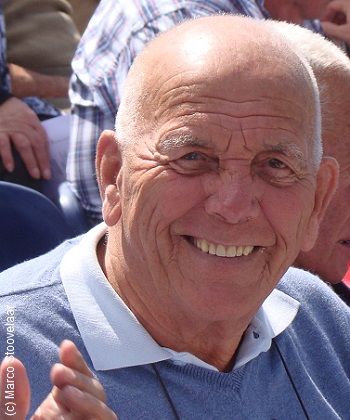
Han Urbanus , who played in the Dutch big league in four decades, pitched eleven no-hitters and played for the National Team for 17 years, passed away on Friday (February 5) at the age of 93. With the Netherlands National Baseball Team , Han Urbanus won seven consecutive European titles. Urbanus also participated in Major League spring training with New York Giants, was a member of the Dutch Hall of Fame, and was a living legend and Dutch baseball icon. |
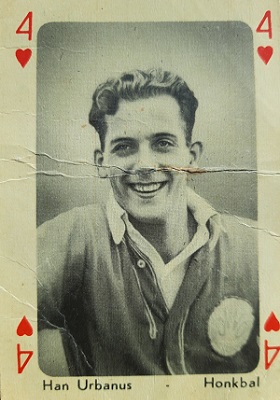 | 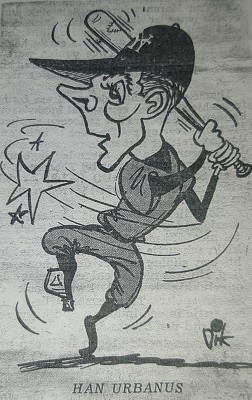 |
| ... On the left a unique playing card with the portrait of Han Urbanus ... ... On the right a caricature made by the famous draftsman ... ... Dik Bruijnesteijn, which was used in newspapers ... | |
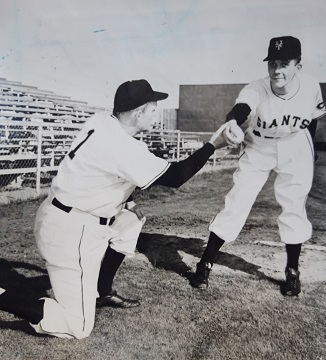 ... New York Giants Pitching Coach ... ... Frank Shellenback ... |
Those dates, in 1956, were monumental for us.
January 7, a Saturday, we were on the boat sailing into New York City -- immigrants to the United States.
January 12, a Thursday, the train pulled into Union Station in Shreveport, Louisiana, at 7 a.m. The sun was just coming up, and for us, the Van Thyn family of four, it really was a new day.
 New day, new country, new life. Forever grateful.
It was, as I recall, a bright day. It was clear, the high was 58; the low the night before and that night was right at freezing (32). (Guarantee you it was colder in Amsterdam, and probably snowy.)
At 8 years old, I don't recall being intimidated or terrified, but "unsettled" might best describe it. Same for Dad and Mom, and little Elsa (who was 4). Just trying to figure out what was going on and how to adapt, what to do next. The only Dutch we could speak was at our house; no one else could understand us. We had to learn to speak and understand English; that was a challenge. It took a while, and for Mom and Dad, months of lessons helped. Don't know how Elsa did it so easily -- she wasn't in school yet, like I was -- but she did ... and even now she remembers more Dutch than I do.
Now we had a President (Dwight D. Eisenhower) instead of a Queen (Juliana). "Ike" would be re-elected later that year, again beating Democratic nominee Adlai Stevenson, just as in 1952.
We had a Congress, not a Parliament. We had a Louisiana governor (Robert Kennon, although five days later Earl K. Long -- the crazy man -- would be elected to his second full term, beating New Orleans mayor Chep Morrison.)
Elvis, with his rock 'n roll and his hips and his sideburns, was the big show in entertainment and on The Ed Sullivan Show.
It was Elvis' biggest year to date -- he was everywhere -- and that March he would end his useful and popular association with the Louisiana Hayride in Shreveport.
But seeing him on television? Not us.
 TV? A phone? We never had those in The Netherlands.
But Elsa remembers that Mom and Dad brought about $200 with them -- converted from guilders -- and one of the first U.S. purchases was a television (black-and-white, of course; a color TV was a decade away for us). They thought the TV might help us learn English more quickly, and maybe that is how Elsa learned it.
Don't think we had a phone until we moved to Sunset Acres on July 4, 1957. It was a party line at first -- that wasn't fun -- and the number was 64122 (soon to be ME1-4122, ME for Melrose, if I remember correctly).
Instead of streetcars, trams -- Dad had been a tram conductor in Amsterdam all my life (1947-55) -- we now traveled by bus and the memorable trolleys.
No car for a few months; Dad had a tough time getting a driver's license in Holland (the tests were difficult; the people giving them very strict), and it would be a few months before he got a license -- and a (company) car -- in Shreveport.
James C. Gardner, at age 31, was the youngest mayor in Shreveport history. His four-year term (1954-58) interrupted the two long stays (1946-70) of Clyde E. Fant in that job.
Shreveport, like all the South, was so segregated, two separate worlds that rarely mixed. That was very different for the Van Thyns; I don't remember race being any kind of consideration in The Netherlands. Maybe I was too young to notice.
Instead of going to the outdoor market, to which we walked with Mom a few blocks from our tiny, cold, two-story house just about every day in Amsterdam, we now walked a few blocks in Shreveport to a grocery store (A&P). The shelves and bins were full of items we'd never seen, and many of our favorite Dutch items were only a memory.
I knew nothing about American sports (yeah, just refrain from any smart remarks here). I only knew voetbal, Dutch soccer. And I loved it.
Not until 1954 did soccer become a professional sport in Holland; until then, teams were semipro or amateur.
Didn't take long to learn that U.S. sports were serious business. But it took me a few months to find my favorite team ... and the New York Yankees weren't even the defending World Series champions then.
For the only time in history, the Brooklyn Dodgers were, having beaten the Yankees in the 1955 World Series -- the only time that happened in the seven Yankees-Brooklyn Dodgers World Series matchups. By that October (1956), the result was more acceptable; it was the first of 11 times I've experienced the Yankees winning the Series (plus eight times they lost it).
Which brings another memory. Although Mom, Dad and I were not far along in reading or speaking English, I know we already were subscribing to the afternoon newspaper (Shreveport Journal) because I distinctly remember coming home from school and seeing the result of the (Monday) October 8 World Series game -- Game 5 -- that same day. The headline said Yankees pitcher Don Larsen had pitched the first perfect game in Series history. Perfect game? What was that?
(Games in those days began at noon, Eastern time; so 11 a.m. Shreveport time. This game took 2 hours, 6 minutes, so it ended at 1:06 p.m., plenty of time for the Journal to get the whole story into its city/home edition.)
In American sports, the Cleveland Browns were the reigning NFL champions, the powerhouse franchise -- led by QB Otto Graham and coach Paul Brown -- that had played in seven consecutive NFL title games, every year since they had joined the league.
Oklahoma was king of college football, the Bud Wilkinson-coached dynasty in the middle of its record 47-game winning streak.
San Francisco -- the Dons -- was the NCAA basketball champions, about to win its second consecutive title led by a shot-blocking big guy, Bill Russell, and defensive expert guard K.C. Jones.
The Boston Celtics had never won an NBA championship (but they soon would win 11 with Russell at center). The reigning NBA champs were the Syracuse Nationals; the Philadelphia Warriors won in 1956.
The NHL champions were the Detroit Red Wings. But in 1956, the dynastic Montreal Canadiens would rule again.
The big names in golf were Sam Snead, Ben Hogan (of Fort Worth), and Byron Nelson (who was about to retire). But Hogan's star was beginning to fade; in 1955, he had been runner-up in the Masters (to Dr. Cary Middlecoff) and the U.S. Open (in a playoff loss to little-heralded Jack Fleck in one of golf's greatest upsets).
Arnold Palmer was the 1954 U.S. Amateur champion who had turned pro and, in 1955, played in his first Masters (finished 10th), made the U.S. Open cut for the first time and finished 21st. Jack Nicklaus was about to turn 16, a chubby kid in Ohio with a lot of golfing promise.
And, back to baseball ... the Shreveport Sports were the reigning Texas League champions. Knowing their manager, Mel McGaha, and their ballpark were in my future.
I had never heard of any of them. But I knew about Abe Lenstra, Faas Wilkes, Wim Van Est, Kees Broekman, Jan Klaasens and Coen Dillen.
Sunset Acres was a fairly new neighborhood in southwest Shreveport; the elementary school was in its second year. My future best friend, Casey Baker, and my future classmates, were in the third grade, and -- beginning on the afternoon of January 12 -- so was I, at Line Avenue Elementary across town. Good memories there, too.
(For my Woodlawn connections: In January 1956, Lee Hedges was an assistant coach at Fair Park High. Jack Rowan, eight days before we arrived, had resigned as head coach at Byrd High. Three months later, Hedges -- at age 26 -- was named the Byrd head coach, a job for which he had not applied. Meanwhile, A.L. Williams was preparing for his senior season as a Louisiana Tech halfback, and Jerry Adams also was a senior at Tech, his college time interrupted by service time, his football career limited by a very damaged knee. But those young men -- Hedges, Williams, Adams -- learned a lot about football and leading/teaching young people and in a few years, many Woodlawn Knights would benefit greatly.)
For us, Sunset Acres -- and owning a home -- was not even a thought. Could not have imagined Oak Terrace Junior High (where my path to keeping stats for athletic teams and newspapering began), "Camelot" at Woodlawn, going to college (Louisiana Tech), a journalism degree, a start at The Shreveport Times, the Journal and a career full of other newspapers.
Shreveport was home for me for 30 years -- Sunset Acres for a glorious 10-year period -- and more than 50 years for Mom and Dad, including 40-plus in the house in South Broadmoor.
For me, there was Beatrice and Jason, then Rachel, then in-law kids and four spectactular grandchildren, a helluva lot of mistakes, misdeeds and moves, too many great times to count but blessed to remember. Fort Worth became the greatest place in the world to live, and specifically, Trinity Terrace.
It all began January 12, 1956. It was a bright day, and it was clear. But clearly we couldn't look too far ahead.
---
Two related blog pieces (from 2012):
https://www.blogger.com/blog/post/edit/5125402567351329247/1373025344885949427
https://www.blogger.com/blog/post/edit/5125402567351329247/8935378780711618213

 |
| LSU's national champions: If this had been the last game of 2020, that would have been fine. |

Johnnie Dawson was a catcher in professional baseball in the 1930s and 1940s, and he was from rural Caddo Parish who became, for a time, a Shreveport resident.
Or maybe his name is Johnny Dawson. We're not sure which spelling is correct.
 |
| Reno newspaper July 25, 1941 (clipping provided by Dr. Margaret Gripshover) |
It was an avid baseball researcher who found Dawson for us and identified him as a Negro Leagues player.
Dr. Margaret M. Gripshover -- whose informal name is Peggy -- is a professor of geography at Western Kentucky University. That field also includes environmental studies.
Originally from Cincinnati, she has been at Western Kentucky for 11 years after previous faculty stops at Marshall University and the University of Tennessee.
So geography is her j-o-b. But she's also passionate about -- and has researched and written on -- horses, the thoroughbred racing industry, mules (yes, mules) ... and baseball.
Pertaining to the great game, she is partial to the Chicago Cubs and the Wrigley Field area, and her current project -- which brings her to us and Mr. Dawson -- is research on African American contributions to baseball.
She is a member of the Society for American Baseball Research (SABR) and is contributing a chapter on Dawson to a book on the 1942 Kanas City Monarchs, a combined writing project for numerous SABR members.
So Dawson was a missing piece and, having seen some of our work online, she wrote us seeking what information we had on him. Which was ... none.
---
Here is what we did find on Dawson from a, well, sometimes-not-sure source, Wikipedia:
Johnnie Dawson (November 8, 1914 – August 6, 1984) was an American Negro league catcher between 1938 and 1942.
A native of Shreveport, Louisiana, Dawson made his Negro leagues debut in 1938 with the Kansas City Monarchs and played with the Chicago American Giants and Memphis Red Sox in 1940. He returned to the Monarchs during their 1942 Negro World Series championship season. It was Dawson's final season in baseball. He died in Los Angeles, California, in 1984, at age 69.
Negro league baseball debut — 1938, for the Kansas City Monarchs
Last appearance — 1942, for the Kansas City Monarchs
Teams — Kansas City Monarchs (1938); Chicago American Giants (1940); Memphis Red
Sox (1940); Birmingham Black Barons (1942); Kansas City Monarchs (1942)
And from the Baseball Reference web site, here is a link to the scant Negro Leagues statistics on Dawson:
https://www.baseball-reference.com/register/player.fcgi?id=dawson003joh
---
Going to let Dr. Gripshover -- "Peggy" -- take it from here. Following are parts of what she wrote to us in mid-October:
"Dawson’s baseball career mirrors that of many second-string players in the Negro Leagues of his day. His life off the field was no walk in the park either. I am pretty sure that it wasn’t easy to be an African American man in “Bloody Caddo.”
Dawson’s immediate family was fractured and unstable from the get-go. He and his brother (Kemp Dawson) were raised in rural Caddo by different sets of aunts and uncles in the Greenwood and Flournoy communities. His father, also named John Dawson, vanished from the picture by 1920 and his mother remarried and moved to Shreveport.
Johnny and Kemp had their scrapes with the law in Shreveport, but nothing major (mostly gambling). Kemp left Shreveport before Johnny did and moved to Los Angeles where he had a brief career as a boxer.
The Dawson boys were just two of the many African Americans who left Shreveport for LA during the “Second Great Migration.” One article I read claimed that there were so many former Shreveport residents in LA, that there was a neighborhood that was informally called “Little Shreveport.”
Johnny ended up in LA after his service in World War II. Dawson continued to play baseball in the burgeoning post-WWII semipro leagues in California, along with some other former Negro League players. He played semipro baseball for a variety of teams until around 1949.
After that, I lose track of Johnny and his brother Kemp until their deaths in the 1980s. Kemp died in San Francisco in 1983, and Johnny passed away a year later in LA. I have a few documents that indicate that both brothers were probably married at least once (maybe twice), but no records of any known children.
I am fairly experienced with doing African American genealogy, but the Dawson family has been a real challenge. Endlessly interesting, but a challenge nonetheless.
… There were a few bright spots in the Dawson family story. The uncles who raised the Dawson brothers were fairly successful farmers in Caddo Parish, and one of the uncles was a regular exhibitor (and winner) at the Louisiana State Fair in the 1910s. Fast forward to the 1990s, and you will find Johnny’s cousin, Matel “Mat” Dawson (1921-2002), a Detroit autoworker turned philanthropist who endowed a scholarship at LSU-Shreveport."