Showing posts with label Baseball. Show all posts

Thursday, March 30, 2023

Opening Day, and a long love affair renewed

         Let's go, Yankees.

     Life -- well, sporting life -- begins again today. This should be a national holiday.
Aaron Judge, the captain (photos from Pinstripes Nation)
     It is Opening Day for major-league baseball, and this begins my 68th season as a Yankees fan. Yes, almost a lifetime.
     Who's counting? So, since the start of the 1956 season -- when a small kid from a foreign country found out that baseball could be a second sports love -- this covers 10,581 regular-season games, 307 postseason games. Lots of glory, lots of agony.
     A friend, a fellow Yankees fan for life, noted that "[today] we get to start our daily suffering." 
     True. There is nothing better for a sports fan than to follow the adventures -- day by day -- of a favorite team. 
      Here, that could be LSU football or Dutch soccer or the woebegone Dallas Cowboys ... but, truly, nothing beats Yankees baseball. Not in this apartment.
     Love the team, love the franchise, love the tradition ... the best tradition in American sports. It is, humbly said, the premier franchise in the world.
     (OK, you could say the Green Bay Packers, Boston Celtics, Los Angeles Lakers, Montreal Canadiens, Manchester United, Brazil soccer, Alabama football, and -- concession here -- Boston Red Sox or New England Patriots. Also, the St. Louis Cardinals and Los Angeles/Brooklyn Dodgers and the San Francisco/New York Giants. You choose; you are entitled to your favorite.)  
      But we have had the Babe and Lou, Combs, Lazerri, Red, Waite, (where have you gone?) Joe D., Marse Joe, Casey (the Ol' Professor), Cro, the Milkman, Snuffy, Spud, the Major, Billy the Kid, Joe G. (two of them), Atley, Heinrich, King Kong, Super Chief, Vic and Eddie, Joe Page, Scooter, Gil, Mickey and Roger (the M&M boys), Yogi, Whitey, a perfect Don, Bullet Bob, Ryne, Ellie, Hank, Moose, Tony and Bobby, Clete, Hector, Mel, Pepi, Murcer, Sparky, Goose, Puff, Thurman, Reg-gie, Sweet Lou, Roy, Willie, Bucky, Mick the Quick, Louisiana Lightning, the great Mo, Derek Jeter, Bernie, The Warrior, Tino, Jorge, Andy P., Robby, Straw, Knobby, Gardy, Dr. Brown, Bob Sheppard, Mel Allen, Geno, etc., etc., a cast of thousands ... and now a guy who hit 62 regular-season home runs last season, the Judge ("All Rise.")
      Tradition, pride, and the Big Stadium in the Bronx (third version), part of the greatest city in the world (thank you, Hamilton).   
      The opinion here: It is the best day of the year, topped only by your team winning the World Series (congratulations, Astros fans).
     We know that feeling -- 27 times. I've been around for 11 of those (and for eight second-best disappointments). But we have not had that championship feeling in the past 13 seasons. Nuts. 
     So we're not the Houston Astros, defending champions, the team that four times in the past eight seasons has ended the Yankees' season in the playoffs. Hard to believe, hard to take.
      We have become what the 1940s/1950s Brooklyn Dodgers used to be for the Yankees: their postseason foils.
      But not surprising. The Astros were -- are -- that good.
     Gosh, the Astros were our favorite National League team for years, especially in the early 1960s when we listened to many of their games on radio -- Gene Elston, Loel Passe and, for a brief, a young Harry Kalas -- and saw a few of their games on Shreveport television. The teams weren't all that good, but they were fun.
     But now that the Astros are in the American League, not so much fun for us Yankees. 
     Wish I could say that this is going to be the year the Yankees displace them. But not so confident about our chances. Darned near forgotten what it's like to win an American League pennant or a World Series; hasn't happened since 2009. 
      The 13-season Series-winning drought is the Yankees' longest since I was a young man (14 seasons, 1963-76, which included three AL pennants and Series losses).
       And think of these numbers: In my first 18 years (1947-64), the Yankees won 15 AL pennants and 10 World Series. Oh, joy. Which is why one of my favorite books is titled Dynasty.  
     Last season was one of the weirdest for the Yankees that I can recall. They looked unstoppable, unbeatable, potential Series champions for three-plus months: On July 8, they were 38 games above .500 (61-23) with a 15 1/2-game lead in the AL East.
     After that -- when injuries and old age and mediocrity set in -- they were mostly terrible, a .500 team in July, 10-18 in August, and the division lead crept down to 3 1/2 games before a small surge at the end. But they were no match (no offense) for the pitching-strong Astros in the AL Championship Series ... out in 1-2-3-4 games. 
     As my old friend, the late Jerry Byrd, would have said: No guts.       
     Going into this season, the Yankees' pitching looks shaky, questionable. Even Gerrit Cole, the supposed staff "ace" who is making a zillion dollars per season, wasn't all that great last year, but was among the MLB leaders in giving up home runs.
      Injuries already have dented a potential starting rotation and the bullpen, plus a defensive whiz in center field. 
       The regular lineup has the usual potential, but so many of the guys need to improve on last season when they particulary faded away in a miserable second half. Too many strikeouts, too many empty at-bats.
      It is a big ask to produce a traditional Yankees-like offense over the course of a full season. Lots to prove.
      Judge likely won't come close to 62 home runs again -- Roger Maris hit 33 in 1962 after his 61 in '61 -- but he can be a force again, and now -- starting on the field today -- he's the Yankees' captain. 
       And he has been a class act off the field, too, saying the right things and showing leadership. 
       This club might need some surprise elements, and the hope is that young shortstop Anthony Volpe -- after a strong spring-training showing -- is one. Will he be 1996 Jeter-like? Maybe some young pitchers will emerge as stars. That would be a boost.
       We like the way the Yankees go about their business, like that they always wear the pinstripes at home and the gray-with-blue trim on the road. No colored tops as an alternative, unless MLB has special across-the-board uniform demands.
      They almost always play the game the right way, they don't make excuses, they meet the media -- win or lose -- and they look business-like. OK, maybe the clean-shaven bit is a bit overdone for these days, but the ghost of George M. Steinbrenner (born on the Fourth of July) prevails.
      But there is this: The Yankees often have players that we don't like much. Uh, Roger Clemens, A-Rod, Aroldis Chapman ...  
      As for the game itself, we love the speed-up rules for pitchers and batters. Been saying for years that batters stepping out after each  pitch, to adjust batting gloves or dig in the dirt or to pick their nose, was a waste of time. 
      Don't like 3, 3 1/2, 4-hour games. Of course, if MLB really wanted to speed up things, cut the between-half-innings time from 2 1/2 minutes to one. But, hey, those breaks for TV/radio advertising, that's m-o-n-e-y. Gotta make millions to pay the poor players.
      Oh, glad that the infield shifts have been somewhat banned. Probably teams will find a way to adjust their defenses to take away what used to be sure base hits. 
       Bigger bases? That will mean more stolen base -- or at least attempts -- but the Yankees seldom have a base-running team worth a darn.
      Can't stand the runner-at-second-base-to-start extra innings rule. Cheap tactic. 
      A note about the local team, the Texas Rangers. They have many fans here in our facility, and I will watch some of their games on TV, provided cable access is available. And we might make a rare trip to the new barn-like ballpark with a roof ... (if someone gives us tickets). 
      The Rangers have spent plenty of free-agent money -- Corey Seager, Marcus Semien, Jacob deGrom and others -- and they have a Hall of Fame, three-time World Series champion manager (Bruce Bochy). Can't do better than him.
       They should be improved. Good luck to them ... but not too much luck. They are in the American League, so ...
      Personally, we have watched less baseball on TV in recent years ... or other sports. Don't watch anywhere as much as my friends might think. Other priorities, and less stress watching the teams I care about. Easier just to follow games via Gamecast on computer or the phone.
      And -- this is old school, old man talking -- just don't like the way today's athletes celebrate every good moment, the arm-waving, signaling to teammates, high fives, low fives, chest-beating, trash-talking, Gatorade-pouring. It is so much crap. 
      We were taught not to show up the opponent, the other team, or the refs (umps). 
      But we are relics, we are dinosaurs. People in my age range don't identify with today's athletes. Coaches, managers, management could control some of those antics, but they won't. Too much money involved.
       End of rant.
       It is baseball season. Glory be. Time to suffer some, time to relish the victories.
       ... And there it goes! See ya! 
       ... How about that!
       Let's go Yankees.

Saturday, March 19, 2022

One October day in 1962, Ralph Terry stood tall

     Ralph Terry died this week, another of our 1960s baseball heroes gone. Their days, and their ranks, are dwindling.

     There was a special personal affinity for Ralph Terry, for several reasons. Primarily because he was the hero of the 1962 New York Yankees' season and World Series championship team.       
     If you've watched the '62 World Series film -- and it's played on this computer about, oh, 62 times -- you know that Ralph threw the last pitch of Game 7, and that the San Francisco Giants' big man, Willie McCovey, knocked the heck out of that pitch ... a screaming line drive right to -- thank goodness -- Yankees second baseman Bobby Richardson.
     Sweet redemption for Ralph (and the Yankees).
     Because two years earlier, he also threw the last pitch of the World Series. That ball ended up sailing off the bat of the Pittsburgh Pirates' Bill Mazeroski and over the wall in left field at Forbes Field. So ... 10-9, Pirates, and an immortal baseball moment.
     Another reason Ralph Terry was one of our guys: (roll your eyes) He once pitched, at age 17, for the Minden Redbirds in the summer semipro Big Eight League, based in North Louisiana. (Yes, we are partial to that area.)
     He was an Oklahoma kid, tall and rangy, a pro prospect looking for good competition. A year later he had signed with the Yankees and was pitching for their Class A farm team. Two years later, he made his major-league debut.
     But he never had a winning season in "the bigs" until 1960, and -- see above -- that season didn't end well (no thanks to Mr. Mazeroski).
 However, when my top  personal memory of
Ralph Terry goes to 1962, specifically Tuesday, October 16, Game 7, and the victory ride his teammates gave No. 23 off the field at Candlestick Park.
      That was, as happens so often, a tense, dramatic, memorable Game 7.
      And my memory takes me to the football practice field at Woodlawn High School, a few minutes -- if I recall -- past 2:30 p.m.
---
     Sophomore year, football manager (equipment dispenser, tower picker-upper, etc.). Innocent (naive) 15-year-old, a sports maniac. Really, the only interest in life, and baseball (Yankees) was the No. 1 concern (Woodlawn was 1-A).  
     But on that Tuesday afternoon, at  practice, my mind wasn't on football. It was on the baseball game on my transitor radio -- brown case -- that I had to my ear.
     Practice? Who cares? There were other managers around.
     We had a helluva good team, a carryover from the "Cinderella" district champions the year before. We were 5-1, 4-0 in district, and that week was a tense one at Woodlawn because our opponent on that Thursday was Byrd High School, the arch-rival.
     Uh, we didn't like Byrd. 
     We had routed a good West Monroe team 26-0 the previous Thursday. Byrd was 2-0 (and had a big, bad team that -- spoiler alert -- would go on to play in the state-championship game). 
     We knew we'd have to play without our promising sophomore quarterback, our friend Trey Prather. He had been the backup QB the first six games, and against West Monroe had emerged as a star, 3-for-3 for passing with two touchdown connections to Edwards Walker (12 and 23 yards). Trey also ran four times for 28 yards. But on his last run, Trey was knocked out of bounds across the field at the West Monroe bench. He didn't get up. Result: broken left wrist.
     Trey easily was our best passer. But the starter, Joe Geter, came back in and found Walker for his third TD catch. (Our friend, Ed Walker, who passed away in Houston just a month ago.) 
     We digress. Sorry. Byrd High was on everyone's mind. Mine was on the Yankees-Giants Game 7.
     Great game, great Series. Rain-delayed for three days before Game 6 in San Francisco. Giants won that one to force Game 7.
     Ralph Terry had been the Game 2 loser at Candlestick and he'd never won a World Series game (his Series record was 0-4)... until a complete-game victory in Game 5 at Yankee Stadium, helped by rookie Tom Tresh's three-run home run to break a 2-2 tie in the bottom of the eighth.
     In Game 7, Ralph was the right guy on the mound in the right place. He had won 23 games in the regular season (23-12 record), pitched almost 300 innings, by far his greatest season. Also gave up 40 home runs, but so what?
     On this day, he stopped an outstanding Giants team -- the first San Francisco National League champion -- on four hits. Some defensive gems helped him.
     Tresh saved him in the seventh inning
with a running backhanded catch in left field on a drive hit by ... Willie Mays. 
McCovey followed with a long triple, but he was stranded at third. Thus, the Yankees' 1-0 lead was preserved.
      Classic ninth inning. Yankees failed to score after loading the bases with no outs -- forceout at home, double-play grounder (5-U, 5-3 if you're scoring, baseball fans). Bottom nine: Matty Alou pinch-hit, perfect drag bunt single. Terry struck out the next two batters. 
     Up comes the mighty Mays (oh, Lord, I'm shaking listening to this). Lines a hit to right field. Roger Maris, a terrific outfielder, rushes over to the corner, cuts the ball off before it can get to the fence and hurries his throw to the cutoff man -- Richardson, in short right, relays it home and Alou has to stop at third. Phew!
     Mays is at second, the potential winning run on a single. 
     McCovey, an awesome man, is up. First base is open; Orlando Cepeda is on deck. Yankees manager Ralph Houk goes to talk to Terry, and they decide to forgo the "percentage" move (walk McCovey, get a righty-on-righty matchup with Cepeda). Huge gamble.
     First pitch McCovey hits a long, long drive ... foul. I'm listening, and really shaking now. Second pitch: the line drive to Richardson.
     Game over, Series over ... the Yankees win! (World Series title No. 20, the 10th of my lifetime. Would have to wait 15 years for  another one. Damn.) 
     Radio goes flying in the air as high as I could throw it, but I didn't yell. Didn't want to disrupt football practice. Probably the coaches and the guys didn't notice. I didn't care. I loved Ralph Terry then, and I loved him forever.
---
     Another scene, two years earlier: Junior high eighth-grade math class, Maurice K. Nickels the excellent teacher, sometime before 2 p.m. We're taking a test, Game 7 of the '60 World Series is going on. I know the Yankees were ahead 7-4 in the eighth inning. Mr. Nickels leaves the room, comes back in after a while and announces to the class that the Pirates have won the Series on a home run by Bill Mazeroski.
     One kid, age 13, in Mr. Nickels' class sinks in his seat, feeling ill. Doesn't want to believe it. Doesn't know that Ralph Terry gave up that home run.
     Two years later, we forgive Ralph.
---
     Met him in the early 1990s when he was playing the Seniors PGA Tour and was in an event at the Valley Course at TPC Sawgrass in Ponte Vedra Beach, Florida. He was that good a golfer, maybe the best-ever baseball player-turned-golfer. It was the day I followed Arnold Palmer's round, but sought out Terry afterward.
     Thanked him for 1962, mentioned Minden, which brought a laugh. He said it was a good memory.
     He was 86 when he left us this week. The only other Yankees who played in that Game 7 in 1962 still living also are 86 -- Bobby Richardson and Tony Kubek. Giants players from that game still with us are the greatest player I've seen: Mr. Mays, and Felipe Alou and "The Baby Bull," Cepeda. 
     Heck, they're all legends. But on October 16, 1962, Ralph Terry was The Man.
--- 
      One postscript: Talk about tense, what we didn't know that day, but would learn by the following Monday ... This item taken from history.com, a "This Day in History" listing:
      "In a televised speech of extraordinary gravity, President John F. Kennedy announced on October 22, 1962, that U.S. spy planes have discovered Soviet  missile bases in Cuba."
       (The Soviets. The Russians. Troublemakers. Some things don't change.)
       Yikes. And we thought the World Series and Byrd-Woodlawn football were tense. Right.


Monday, May 24, 2021

'Country Joe' West: We remember him when ...

    Joe West -- umpire, football star.

   If you were watching Monday night's St. Louis Cardinals-at-Chicago White Sox game on ESPN, you saw a lot of umpire Joe West.
   Not a pretty sight ... ever.
   But the TV crew focused on Mr. West for a full inning -- and more -- because he is about to become the umpire who has called more major-league games than anyone in history.
   The focus was on him Monday night because -- stationed at first base -- he was calling his 5,375th regular-season MLB game, tying Bill Klem's all-time record. Tuesday night he will break that record.
   Bill Klem was inducted into the Baseball Hall of Fame. Joe West a Hall of Famer? C'mon ... be serious.
   He has proven that arrogance (always) and incompetence (often)  is acceptable in Major League Baseball.
   You might have guessed that Joe West is not my favorite umpire. He would rank near the least favorite.
   But at least as long as Angel Hernandez and C.B. Bucknor are calling games, West won't be the worst umpire in the big leagues. Nor the most arrogant; Hernandez locks that up every night he steps on the field. That, and most incompetent.
   Actually, Joe West is a good umpire when he doesn't doze off and turn lazy. But when he's challenged on a call, he is insufferable, and has been for years.
   He's been chosen -- in frequent managers/players polls -- as among the worst umps in the big leagues. To be fair, some voted him as among the best.
   Klem umpired in the National League for 37 years, retiring in 1941. 
   West first umpired in the NL in 1976 and became a fulltime MLB ump in '78. His 43 years is the longest ever for an umpire. 
   He's worked too many World Series and league playoff games, and he's often been -- willingly -- the center of attention/controversy.
   He's known as "Country Joe" or "Cowboy Joe" because, in addition to messing up baseball, he's a country-western singer-songwriter, with a couple of recorded albums.
   But we don't sing his praises. No, thank you.
   He's 68 and he has said that he will retire after this season. Not soon enough.
   However, we have one soft spot for Joe West. Because -- of course -- he has a Shreveport connection.
---
   When he was a college senior, at Elon (N.C.) College, this umpire-to-be was a quarterback ... and a good one. At least, on the afternoon he played in a national championship game at Shreveport's State Fair Stadium.
    It was Saturday afternoon, December 8, 1973. The NAIA national championship game.
    He was not the best QB in the game, however.
   Joe was Elon's alternate quarterback and he was a passing sensation once he entered the game. But his team was far behind.
   Elon was the No. 1-ranked NAIA team. But No. 3-ranked Abilene Christian, with two stars who would make headlines in the NFL in the near future, routed Elon 42-14 before only 4,162 fans in a 33,000-seat stadium. 
   Entering the fourth quarter -- when West put on his show -- Elon was behind 28-0. 
   ACC -- now ACU -- was far too good because (1) its quarterback,  Clint Longley, passed for 341 yards and three touchdowns in the game and (2) its star running back, freshman Wilbert Montgomery, ran for 159 yards and caught four passes for 79 yards. 
   You might have heard of them.
   That season, before this game, Longley had passed for 2,826 yards and Montgomery had run for 1,022 yards, and combined they had accounted for 61 touchdowns.
   They were NAIA All-Americans. Another NAIA All-American running back that year was Walter Payton of Jackson State. You might have heard of him, too.
   Bill McIntyre and Jim McLain covered the game for The Shreveport Times. Here are a couple of items from their coverage.
   So Elon was no match for an Abilene Christian program that only two years earlier had left the Southland Conference, unable to fund its scholarships that league required. The Lone Star Conference was more affordable for ACC, but it obviously had some recruiting attraction.
   Longley would become a Dallas Cowboys QB, famous for his 1974 Thanksgiving Day TD heave to Drew Pearson to beat the hated Washington Redskins and infamous for his locker-room, sucker-punch of Cowboys starting QB and superhero Roger Staubach that was Clint's goodbye to the team.
   Montgomery would help run the 1980 Philadelphia Eagles past the Cowboys in the NFC title game and into the Super Bowl.
   And Joe West? He left football behind because he also liked baseball and found a role in it. 
   Many a manager and player has told him -- and told the world -- how much they dislike his umpiring. He doesn't care. He's convinced he's never missed a call.
   And we can't get him off our television screen.
   But, although few will remember, he had one good afternoon in Shreveport. Of course, he played on the losing side. So there.


Sunday, February 7, 2021

Hannie Urbanus: Holland's baseball superstar

   
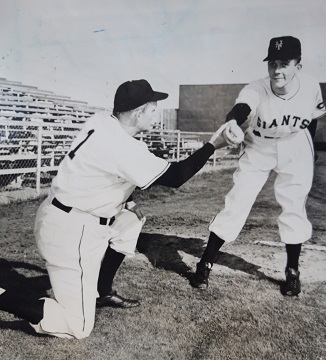
Spring training, New York Giants, 1952:
Dutch superstar pitcher Hannie Urbanus
and Giants manager Leo Durocher.
     Hannie Urbanus died Friday in The Netherlands at age 93. This is stunning to me because I thought he long ago had left us.
     He was my first baseball hero. 
     In fact, he was the only baseball player I knew of until we came to the United States in early 1956.
     Of course, that name will be foreign to you ... unless you are -- or were -- Dutch, and only then if you were a sports fan, or more specifically a honkbal fan. That's the Dutch word for baseball.
     Hannie Urbanus was the superstar of the sport in our home country, a right-handed pitcher for the OVVO team in Amsterdam. They were the Dutch  Yankees, the perennial 1950s champions.
      He was good enough to warrant a month-long spring-training stay with the 1952 New York Giants, the reigning National League champions. It was more of an exhibition appearance rather than a tryout. When he returned to Holland, he resumed leading his team to championships and as the No. 1 pitcher for the national team.
      Baseball was far from a major sport in The Netherlands in the late 1940s and early 1950s when we lived there. Soccer (voetbal) was the  sport most people cared about, although other sports that were popular included cycling, swimming, speed skating, basketball, track and field, field hockey, and an odd mixed-gender sport called korfbal -- a derivative of basketball, without dribbling --  in which Holland was the world's best. 
      Here is how I learned about Hannie Urbanus and baseball:      
    In 1955 (the year before we left), the Blue Band margarine company in Holland sponsored a series of small publications -- 10 books in all -- titled 40 Sporten en Spelen in Woord en Beeld (40 Sports and Games in Words and Images). 

      Here was history, highlights, photos, rules of all these sports. It was great for a kid who was absorbed in it all and loved to read. Soccer was the main emphasis, of course, and there were only two relatively small sections on honkbal/baseball. 
      Still didn't understand the game much because we'd never seen it played, even though home base for Hannie Urbanus and his OVVO team was in Amsterdam.
       To collect the books, and the paste-in photos, I suppose, we had to buy lots and lots of Blue Band margarine. And we did.
       Those books, bound together in a neat folder, came with us to the U.S., and they're right here -- barely holding together; they're fragile  -- on a shelf to my left as I type this.
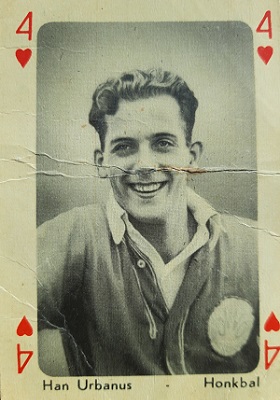
       And here was Hannie Urbanus' photo from that book (which also is online now). 
      Seeing notice of his death today sent me on a Google search for Hannie Urbanus. Here, from www.knbsb.nl, is the headline on the best story -- really his life's story -- that I found: 
        honkbal icoon, heuvel legende, en hall of famer han urbanus overleden 
        Translated: Baseball icon, hill legend and Hall of Famer Han Urbanus passed away 
---
     Here is the first portion of that story:
 
IN MEMORIAM
... Han Urbanus ...
(1927 - 2021) ...
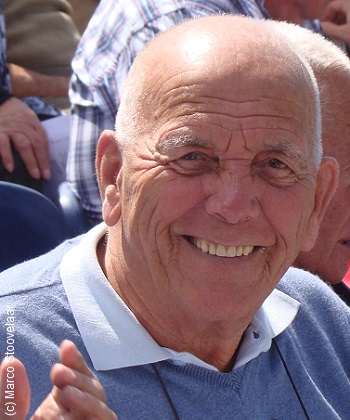
(© Photo: Marco Stoovelaar)

Han Urbanus , who played in the Dutch big league in four decades, pitched eleven no-hitters and played for the National Team for 17 years, passed away on Friday (February 5) at the age of 93. With the Netherlands National Baseball Team , Han Urbanus won seven consecutive European titles. Urbanus also participated in Major League spring training with New York Giants, was a member of the Dutch Hall of Fame, and was a living legend and Dutch baseball icon.
 
   Consider some of his feats: 
     -- Eleven no-hitter, from 1954 through 1961  (take that, Nolan Ryan). That included nine for OVVO and a couple in the rivalry national-team games with neighbor Belgium. Twice (1954, 1956) he pitched two no-hitters in one season.
     -- He was selected the Dutch major league's "Best Pitcher" five times (1953-55, 1957-58), and set a league record for strikeouts (213) in 1955, a record that stood until 1980. He was the league MVP three times (1954-55, 1961).
     -- He also played second base and shortstop at times for OVVO and the national team, and was a solid hitter with home-run power. In 1959, he was the league's Best Hitter with a .348 average.
      -- He played in 64 international games, a record at the time of his retirement. 
      He played in the highest division for four decades (1947-70) and his 24 seasons was a long-standing record.
... On the left a unique playing card with the portrait of Han Urbanus ...
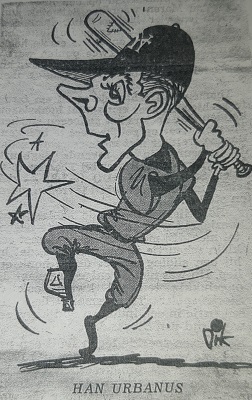
... On the right a caricature made by the famous draftsman ...
... Dik Bruijnesteijn, which was used in newspapers ...


---
     In 1952, at age 24, he received a unique invitation -- the first European player to take part in one of America's major-league spring training camps. It was the Giants' camp in Phoenix that included BobbyThomson (whose famous pennant-winning home run was the previous October), Wes Westrum, Alvin Dark, Sal Maglie, Monte Irvin, Hoyt Wilhem, Jim Hearn, Larry Jansen ... and a young Willie Mays.
    The manager was Leo "The Lip" Durocher. Frank Shellenback was the pitching coach.
      From the story:  
 A year earlier, Urbanus had been interviewed by Albert Balink, the publisher and editor of 'The Knickerbocker,'  a Dutch/American magazine for Dutch immigrants in America. It was Balink who arranged the trip to promote and stimulate baseball in Europe. 
      When Urbanus received the invitation in February, he worked as an assistant accountant at an Amsterdam office. His employer immediately gave him the opportunity to travel to America. ... In an interview in Het Parool at the time, Urbanus said: "I just wonder if I will be able to keep up with the level. And if they ask to remain as a professional, I refuse firmly.'' He was described as 'a calm and jovial man of 24 years old.' "
... Han Urbanus receives instructions from ...
... New York Giants Pitching Coach ...
... Frank Shellenback ...
    When Urbanus returned a month later on March 15, he brought back an instructional video and in the weeks and months that followed he traveled across the country to lecture on pitching, what he had learned and what it's like to participate in a professional training camp. All these lectures were organized by clubs or the union in canteens or rented halls that were packed with many baseball enthusiasts. In an article in the Algemeen Dagblad, Urbanus said: “To my great surprise, I have experienced that in America people throw completely differently. Besides, I learned that the pitchers are completely focused on pitching and not hitting themselves. '' Urbanus also wrote many articles about pitching and the correct way to throw a ball in Baseball News.
---
    And then there was the Urbanus tie-in to Texas. 
    His grandson Nick Urbanus, who was a star in the Dutch leagues playing for the Amsterdam Pirates, signed with the Texas Rangers' organization in 2011 and was a middle infielder in the rookie leagues and Class A for four seasons.  But he never hit much here, and returned to play in Holland.
      Throughout his life, Hannie was a constant -- and revered -- presence at any baseball gathering of note in The Netherlands, and also in Europe. He remained visible almost to the end, always the ambassador for the game.
       And always a Dutch hero, including one baseball fan in Fort Worth. Hannie preceded even Mickey Mantle.

Wednesday, February 12, 2020

The strange, sad story of Don Bessent (and a connection)

    One of the saddest stories we encountered in our journalism career involved a 1950s baseball pitcher and where, when and how he died.
1957 Topps card
     The man's name was Don Bessent, the place was Jacksonville, Florida, the time was July 1990, and the circumstances were tragic.
     It was a self-imposed tragedy -- with alcohol as the cause.
     The details of his death and his baseball life are in the Los Angeles Times story below, published four days after the incident. I suggest you read that, as gritty as it is.
     Background info and connections:
     -- This ties into our blog a couple of days ago on The Boys of Summer, the Brooklyn Dodgers' 1950s teams and the book, and its author, Roger Kahn. 
     -- Don Bessent was a right-hander with much talent -- a hard thrower -- for the Dodgers from 1955 through 1958 (so Brooklyn the first three seasons and their first year in Los Angeles in that monumental move). 
     -- He was not mentioned much, if at all, in Kahn's book, focused on the 1952-53 Dodgers teams. Bessent was in the U.S. Army those years. But subsequently he was a teammate of most of the book's (and team's) stars, and Kahn is quoted talking about Bessent in the LA Times story. 
     -- And our connection? We were in Jacksonville, my first year at the Florida Times-Union, when news of Bessent's death broke. 
     It was a newsside story, really, but the sports angle helped enhance the coverage of the story. (Bessent's baseball career led to our department's follow-up efforts.)
     On that Monday, I happened to be in the 3:30 p.m. news meeting in which the contents of the next day's paper were outlined. Did not usually attend those meetings, but likely was there because the sports editor and assistant sports editors had the day off or other tasks.
     Among the stories newsside was covering was the death of a man inside his car parked outside the Wendy's restaurant near the Five Points intersection close to  downtown Jacksonville (and not far from our offices).
     That was on Saturday, but the police report apparently was not available to our reporters until that Monday morning.
     Sounded like a strange, sad story. And when the newsside editor said the man's name was Don Bessent, it got this baseball fan's attention. I remember saying something like: Hey, hold on, let me check on that. 
     I knew that name. Had to think, to try to place it. Had no idea about his Jacksonville background, but I knew it was a significant baseball name.
      Meeting broke up; I went to my desk and to the baseball guides on file and ... boom. Yeah, he pitched for the Dodgers in the 1950s. He is a local guy. It was a "wow" moment. 
       Back over to newsside to tell them: This is a significant sports name here. 
        As I recall, the newsside did its usual thorough job of coverage, and a day or two later, one of our sports columnists wrote a very nice piece on Mr. Bessent.
     He was 59 when he died. He had been out of baseball for 28 years by then. Lord knows the troubles he'd seen.
     He had two significant times of glory: 
     (1) As a rookie in 1955, he was part of the only World Series championship for Brooklyn, and his contribution was an 8-1 record after coming out of the minors to join the team near midseason;
      (2) Pitching in the 1956 World Series against the Yankees -- the team that originally signed him out of Lee High School in 1959 -- he was the winning pitcher in Game 2, working a strong seven innings (six hits, two runs) in relief. He stopped the Yankees for most of the game as the Dodgers, behind 6-0 after 1 1/2 innings, tied it with six runs in the second and rolled to a 13-8 victory.
      But he never blossomed into a major-league star; arm troubles curtailed his effectiveness. Although there are 1959 Dodgers baseball cards of him, he was in the minors that year and three more.
      In his final season, 1962, he pitched in 10 games for the hometown team, Jacksonville, in the International League. And then he was out of the game.
      In searching Google for information for this piece, we found the obituary for his widow, Joan, who died in Jacksonville last July 2 at age 85. 
      (Interesting sidelight on the LA Times story below: It mentions that Bessent was tipping off his pitches and the Yankees used whistling to alert their batters to what pitches he was throwing.).
      He was known in the Dodgers clubhouse as "The Weasel," a quiet guy respected as a loyal teammate. Good to know. It softens what was a difficult ending.         

Death of Bessent Is Special Tragedy : Baseball: Former Dodger pitcher is found in Florida parking lot, a victim of alcohol poisoning.

By ELLIOTT ALMOND, TIMES STAFF WRITER, JULY 11, 1990
    Perhaps Don Bessent was not the best known of the fabled Brooklyn Dodgers. He was a young role player among the Boys of Summer.
   Still, his death Saturday at 59 will be marked by a special sadness because of its tragic elements.
    Bessent, who pitched for the Dodgers from 1955 to 1958, died in the parking lot of a fast-food restaurant in Jacksonville, Fla., while employees watched.
    The Jacksonville Medical Examiner’s office reported that Bessent died of alcohol poisoning, aggravated by cirrhosis of the liver. The report said he had a blood alcohol level of 0.35% when he died, sometime between 4 p.m. and 5:30 p.m.
     Employees of the Wendy’s restaurant where he died said they noticed Bessent was slumped in his car in the parking lot. Police have not determined why he was at the restaurant in the upscale Riverside neighborhood of Jacksonville. Nor do they know where he had been earlier that day.
     Employees said Bessent at first said he was OK when they offered assistance, but later asked for help. They told police that assistant manager Cesar Taracena threatened to fire them if they called for help.
     Two employees, however, approached an off-duty police officer who called paramedics, said Sgt. Steve Weintrab of the Jacksonville sheriff’s office. The paramedics declared Bessent dead when they arrived.
     Mark Starbuck, a regional vice president of Wendy’s franchises in the Jacksonville area, said managers are not trained to handle the kind of emergency Tarcena encountered.
      Starbuck said restaurant officials are cooperating with an investigation by sheriff’s deputies and refused to discuss the situation.
      He said Taracena was fired Tuesday. Taracena refused to comment on the situation.
      Bessent’s death in his hometown ended a life that once was promising.
      Although overshadowed by such Dodger stars as Pee Wee Reese, Jackie Robinson, Roy Campanella and Duke Snider, Bessent made his mark--first as a starter, then as a reliever--in four seasons.
     He was best remembered for his World Series performances, pitching against the New York Yankees in five Series games in 1955 and ’56. He was 1-0 with a 1.35 earned-run average in 13 1/3 innings.
     Bessent, who grew up in Jacksonville, was called up to the Dodgers from their triple-A farm club in St. Paul, Minn., in 1955, at the same time as Roger Craig, now manager of the San Francisco Giants.
     The rookies were called when the team slumped in mid-summer after a 25-4 start. They gave the Dodgers a welcomed lift by pitching complete-game victories in a doubleheader against the Pittsburgh Pirates.
     Bessent went on to finish 1955 with an 8-1 record and a 2.70 ERA. In 1956, he was 4-3 with a 2.50 ERA and had nine saves. He was only 1-3 with a 5.73 ERA in 1957, then was 1-0 with a 3.33 ERA in 1958, the Dodgers’ first season in Los Angeles.
      “Don Bessent won my 27th game for me in 1956,” said Don Newcombe, one of the Dodger starters. “That save always reminded me Bessent was involved in helping me win the Cy Young (Award).”
      Teammates have fond memories of “the Weasel,” as they nicknamed him. Although Bessent was a quiet, well-mannered youngster, the Dodgers respected him.
     “He was quiet in his own way, but he would go to war for you,” Don Drysdale said. “They always talk about Dodger starters, but I’m the first one to say, ‘Hey, let’s talk about our bullpen, too.’ Don was part of those early great bullpens.”
     Newcombe recounted the time the Dodgers were barnstorming in Japan in 1956 when he and Roy Campanella, both blacks, were barred from certain establishments. Bessent and Bob Lewis refused to join their white teammates at such social gatherings, opting to stay with Newcombe and Campanella.
     Newcombe said he particularly respected Bessent for staying behind even though Bessent grew up in the South.
     Roger Kahn, author of “The Boys of Summer,” said Bessent’s quiet manner perhaps kept him from being more famous. But Kahn marveled at Bessent’s fastball, which many catchers did not want to catch because of its velocity.
     “His personality was recessive,” Kahn said. “He was just one of the many promising kids who came out of the Dodger system. One of the curious things was that they produced so many promising pitchers who blazed briefly and then expired. After the first year, we thought he would win 20 games.”
     Instead, Bessent was relegated to the bullpen, from where he could intimidate hitters with the fastball for a couple of innings.
      Drysdale recalled the frustration of having the Yankees read Bessent’s pitches, which encompassed a fastball and a curve. He said every time Bessent was about to throw a curve, they would hear a whistle from the Yankee dugout.
     “We couldn’t figure out why,” Drysdale said. “Later, we learned that every time Bessent threw a curve, he stuck his tongue out.”
      Bessent finished his big league career with a 14-7 record, a 3.33 ERA and 12 saves.
      He teamed with Clem Labine and Ed Roebuck to form one of the league’s best relief staffs.
     Bessent developed arm trouble in 1959 and retired in 1962 after four seasons in the minors.
      He graduated from Jacksonville Lee High School in 1949 and was drafted by the New York Yankees. After pitching for the Yankees’ farm club in Norfolk, Va., he was left unprotected and picked up by the Dodgers in the 1953 draft.
      “One thing that could be said for Don, he always went out strong every time he pitched,” Carl Erskine, a Dodger pitching star from the era, told the Associated Press.