Showing posts with label high school football. Show all posts

Tuesday, January 8, 2019

He ran into history, and lived a life

      He was one of our "Cinderella" Knights, a significant one who made a run into history.
      For me, James Rice was the older kid who lived in the next block on Amherst Street in Sunset Acres, a nice guy, always friendly. And he could run fast.
      He was one of my heroes, like so many on those first two Woodlawn Knights football teams. But we especially loved our guys (and gals) from Sunset Acres.
      So it was with some sorrow when the well-after-the-fact news came -- from a couple of sources -- that James Dewayne Rice died October 23, 2018, at a nursing home in Shreveport, age 74.
      Had not seen an obit in the paper. What we did see, confirmation of his passing, was a "findagrave" post.
      James Rice -- football halfback and safety (even at 130 pounds), track sprinter, hard-working and dedicated in athletics and as a longtime hotel/motel employee and manager, responsible older brother, husband, father, grandfather ... friend.
      Another loss from "The Team Named Desire." Don't like those. That team, as a whole, was among the biggest winners we have ever known.
      And it is with some surprise to learn that James' life wasn't a Cinderella story, that what followed after the "Camelot" chapters was an often mixed journey.
      As with many of us, most of us, there was success and struggle. Happiness, and sad times. 
      Turmoil at home in his early life. Love, a lengthy marriage (to Phoebe), and divorce. Two children (a daughter and a son who is a Notre Dame graduate), and then estrangement. Good jobs, steady ones, and then failure. Several moves -- to points east. One grandson, and although there was distance, monthly financial aid almost to the end.
      In the last few years, there was dementia/Alzheimer's, Parkinson's, diabetes, alcohol, a move back to Shreveport, a place to live and with two women (his younger sister and her best friend) looking after him, stays in hospitals and nursing homes ... and the final decline.
      But our memories, and those of good friends, are sweet.
      "He was very reserved, quiet, and very smart," said Jerry Downing, one of his closest friends in the Sunset Acres years, a teammate on many athletics teams.
      "He was, to me, the golden boy," said Andra Wilson, who in high school dated James steadily for a year and then on-and-off after that. "He was supposed to have had a successful life, not only financially.
     "He was disciplined, made excellent grades ... worked a  parttime [filling station] job."
      Johnny Maxwell, a longtime hotel/restaurant operator in Ruston (and other places), was one of James' benefactors, and his longtime boss. 
     "I thought a lot of James," said Maxwell, 81, still a Ruston resident. "He was a good guy, a kind guy; he would do anything for anybody if he could.
     "I loved him like a brother. I tried to help him along."
     Connie Reed Roge' literally loved him like a brother. She was his youngest sister (nine years younger), a premature baby (1 1/4 pounds at birth), and so there was a bond.
     In Sunset Acres, their mother worked, the stepfather was in-and-out and difficult, and James often was in charge of the four younger children (whose last name was Reed).
     "He took care of all of us, babysat us all the time," Connie recalled. 
     She mentioned that the teenage James, while Mom worked, liked talking on the phone to his girlfriend, perhaps a little longer than what was acceptable.
     "Don't tell Mama, don't tell Mama," he instructed his siblings. But to be sure that would not happen, he promised to make oatmeal cookies for them. A bribe.
     He had the recipe, perhaps from home ec classes, and kept the recipe for years. "He could cook," Connie recalled.
     When their mother died in 1969, Connie was 16, James was working in Ruston, and he helped her move in with an aunt and checked on her often.
      "We were always close," Connie said, "but after a while, he moved away. So we kept in touch by phone, but didn't see each other much because of the distance."
      Her payback to him would come decades later.
---
     When we knew him, he had gone through Sunset Acres Elementary, then Midway Junior High, a sophomore year at Fair Park High and on to Woodlawn when it opened in the fall of 1960.
     Which brings us to football.   
     On October 19, 1960, junior halfback James Rice -- small, thin and fast -- made history: He ran 57 yards for the first varsity touchdown in Woodlawn history.
     After the Knights had been shut out in their first four games, James hit the end zone -- and he did it against the school that would become our arch-rival, Byrd, and against a Byrd team that was ranked No. 1 in the state and would go unbeaten that regular season. I won't bother to give you the score of that game, but Woodlawn had 6 points.
     (Bobby Glasgow, a sophomore that year, will tell you that he scored the first Woodlawn touchdown -- and he did ... but for the B-team a week earlier. It was a varsity game, but only for Haughton.)
      James had been a B-team back for Fair Park in 1959, then came to Woodlawn with a rag-tag bunch of players -- a few seniors, but a lot of juniors (transfers from Byrd, Fair Park and Greenwood) and sophomores fresh out of junior high.
     Wrote about that team in the first year of my blog, almost 6 1/2 years ago: http://nvanthyn.blogspot.com/2012/08/the-team-named-desire.html
     James started two seasons for Woodlawn -- the awful first season (0-9 record), the second (his senior year) a glorious, astounding district championship -- a 9-2 regular-season record in which they kept winning games with fourth-quarter heroics. The Knights' first playoff game followed.
     That very small physical team -- Rice at 140 by his senior year had lots of company in the "lightweight" category; an offensive guard weighed 145, a tackle 165. Only one starter, a tackle, had any real size (for then) -- 195 pounds.
     This was a quick, supremely conditioned, mentally tough -- and talented -- team. The Team Named Desire. The "Cinderella" Knights. A Cinderella story.
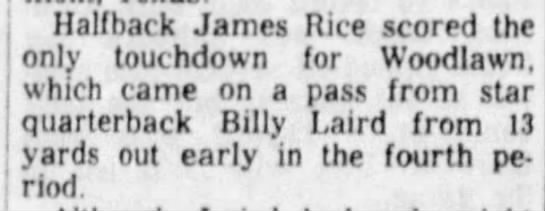
      There were a half dozen future college players -- some all-conference ones -- on this team. Not James (too small), but he was one of the top stars. Check the clippings. And he scored the final touchdown of the season -- in the state playoff game. 
      Downing was the 160-pound center on those teams (and the starting catcher in baseball), and always James' friend. He lived two blocks away on Sunnybrook, across from the well-known scout hut on the Sunset Acres Elementary grounds.
      "He was in my first wedding," Downing said, "and we each delivered newspapers, we had newspaper routes. We would go near the A&P store in the Sunset shopping center early in the mornings to pick up our papers, and vendors would leave us honeybuns and chocolate milk. The store manager was OK with that, as long as we cleaned up the area. We were barely teenagers.
     "We played on a lot of teams together. Everyone knew he was a fast runner."
     And in high school, they often joined with [end] Ted Bounds for, well, some joy rides in Ted's Rambler.
     Downing, too, was at Louisiana Tech at the same time as Rice, and "we had a great time playing flag football.
     "What a great loss, and I hope to see him again on the other side. ..."
      Ronnie Mercer, at 135 pounds, was James' partner at safety in football and also a good friend through the La. Tech years.
      "When we were in Ruston, we lived in a four-plex and James and Phoebe were our next-door neighbors," Mercer recalled. "I don't think I ever saw him angry, which was a complement to the angry person I was.
     "He deserves to be written about. He was a man of tremendous heart."
     Mercer remembered one football incident at State Fair Stadium (now Independence Stadium)
      "Don't remember who we were playing, but we were on defense and James made a tackle and it knocked him goofy," Mercer said. "He actually went and lined up in the other team's huddle. I don't think anyone noticed until they broke the huddle to run the play. Then one of the referees noticed. But I guess he was going to run the offensive play for the other team."
      In the long run, Woodlawn football was a memorable experience for James Rice, for all of us 1960s kids. The long run of his life -- a little more than 57 years after that 57-yard run -- was a bigger test.       
---
      College was in his plans, but money was short. His stepfather promised to pay to start his education ... if James would work at his filling station that summer. But the deal fell through, and helped was needed.
      It came from then-Woodlawn counselor Mary Higginbotham, who had Louisiana Tech and Ruston connections (and a year went to work at Tech).
     Mrs. Higginbotham called her friend Johnny Maxwell, recent new owner/operator of the Holiday Inn near the Tech campus, and asked if he could find James a job and a place to live.
     "I can do that," Maxwell told her. Some of us remember James working at the Holiday Inn during his college years and then becoming a fulltime employee, first as restaurant manager.
     He met Phoebe, married and soon they started a family.
     After some years, it was time to move on. After a job for a food company in Jackson, Miss., James knew Maxwell had bought the Holiday Inn in Oxford, Miss., and asked if he had a job for him there. He did: manager.
     He was a neat dresser and he learned to do the maintenance job required to keep a hotel/motel in top shape.
     From there, it was on to another hotel managing job in Augusta, Georgia -- home of the Masters golf tournament. One year Maxwell took his son and grandson to the tournament, and James arranged tickets and a place for them to stay.
     After the divorce, as Maxwell recalled, "he went off the radar for a number of years" and moved to Meridian, Mississippi. 
     Some years later, Connie got word that there were gaps in James' managing his life.
      She and husband Harold went to Meridian, packed up his belongings and brought him back to Shreveport. Contact with his ex-wife and children ended, but his grandson remained in his thoughts.
---
     He loved going to church, loved the dog "Lil' Man" he was given, took him for walks every day at the Southern Hills recreation park. He worked in gardens and tended to roses he planted.         
     Over the past couple of weeks, Connie and Shirley Weaver have put together memories of James for the memorial, which will happen two days before what would have been his 75th birthday.
     "I am glad that he did not suffer long," said Connie of the last part of James' life. 
     "He was such a kind, loving person," said Shirley, "... He was loved by many." 
      And in the final year, some old friends -- Maxwell, some of James' working employees, and a few Woodlawn buddies -- came to visit him.
      Long-ago girlfriend Andra Wilson, reflecting on James' final years, said the stories she heard "have kept me aware; I have had nightmares ... James was kind of a naive guy, but he was sweet."
      As Connie worked to arrange a memorial, she said, "Talking to all of ya'll [James' old friends] has helped me with closure about James."
      Because he loved the song The Rose, the Conway Twitty version, that will be part of his memorial.   
       He will be -- he is -- fondly remembered by many of us. He not only ran into history, he ran into a place in our hearts and memories.
---
     A memorial for James Rice (WHS Class of '62) is scheduled Saturday, January 19, 1 p.m., 11055 General Patton Avenue, Shreveport (Connie Roge's house). Please contact Connie at 318-453-4902 or 318-687-6369 if you plan to attend, and share your thoughts at the memorial.


Saturday, August 4, 2018

A flying trip to Tennessee for a special visit

     This photo has significant meaning for those of us who were Woodlawn High School football fans in the 1960s.
     What makes it special is not only the seven men pictured here, but where it was taken -- Lawrenceburg, Tennessee.
     The man on the left is Coach Jerry Adams, who has lived in Lawrenceburg with his large and -- editorial comment here, beautiful -- family since 1974.
      Primarily, he is the reason for this gathering. 
      Because the six men on the right in this photo -- (from left) Joe Ferguson, Clinton Ebey, Coach A.L. Williams, Ronnie Frazier, Coach Ken Ivy and Cayce Hand -- got on an airplane and flew to the deep south central Tennessee town and visited the Adams Family. 
     That Thursday, July 26,  was a good day for these Knights of old. It was a mini-reunion they all relished.
     "It was pretty good little time," Adams said of the four-hour-plus gathering at the big, old two-story house on a  corner spread in the neat old city. 
      In the 1968 season -- the greatest year of a decade of Woodlawn football excellence -- this group was much of the heart of the Louisiana Class AAA state championship team that went 14-0.
      Here were the three All-State players from that year -- Ferguson (the superstar quarterback), Frazier (defensive end) and Hand (cornerback) -- and the standout linebacker (Ebey) who made the most memorable and heads-up play of that perfect season.
      And here were the three coaches still living from that staff -- Williams (head coach), Adams (defensive line/linebackers) and Ivy (B-team football, head basketball coach and even tennis coach). 
     All have fond memories of those coaches no longer with us -- Billy Joe Adcox (offensive line), W.B. Calvert (ends) and Lowell Morrison (defensive backs). 
     Just about anyone who knew the 1960s Woodlawn coaches remember and still respect these men, beginning with the first head coach, Lee Hedges, who by 1968 was at Captain Shreve High.
      So here at this reunion was a time for stories galore, for reminiscing and for catching up with the most lively, most demonstrative, versatile and -- my opinion -- most interesting member of that coaching staff.
      Coach Adams was fun, mischievous at times, but also serious about coaching -- and winning. He was the slogan creator, the "fire-'em-up" guy, but also the main one appealing to players' pride and determination with the reminders that "you've got to want it the most."
       In that regard, he was much like his father-in-law, Miss Pat's Dad, the Neville (Monroe) High coaching legend Bill Ruple. (Personal note: Believe me, I have heard many an Adams-told Ruple story.)
     The Adams crew made frequent trips back to Louisiana, to Shreveport, Ruston (Coach's hometown, where in 1948 he was an All-State running back for Ruston High and then played some at LSU) and Columbia, where the Ruples had a farm. 
      Many Woodlawn people only saw him occasionally after 1974. When we were living in Knoxville, we made several visits to Lawrenceburg and were the Adams' guests some nights. 
     (In case you were wondering, Adams is 87 with a birthday next month, Williams is 83, Ivy 80, and the players either 68 or 67.)
---
      Ferguson and Ebey, who have stayed in touch and remained good friends for decades after their WHS and college playing days, generated the idea of the visit, having talked about it for several years. 
      Ferguson, with his long University of Arkansas ties,  lives in the Fayetteville area and has worked in real estate since the end of his nearly four-decades playing and coaching days. Ebey, who played at Northwestern State, has lived in Kilgore (actually on Lake Cherokee) for 11 years, but travels a great deal as regional manager for Ranger Boats.
      "We planned to drive up there," said Ebey. But when they told Hand -- also still a good friend through all the years -- he had a better suggestion.
      They could fly in the airplane Hand, who has a very successful construction company in Shreveport, shares with  partners. 
      And they did, with Cayce going along and paying the way.
      So in the seven-seat King Air plane, there was room for Frazier, who also played at Northwestern State and now lives in Stonewall (just outside Shreveport), having retired from insurance and then concessions-distributing careers, and the two coaches.
          "You know how Coach Williams is," Ebey said. "He doesn't miss anything, anywhere." Meaning, if there is a reunion or meeting or -- unfortunately -- memorial/funeral service that has touched the Williams' lives, A.L. and Sarah will attend, if possible.
      "Joe called me and said, 'What are you doing Thursday?" Coach Williams said. "I had to check with Sarah to see what was on the calendar. And it was clear that day."
      So he was in. So, after another Ferguson call to Sarepta, La., was Ivy, who lives on his family's old farm in his little  hometown. He has been retired for 10 years after 48 years of coaching.
      Ebey drove to Shreveport to board the plane with Hand and Frazier; they flew to Ruston to pick up Williams and Ivy, then to Bentonville for Ferguson (AKA "The White Knight.").
      Adams knew they were coming, but he wasn't entirely clear when. Ferguson texted Teri Adams Shackleford, youngest of the four Adams children and told her "we'll be there in an hour and a half."
      "I was going to do all these things -- send a bus, hire a driver, order barbecue ... I was going to do the do," said Coach Adams. "But it was a little rushed, so some it was unplanned."
      But ... get this. Bill Adams, son of the father and now head man at the Adams' Rent-Right store that Coach and Mrs. (Pat) ran for years, is also a part-time preacher and operator of a trailways bus company for tours and trips.
      So Bill drove one of those big buses to the Lawrence County airport to ... pick up seven people. On the return trip, Coach hired a driver to take them back in the bus.
      A bit much?
      "Aw, you got to put a little mustard on it," Coach Adams said. "Not gonna send a school bus out there."
---
      The barbecue meal came from one of Coach Adams' former quarterbacks at Lawrence County High. It must have been good, but probably not as good as the conversation.
      "We talked about everybody," said Ebey, "seems like we talked about everybody who played at Woodlawn."
      Anyone who has been around Williams, Ivy and Adams knows that they did the majority of the talking. The four ex-players were happy to listen.
      But Adams said it was a fair distribution: "Everyone gave way to everyone else; there was not a major guy. Everyone had their part to say. ... I was pleased with the sincerity."
      No doubt, one main topic was Ferguson's predecessor at QB for Woodlawn, the once-blond haired, strong-armed, four-time Super Bowl champion Pittsburgh Steelers hero and Hall of Famer. Terry Bradshaw almost delivered a state championship for Woodlawn; Ferguson -- for most of us the greatest high school QB we've seen -- did so three years later.
     One great memory was Ebey's play in the 1968 state quarterfinals, a Saturday afternoon game in New Orleans against Holy Cross.
    (Woodlawn's team two weeks in a row flew to playoff games in NOLA, an unheard-of luxury then and maybe now.The program by then was so established, so popular and so well-off financially that the coaches had planned before the season to explore the possibility of chartering a plane for lengthy playoff trips.)
     It was a get-even game for Woodlawn. Holy Cross had eliminated the very surprising 1967 Knights in the state semifinals, only to lose in the title game to Airline (Bossier City). 
     Woodlawn had beaten those Airline champs in the season's fifth week when, abandoning an ineffective running game after halftime and throwing on almost every down, Ferguson went from promising young QB to the memorable, accurate, quick-delivering passer for years to come. He was 29-of-48 for three touchdowns and a then-state-record 317 yards in a 28-14 upset.
     Against Holy Cross this time, turnovers got Woodlawn in early trouble and a 13-0 deficit in the second quarter. Then Ferguson, as usual, got the passing game cranked up. It was 13-7 at the half, but the Knights were on top 21-13 by the time they forced a Holy Cross punt in the third quarter. The bouncing ball was at the Woodlawn 45 when a Holy Cross player batted it down it ... but the ball was still moving.  
     Ebey knew the rule. It was not a dead ball until touched still or picked up, and with an official's whistle. In this case, no whistle.  
     So Clint, part of a talented linebacking pair with Frank Racine (a fast, rangy player who went on to start at a safety for LSU), picked up up the ball and raced the 45 yards for a touchdown while a stunned Holy Cross team watched. Woodlawn went on to roll 35-13. 
     Of course, for years and certainly in Lawrenceburg, that play has been recalled.
      It was a big game, too, for Hand -- two interceptions and a fumble recovery at the Holy Cross 13, which he fell on but easily could have run in for a touchdown. And, well, Ferguson that day was sharp throwing the ball.  
---
      Adams and Williams, as part of the original 1960 Woodlawn staff, were at the school longer than the others. Adcox and Calvert moved on after the 1968 season, and Adams became the first head coach at brand-new Southwood in the fall of 1970. 
      After four years at Southwood, Adams -- for a variety of reasons -- moved his family to Lawrenceburg, influenced by a former Shreveport neighbor who had moved there. Some land and a coaching job were two of the reasons. 
      Williams stayed at Woodlawn through the 1973 football season, winning a district title his last year (his fifth as head coach, the seventh -- in 14 years -- as a staff member). He went on to be head coach at Northwestern State and then his alma mater, Louisiana Tech, and settled nearby in Choudrant.
      Ivy came from junior-high coaching and summer swim team coaching to Woodlawn as a coaching-staff addition in the fall of 1965. He stayed longer (15 years) than any of the First Five coaches.
      His primary sport early on was basketball. In only his second year as head coach -- after WHS basketball had been a doormat, mediocre-to-worse program for six years -- the team went 24-5. His third team was 33-3 and the Class AAA state champion in 1969, giving the Knights a "double" to go with the football title.
     Ivy's Robert Parish-led teams were state runner-up and then state champion in 1971-72. He soon gave up basketball to begin coaching football full-time. 
     With Lowell Morrison -- Cayce Hand's primary position coach at Woodlawn -- as head coach and Ivy as chief assistant, Knight teams in 1976-77-78 reached the state semifinals. Morrison went on sabbatical and Ivy was the head coach in 1979 (9-3-1 record), then -- following Adams' path -- moved to Southwood as head coach for three years (1980-82), with records of 10-1 and 9-2 the last two seasons.
      His well-traveled path took him to Marshall, Texas, and Sarepta, and finally to Captain Shreve for seven final years as head football coach until his retirement in 2008.                 
      Adams, as he had years before, was on Ivy's case, especially because of Ivy's deafness in one year. "Gave him hell," Adams said, laughing. "HEY, IVY, CAN YOU HEAR ME?
      Ivy's retort: "Adams, you haven't changed a bit."
---
      "The coaches taught me never to give up, work harder than the competition, give 100 percent," Hand said. "It helped me in life and in business."
      "We always knew that the coaches cared about us, as players and off the field," Ferguson said.
      "As coaches, we were grateful to the parents to letting us borrow their kids, and we felt like they were ours, we tried to treat them like our own children," Williams said. "All these years later, we still feel like they are ours."
      "We tried to talk to the kids about bigger things than sports," Adams said. "About life, about responsibilities and accountability, about careers and having families and kids."
     For him, there was a confirmation from the time with his recent guests.
     "The biggest thing I got from it," he said, "is that some of the people up here [in Lawrenceburg] could see what I have been talking to them about for years, how good those years [at Woodlawn] were."
     Health issues in recent years, such as knee replacement for his long weak knee that cut short his college football career (at LSU and then one year at Louisiana Tech) and a faulty aorta valve that needed replacing, are a part of his life now.
     And this, which he did not tell the Woodlawn group at the meeting but did share with a couple privately -- and with me, with permission to write about it: For several months, he has been dealing with cancer.
     Melanoma in his back required surgery and (ongoing) chemotherapy. 
photos provided by Teri Adams Shackleford
     "I don't want to deal with the details -- the drugs involved, the procedures," he said. "I don't go there. Let's just go do what we need to do. If it works, great."
     But he sounded robust and strong in our 34-minute conversation -- which included his usual story-telling, philosophizing bent -- and he looks good in a photo with a promising 10-year-old athlete from Nashville he met with and talked to (about athletics and life) at the young man's grandfather's request.
      Life goes on -- a haircut and toenail job at oldest child Mary's shop near Spring Hill, 30 miles or so up the road where Coach is taking medical treatments, work in the yard and his craftwork in his shop, puttering her and there, coffee with the bunch in downtown, long talks with daughter Sarah (just retired as a college professor), time with the grandkids and great grands.
      He is, I would say, a contented man.
      "He is an absolute wonder," said youngest daughter Teri. "We are so thankful that he is responding to the chemo with insignificant side effects."
     And Coach Adams was grateful for his old friends from Woodlawn coming to Tennessee.
     "I appreciate the pain and effort it took for them to come here," he said. "They seemed to all be fine with it. ...
     "Why would they spend the money and time to come up here. I can't figure that out yet."
      We can figure it out. They wanted some stories and some laughs, and some memories. 
---
Joe Ferguson, an NFL quarterback for 18 seasons (1973-90), talking about today's game.


Tuesday, October 3, 2017

Giovanni-Johnny Piazza: a story, a story-teller

      We knew him as Johnny Piazza, but that's only part of the story. At home growing up he was Giovanni Piazza, and that is Chapter 1.
    Our high school friend, our star fullback/linebacker in 1963, and "Mr. Woodlawn" in the 1964 yearbook, had 70 years of stories stored up.
    So he put together his story -- and his many stories -- in a book, From Giovanni to Johnny, and I think that it is "a good read."
    It is a good read especially if you were a Woodlawn Knight in the 1960s. But it is a good read for anyone because it is about life in general.
    It is, as one of our mutual friends said, "an honest book. His recall of high school was spot-on; I was surprised he had kept all that within himself all this time. ... He kept this spark alive for 50 years. 
    "He captured the feeling of a period; it is a good period piece."
    This self-published, 222-page book is about Shreveport and the United States in the 1950s and 1960s, and then about Johnny's nearly four-decade career as a high school teacher and football coach.
    You will find that, in the end, he has great fulfillment from his career and from his marriage to Rosario, his wife of 28 years, and his children. 
    It is a plain-written story -- with lots of funny tales -- of a second-generation Italian kid growing and trying to find his place in his world. This is a book without harm, without malice.
     Makes one realize (again) that among your high school friends most are just casual friends -- or maybe acquaintances -- and you don't know what really is going on in their lives.
     To me, Johnny Piazza was quiet and polite, a team leader good enough to earn a college football scholarship, and one of the most popular kids in the WHS Class of '64.
      But read the book and you find that despite the outward camaraderie, there was much insecurity that he kept well-hidden. 
      His home life often was a tough one with his World War II Army veteran, policeman father. Johnny calls him his "oddfather" and says his mom was the soft touch. Johnny  came up in "Little Italy" of Shreveport, his Catholic roots showing, and he was teased endlessly about his Italian (more specifically, Sicilian) heritage.
     The "nice guy" we knew actually was a prankster and a bit of a troublemaker early in school; his junior high and high school dating life was a mess; his football playing days were challenging but satisfying; and his adjustment to being an ex-player took a while, as did his finding his career.
      Don't think we ever had a conversation of any detail or substance until Sunday night when we talked for 40 minutes about the book, about Woodlawn, and about our lives.
       "I was retired and I thought I had some good stories," Johnny said, "and I wanted to share some of the fun I had in high school and then as a teacher and coach."
---
       The book captured me in the first sentence of the introduction with a reference to The Beatles' song In My Life, one of my favorites. Johnny goes on to say that the book is "a shout out" to "the people who made my life so wonderful."
      He makes it fun by interjecting trivia-quiz questions (provides answers pages later) and short poems. There are many pop-culture references -- chapters on '50s/'60s music,   television, sports and automobiles. 
       There are lines from popular songs throughout the book.
       There are what I consider courageous chapters on the civil rights movement, the role of minorities in our society, abortion, the hippies, the Catholic church, women's rights and wrongs, and "Barbie." And one less serious one, a farce, on -- yes -- McDonald's.
        Much of the early portion deals with growing up in the neighborhood -- first in the Italian section a block from Texas League Park (later SPAR Stadium), later from deep in Cedar Grove, and all the trouble kids can find. Playing football in the street and on the playgrounds was foreshadowing.
       To be honest, the book includes some ethnic names, locker-room language and jokes, bawdy sexual references (body parts, bathroom humor) and a really smelly chapter on his summer work as a sanitation worker (garbage man).
        And there is an eye-rolling chapter on his U.S. Air Force Reserves' basic training and duty.    
        There are some corny plays on words ("eargasm," "eleckissity," "I don't know jack about Jill," great sets of "ears," "two silhouettes on the shade," "Rigor Mortis dance"). 
        I'm just saying, be warned.
---       
       For our Woodlawn friends, Chapter 11 is titled "Finding Camelot." 
       As an eighth-grader, he declined an invitation to attend the all-boys Catholic school in town (Jesuit), a decision he later regretted. In 1961, he originally was zoned into the well-known, highly regarded old-line high school -- yes, that school on Line Avenue -- and started there in the 10th grade.
       He stayed one long day, asked about football and was refused, realized it wasn't for him, and began skipping school. Found out, he confessed to his parents, and they went to the school board -- and arranged a transfer into the district where most of his junior high school friends were, the new school near Cedar Grove.
Miss and Mr. Woodlawn, 1964:
Sheila Mondello, Johnny Piazza
        His introduction to Woodlawn (page 72) will please just about any ex-Knight. Believe me.
        His loves: He goes into some detail -- but nothing explicit -- about girls he dated (the names are changed). These are nostalgic tales, and Johnny is self-deprecating, almost to a fault, and you can feel his pain at the breakups.
         His friends: His closest friends -- in football and off the field -- are Jack and Mitch, with the woebegone Don as an accomplice in mischief. They had some crazy adventures.
        Also mentioned are the "very truthful" Thomas as their designated straight guy, and Warren as part of a double-date Natchitoches Christmas Festival trip.
         Some photos from that time are there; those of us involved then know the last names. 
         Football: In 1963, Piazza was our best running back and one of the best players on that 8-3-1 team (an indication of how strong Woodlawn's program -- from 1961 to '69, that was the worst record of any team).
         All three losses were by one touchdown to strong opponents -- Bastrop, Byrd and Class AA state champ Minden. The tie, 7-7, was in the state playoffs at East Jefferson (Metairie) on a memorable day: Nov. 22, 1963. (East Jeff won the first-down tiebreaker, 6-5, to advance.)
       Johnny had a tough act to follow; the fullback from 1960 to '62, Tommy Linder, was Woodlawn's first outstanding running back who received an All-American honor and a college scholarship.
        Johnny's football recollections are not exactly what I remember, but I won't nit-pick here. As our friend Warren said, "You are probably the only one who would know those things anyway."
        In a very short chapter, Johnny pays tribute to our quarterback, Trey Prather (with his photo), and his death as a U.S. Marine in the Vietnam conflict. He mentions the other Woodlawn grads killed there, and follows with a chapter on the ugly Vietnam war. Very touching.
        Piazza earned a football scholarship to then-Northeast Louisiana University. He redshirted as a freshman, and paid the price for facing the varsity in scrimmages as new coach Dixie White, who had been an assistant at LSU, began to toughen the NLU program.
       But Jack and Don, who had gone to NLU with him for football, left after a semester, and Johnny -- heartsick for home and a girl he left behind -- decided he'd had enough, too. 
       Coach White told him he was the No. 3 running back on the depth chart for spring training 1965 when Johnny went in to tell him he was leaving. White was not happy.
       Eventually, after a wayward year or two, Piazza returned to NLU, his football desire gone but with new determination to earn a degree and become a teacher and coach.                
---
       And he did. As the book winds down, you sense the pride, pleasure and dedication he took in those jobs.
      There are plenty of stories about teaching American History, geography, civics and drivers' education (separate chapter) and his relationship with administration, fellow faculty and students.
      And on coaching. After nearly three decades as a freshman coach and then defensive coordinator at Southwood, he became head coach at -- as he writes it --  HHS.
      That's Huntington High, and the challenge he took on for five years there was as a white head coach at a predominately African-American school. 
       He three times had applied, and not received, head-coaching positions in Caddo Parish. But this turned out well. 
       After three sub-.500 seasons, the Raiders in 2002 had a 9-3 record and in 2003 went 8-5. No other Huntington teams in the school's 44-year history ever won that many games. 
       In 2002, Huntington won a playoff game for the first time since the school's lone playoff victory in 1980. In 2003, it won two playoff games. 
       In those years, Piazza points out, "We beat every Shreveport-Bossier public school we played." In the 9-3 season, two of the losses -- regular season and playoffs -- were to state superpower Evangel Christian, the private school which beat everyone else, too. 
       And in his personal life, Johnny also "hit it lucky."
Warren Gould, with Rosario and Johnny Piazza.
       He met Rosario, a native of The Philippines visiting the U.S. on a visa, through a date set up by a Filipino student of his. They clicked, and when she went home, he soon followed for a visit. "We got serious there," he recalled, and he asked her to marry him.
       Agreed. They filled out the necessary papers and in the summer of '89, she returned to the U.S. as Mrs. Piazza. 
       They have a daughter, Nicolette, 24. Johnny has two sons from a first marriage -- Chris, 45, and Benji, 43. And through a family connection, they have an "adopted" granddaughter, Sophia.   
      And now Johnny -- the little Italian kid grown up -- has a book.
     "I achieved a lot more than I ever thought I would," he  summed up Sunday night.
---
To order the book: https://www.amazon.com/Giovanni-Johnny-cultures-setbacks-laughter/dp/0692594957 


Wednesday, January 23, 2013

Few have won as much, or as long, as "Corky"

      At every stop in my career, there have been outstanding coaches/people, most of them in Louisiana, where I spent 30 years.
      I've written about some in the past year, and I will again. But today's focus is on the Jacksonville, Fla., area, where I encountered some remarkable coaches in seven years there.
     That was in the late 1980s/early 1990s, and Charles "Corky" Rogers was already well on his way to being a legendary coach.
     There's no doubt now.
     After 41 seasons as a head football coach -- the first 17 (1972-88) at his alma mater, Lee High School, the last 24 at the prestigious Bolles School, Corky's teams have won 423 games, 73 of them in the playoffs, and 10 state titles. All are Florida state records. 
     
Corky Rogers (Bolles photo)
He might hold another -- more dubious -- record. Last January, Corky thought he was going to have shoulder surgery. Instead, tests showed heart problems. The result: Blockage in seven arteries, and immediate septuple heart bypass surgery. Septuple -- look that one up.

      He was 68 then. He wasn't just worried about his future as a football coach; he was worried about his future, period.
      But he made it back, with hard work -- the kind he's always demanded from his players and coaches, and himself. The kind it took when, in 1988, his left leg was badly damaged in a hit-and-run accident with a drunk driver. He coached that season on crutches and endured a dozen surgeries for the injuries. 
      It's obvious from photos I've seen in doing Internet research that he's a lot slimmer than in recent years, and it's obvious from what Bolles did this past season that he hasn't lost his touch as a coach.
      Because the Bulldogs made it back, too -- to a state championship game. For the 13th time since Corky became their coach.
      They didn't win the Florida Class 4A title last month, losing to Miami Washington 35-7 in a rematch of the 2011 state final when Bolles rallied for a 33-25 victory. It was only the third time a Rogers-coached Bolles team had lost in the championship game.
      Will Corky, who turned 69 on Dec. 19, be back for another try? I'm a long way away, and I haven't been in Jacksonville in 18 years, so I don't have that answer. But I would bet he hasn't lost his competitive urge.
---
A younger Corky Rogers
(St. Augustine Record photo)
      I first met Corky Rogers in the fall of 1988, not long after I became prep sports editor of the Florida Times-Union. It was clear that he was an outgoing, personable, media-savvy coach totally invested in his school -- really his school -- his program, his staff and his kids.     

      In the early 1960s, he had been a star football and baseball player for Lee -- one of Jacksonville's three old-line public high schools for whites (with Jackson and Landon). He was a key player when Lee won a 1960 Florida state football championship and a 1961 state baseball title.
      From 1963 to '66, he played wide receiver and cornerback for Georgia Tech under famed coach Bobby Dodd, winding up his college career in the Gator Bowl at home in Jacksonville. He was good enough to get a shot at making the Baltimore Colts.
      He had come back to Lee to coach, taking over as head coach in 1972 at age 28. He had taken the Rebels to 10 consecutive state playoff appearances, with his best teams in the mid-1980s featuring future Florida State/Green Bay Packers stars LeRoy Butler and Edgar Bennett.
       And then, after my first football season in Jacksonville, Corky shook up the prep world there. 
       He made a move from the public school system to the private-school world -- to Bolles, the best-known and arguably most celebrated of some classy private schools in town.
       Plus, he took an assistant coach (Wayne Belger, who had been his first QB at Lee ) with him.
       Perhaps you could term it a controversial move. There was concern that Bolles would "recruit" kids; perhaps it always had. Certainly, private schools search the area for potential students who can enroll as early as kindergarten or grade school.
       Bolles, founded in 1933 as a boys all-military school, had evolved as a coeducational school, with boarding students and top-notch facilities -- certainly the best football facility among Jacksonville high schools. Its nice main campus, on San Jose Boulevard near the St. Johns River heading into downtown, and most everything about the school had the auru of "upper class."
       In athletics, it was known mostly for state-championship level teams in basketball and baseball (Chipper Jones was MLB's No. 1 draft choice out of there in 1990) and especially swimming (a dozen Olympic stars). But football had been only so-so ... until Corky arrived.
       Didn't take him long to build a great program. He brought in a staff that has been stable for most of his 24 years there and athletes from all over, many going on to play college ball and several in the NFL.
        In all his time at Bolles, Rogers' teams have missed the state playoffs once (1992).
        He's always used the simple but tricky Wing-T offense, teaching it with precision and unyielding repitition. He's been a hard-driving, intense perfectionist, but also an approachable, affable guy away from the field. Seeing the available interviews and videos on the Internet, and remembering my talks with him some 20 years ago, he's always believed nothing substitutes for hard work -- like his idol, his father, taught him.
        Back to his record, the 423 victories. It's tied for fifth-most among high school football coaches all-time. Interestingly, the four guys ahead of him -- one of them is John T. Curtis Jr. of Louisiana's John Curtis School (in the New Orleans suburbs) -- and one guy tied with Corky are active coaches. 
        I didn't have anything to do with the other guys. But I do know this about Corky Rogers. He's remarkable.        


Thursday, August 30, 2012

The Team Named Desire

       The first high school football game I saw, 51 years ago, began with a 90-minute delay because the lights wouldn't come on at Shreveport's State Fair Stadium.
       It ended with a touchdown pass on the game's final play. Not only a touchdown, but a spectacular one, and with our team -- the Woodlawn Knights -- winning the first district game they ever played.
Brenda, Brad and Billy Laird
       Wayne Davis was falling and then juggled Billy Laird's pass, finally grabbing the ball -- after a defensive player batted it -- while he was flat on his back in the southwest corner of the end zone, on our side of the stadium.
       The scoreboard clocks read: 0:00. The score read: Woodlawn 12, Fair Park 6.
       For those of us who remember, it was magic. It was a magical season. It was Woodlawn's "Team Named Desire," as it would soon be called by Shreveport sportswriting legend Jerry Byrd and others.
        No question, the 1961 Woodlawn Knights are among my favorite teams. They are why I fell in love with high school football. I'm sure many of the people in my age range from the Woodlawn area (and era) feel the same way.
         I wasn't even in high school yet; I was a ninth-grader at Oak Terrace. But that night, that year, I knew I was going to love being a Woodlawn Knight.
---
        Woodlawn opened in the fall of 1960, the third all-white public high school in Shreveport, and the first to open since Fair Park (1932). Byrd (1926, the successor to Shreveport High) and Fair Park had been the all-consuming rivalry in town.
       Bossier High, across the Red River, had been the third party in the mix. St. John's, which by 1960 became Jesuit, was the private school in Shreveport but never much of a factor in athletics other than baseball.    
         In 1960, Woodlawn had mostly sophomores and juniors. Seniors could choose to stay at the schools they had been (mostly Byrd and Fair Park), except for those from Greenwood High, which closed as Woodlawn opened.
           So the 1960 Woodlawn football team -- with a new coaching staff headed by Lee Hedges and without practice fields at the school the first few weeks -- was young and green (many kids had never played before) ... and terrible. It wasn't eligible to play in District 1-AAA, but it had to play a varsity schedule. The 0-9 record, with no points the first five weeks, included only one close game.
           But almost all the players -- including a few promising prospects -- were back for '61, including the senior quarterback, Billy Laird, who missed the '60 season with a broken ankle. And Wayne Davis, for some reason, hadn't come out for the team in '60.
             This would be a very small team, physically, by high school standards, even then. Now, it would be laughable. One regular player, tackle Claude Carrigan, weighed more than 180 pounds. Most of the linemen were between 170 and 145. Most weeks they were outweighed 15-20 pounds up front.
              The best running back, Tommy Linder, was about 5-foot-8, 170, but as tough as any player Woodlawn ever had. He teamed at linebacker (and running back) with Paul Clark, bigger and solidly built, a terrific athlete.
              (Getting ahead of the story here, all five of the guys named above would play college ball at Louisiana Tech, all of them regulars, some of them stars.)
             This small Woodlawn team -- seemingly dressed each week in blue jerseys, blue pants and blue helmets -- didn't have much depth, so many players played offense and defense. But this team was so well-disciplined, so well-conditioned, so quick, so determined, so well-coached ... such winners.
              The Team Named Desire just kept winning games, almost every time pulling heroics in the last quarter.
             It set the tone for everything that would happen at Woodlawn the rest of the decade, a decade in which Woodlawn was the winningest big-class school in Louisiana.
 ---
            Victory No. 1 in school history came in the season opener at North Caddo, 13-6, on a final drive and a last-minute touchdown. That game ball went in the trophy case.
             Week two was the District 1-AAA opener with Fair Park, where three of the coaching staff (Hedges, A.L. Williams, W.B. Calvert) had been star players a decade or so earlier. And again, a final drive (75 yards, seven Laird completions in a row, including the last-play touchdown pass described above).
              The next three weeks -- Bastrop, Ouachita and Springhill -- were victories, the first two district games in which Woodlawn again made the big plays in the final 12 minutes. Springhill, a tough opponent always, was a 20-0 rout.
             Then came a game at West Monroe, the same place where the first Woodlawn game a year earlier had been a 44-0 loss. This was a 7-0 victory -- preserved by four separate goal-line stands (yes, four). The Knights were 6-0, and 4-0 in the district.
            Byrd, which would become the arch-rival, broke the magic spell the next week with a 26-0 whipping before the first of what would be crowds of 20,000-plus for this rivalry through the rest of the '60s. But Woodlawn bounced back for two more wins before another loss, 19-13 to the first of coach C.O. Brocato's great teams at Jesuit.
             The regular season came down to one final District 1-AAA game -- with the championship at stake -- against a very good Bossier team that had beaten Byrd 21-20 to open the door to the district title. Again, it was at State Fair Stadium; again, it was magic -- a 12-7 victory.           
              The rag-tag team of 1960 had become district champions of 1961. Cinderella story.
              The little Knights were no match for Sulphur in a playoff game, but the Woodlawn tradition had been established.
---
              Wayne Davis, already a man in '61 and an outstanding pass-catcher and blocker and strong defensive end, was Woodlawn's first All-State player. Billy Laird, mostly a rollout passer in the Wing-T offense but later an accurate, bullet pocket passer in coach Joe Aillet's pro-style offense at Tech, was second-team All-State.
              Both of them would be all-conference players at Tech and be drafted by pro teams.  
Coach Billy Laird
               Billy Laird is now the athletic director/head football coach at Ruston High School. On  Friday night, he begins his 37th year coaching football, his 21st year as a high school head coach. He had several college assistant coaching jobs -- coaching quarterbacks --  and success everywhere; he's also been on some staffs that were let go.
              He got out of coaching a couple of times -- once when his son Brad quarterbacked Ruston High to a couple of state championships (including the 1990 team many consider Louisiana's best ever). But Billy took another coaching opportunity in Nashville, Ark., and was there for 12 years, one team winning a state title and another finishing runner-up once.
               He's had one losing season, his first at Ruston, and while his Ruston teams haven't had the success of two of his predecessors there (L.J. "Hoss" Garrett and Jimmy "Chick" Childress, each with multiple state titles), no one plays Ruston without a battle.
             Coach Laird, as always, loves the passing game. He once told me, jokingly I think, that he dreamed of a game in which his team passed the ball on every play. Maybe that's why he's still coaching at age 68. Really, it's because he loves being around the kids, and loves the game, loves the competition.
          The Laird I know is one of the great competitors -- a fiery one at times, too. He was the hero, I guarantee you, to the great Woodlawn QBs that followed in the '60s -- Trey Prather, Terry Bradshaw, Joe Ferguson, Johnny Booty. He was a hero to everyone who was a Woodlawn fan.
           And, of course, he got the girl -- the beautiful blonde cheerleader/homecoming queen, Brenda Boyette, the Sunset Acres girl from our Woodlawn Class of '65. Although Billy graduated before we got to Woodlawn, he would often show up at the school the next three years, purportedly to see the coaching staff and help counsel quarterbacks. I think he just might've been there to see Brenda, too.
           They married soon after she graduated from WHS. They have this beautiful family.
           Football is still a big part of the Lairds' life. Brad also became a college coach and just left coaching for an administrative job at Northwestern State. Billy intends to coach a couple more seasons.
            I suspect through all that's happened in his football life, though, that Woodlawn's Team Named Desire has a special place in Billy Laird's heart. He would not be alone feeling that way.