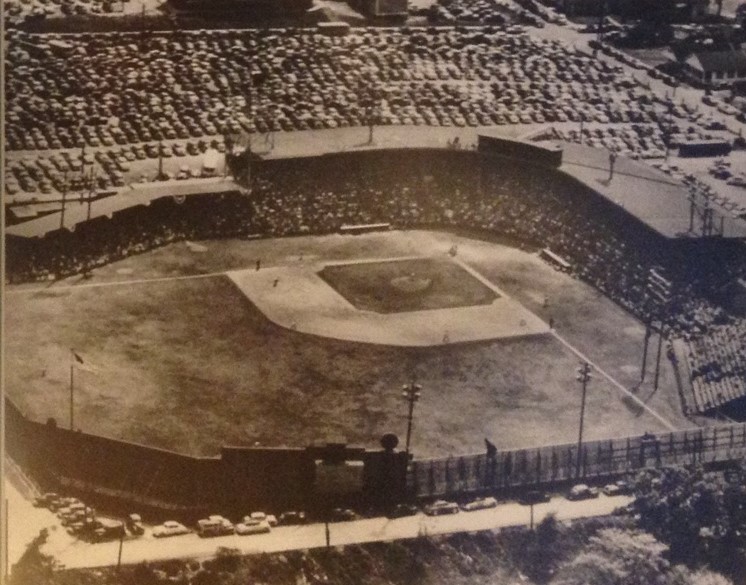
Photo from The Shreveport Times, at the start of the 1959 Southern Association season
Chapter 19
Life at the old ballpark
The old Texas League Park/SPAR Stadium is long gone. The memories are not.
Perhaps the place was never considered “beautiful,” but for many years, it was a useful, functional baseball park; a good place to watch games. The box seats and reserved sections were close to the field, the grandstand was easily accessible, and the bleachers down the lines were much in use.
The playing field itself most considered superb. The rest of the stadium, well …
Just as its predecessor, League Park/Gasser Park/Biedenharn Field, this stadium was located in the Allendale neighborhood, then an older middle-class area of Shreveport only a few blocks -- maybe a mile -- southwest of downtown.
It was built in a city block, facing northeast from home plate toward downtown.
The streets were Gary Street (parallel to the left-field fence); Park Avenue (parallel to the right-field fence) -- the Gary and Park intersection was right behind straightaway center field; Sycamore Avenue (parallel to the third-base line, site of the small "home" parking lot); and Dove (parallel to the first-base line, with the bigger main dirt parking lot). The team had a Dove Street address.
Club offices and the largest concession stand were located under the main grandstand.
There were large bleachers down the right-field side -- the 1930s/’40s/’50s/early ’60s African-American (or Negro) section -- and smaller bleachers on the left-field side, which is where the Knothole Gang kids sat and/or played.
(After seating became integrated, starting in 1968, those right-field bleachers were torn down and the open area became the beer-garden area, an enjoyable spot for many spectators.)
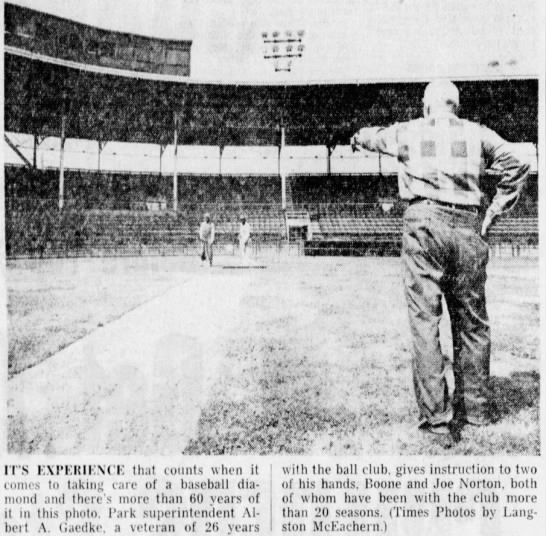 Through the late 1930s, ‘40s, ‘50s and into 1961, stadium maintenance and of the playing field and grass came under the supervision of Albert A. Gaedke, a legendary -- and often crusty -- ballpark figure. He kept a full crew during the season, and the condition of the playing field and grounds always was considered one of the stadium’s best assets.
Even after Gaedke’s time, for decades the playing field was still well-maintained, although manpower was greatly reduced. But the stadium soon was not the same.
Without regular maintenance, the ballpark decline began in the 1962-67 period when Shreveport did not have a professional baseball team.
By then it was owned by the City of Shreveport and operated by the Shreveport Parks and Recreation (SPAR) department. It was used for the occasional college baseball game, but mostly for high school, American Legion and some SPAR baseball -- and, for a time in the 1960s, for high school football by the then-all-black Shreveport schools.
When the Atlanta Braves agreed to put their Class AA franchise in Shreveport in 1968, thus bringing the pro game back to the city, they also split the cost of stadium renovations with the city.
That meant a good cleanup job, fresh paint everywhere -- the stadium seats were a combination of garish colors -- and a new outfield fence: one deck instead of the rotten old two-deck fence.
So there was less advertising space and perhaps less revenue opportunities, but a safer result for outfielders banging into the fence.
Another change involved the outfield. One problem with the field for many years was that the outfield sloped downward toward the fence. Those seated in the dugouts could not see the outfielders. In the ‘68 renovation, the grounds were filled until the field was level from infield dirt to the outfield fence.
The wooden scoreboard, always manually operated except for the ball-strike-out lights, remained in left, just behind the fence. A ball hitting it was out of the park -- a home run.
A green batter's eye backdrop stood behind the fence in straight center. That's where the flagpole was, too. The sign at the base of the wall there read "398" (feet) -- a good home-run challenge. Down the lines it was 320 to left, 321 to right. The power alleys, reachable but a fair distance, were about 350-360. If the wind blew out, it could be a hitter's park; otherwise, it was fair to pitchers.
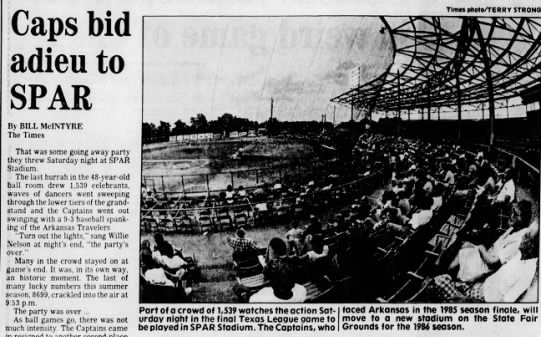
Also new in ‘68: A press box at the top center of the grandstand. The old press box above on the roof -- almost totally rotten -- was torn down. It was as rotten as the roof that covered the grandstand from a little past the first-base bag around to past the infield dirt on the third-base side.
But what was not redone was that roof. It remained rotten.
So rotten that anyone who climbed the fenced-in stairs outside the stadium to go retrieve foul balls caught in the gutter running alongside the fence on the roof had to be very careful walking on those creaky, tar-covered roof boards.
Finally, by 1982, the roof was deemed so unsafe, and the expense of rebuilding it too great -- that had been the case for 20 years -- that it finally was torn down. Thus, all that remained were the steel beams that had held it -- exposed, an ugly sight.
Taylor Moore -- longtime Sports/Captains fan and, from 1976, the team president/operating managing partner -- said, "It looked like something out of the Bronx that they started tearing down and did not finish."
---
By the late 1960s, the maintenance situation had changed. No full grounds crew; only a couple of people. And no infield tarpaulin; only smaller ones to cover the mound and home plate areas.
That became a real problem in the 1975 season when the Captains were plagued by days and days of rain that led to a couple of dozen home-game rainouts..
A couple of years later, the ballclub convinced the city to invest in a tarp, but then because there was hardly any ground crew, spectators were often asked to aid in putting the tarp down when the rains came.
And in the early 1970s, parking near the stadium also had become a major issue. What was a plus was that ballpark visitors never had to pay for parking. But safety, and rain, were problematic.
A small parking lot near the front-gate entry and on the third-base side was reserved for season-ticket holders and club personnel (including players).
But the bigger parking lot -- all dirt -- was where the bulk of the spectators parked, and when it rained, it could be a mess.
Financially, the ballclub had to buy the rights for parking in that lot from its owner, the nearby Galilee Baptist Church. That yearly fees negotiation could be a hassle, and the terms included that church personnel would operate the lot. (Read below for the safety issues.)
The stadium clubhouses were not cramped, but not roomy, either -- and, significantly, not air-conditioned (it does get hot in Shreveport in the summer). Big fans had to do their work.
The manager's offices (home and visiting sides) were big enough for three people; four was a crowd. The umpires' dressing room was closet-like. Two-man crews were standard; more than two … good luck.
By the 1960s and certainly in the 1970s and '80s, the ballpark roofs were leaky. Clubhouses, offices, concession areas, restrooms, storage space -- not much was safe from rain. There were critters there, too -- rats, scorpions (big ones), mice, whatever.
But the biggest problems were smelly, antiquated restrooms, especially the women's ones, outdated concession areas and -- most significantly -- vandalism.
The older the stadium grew, the more the neighborhood aged. What was once a working-class neighborhood changed; the demographics wee different. Older white folks remained, but it became a predominately minority area.
There were few reports of physical crimes, but a number of reported break-ins of cars and the park itself -- the club offices, concessions, clubhouses. The team's safe, far back under the grandstand in a secluded area, was vandalized a few times. So were players' cars, parked inside the stadium during the team's road trips.
And reports of car break-ins on that big parking dirt lot were not as frequent as the rumors to that effect.
Still, people were hesitant -- scared, maybe -- to come to the stadium, afraid to drive in the area. Street access to the ballpark wasn't that easy; there was no main road leading directly to the parking lots.
Perhaps some of the stadium’s “reputation” was more perception than reality. No matter, it made advertising and ticket sales a tough sell for club personnel.
Most everyone in Shreveport-Bossier and North Louisiana knew where the stadium was located. But you had to want to go there.
So the attendance declined. That began in 1956 -- despite Ken Guettler's record home-run heroics -- and never really let up much. For much of the next 30 years, attendance at the ballpark was woeful -- 250-300 far too many nights, 500 was good, 1,000 or more not all that often.
There were still some crowds of 5,000 or so for special promotions (bat night, jersey night, the 1974 Texas League All-Star Game with the Texas Rangers, managed by Billy Martin) and the Captains did have a few significant games.
The most significant was when the 1976 TL Eastern Division pennant race came down to one showdown game -- a victory meant the division championship; a loss meant the season was finished.
The Captains fell behind early, then rallied to win the game and the division. So it was on to the Texas League Championship Series, beginning with two games at home against Amarillo -- the first playoff games for Shreveport baseball in 16 seasons.
Those were exciting times for crowds in the stands and the gang in the beer garden, often raucous, was rowdy.
They were also the last crowds of more than 2,500 at that stadium. Because one week before the 1977 season opener, ballclub officials were told the upper grandstands -- which could seat about 2,500 -- were unstable, unusable, and closed ... for good.
It remained that way through the 1985 season. And then it was good-bye to the old place.
Through all the small-attendance years and tight-revenue situations, the club’s ownership remained hopeful that a new stadium would be built. There were a couple of possible franchise relocations, but they fell through … and finally -- after many talks, several potential sites and a new stadium deal was arranged.
Now, on the grounds where the old stadium stood, there is a smaller facility because some good folks wanted to preserve baseball there.
Named for the Baptist church located just behind what was the fence in right field and for two Shreveport pro baseball stars (Riley Stewart and Albert Belle), Galilee’s Stewart-Belle Stadium is used for recreational games.
Perhaps the echoes of cheers, and thousands of games, still remain.