Showing posts with label Louisiana Tech football. Show all posts
Tuesday, May 25, 2021
Wednesday, August 28, 2019
Sixty years later, J.W. Slack is a Hall of Famer
(Note: This was written for the Louisiana Tech sports information office for the Athletics Hall of Fame induction weekend Oct. 18-19. This is the full version; a shorter take has been released on Tech web sites.)
Sixty years after he played his last football game for Louisiana Tech, J.W. Slack -- finally -- is going to be inducted into the Tech Athletics Hall of Fame.
In the 1950s, he was a do-everything back and athlete for Bossier High and then arguably one of the more underrated players in Bulldogs' football history.
A three-year starter, all-conference as a senior on one of Tech's best-ever teams, a solid running back, safety, punter, placekicker, kick returner, and team leader, the honor is for much more than just football.
James Watkins Slack -- always just J.W. to everyone -- followed with a notable career in law enforcement, numerous contributions to life in Bossier City and Parish, and at Tech, where he has remained a fan and supporter, he created a legacy.
The Slacks are the first three-generation football family in Tech history.
Two of J.W. and Ginger's sons played defensive back for Tech -- the oldest, Terry, in 1974-77; the youngest, Jay, in 1984-87. And Terry's son, Hayden, was a walk-on wide receiver who earned a scholarship to play for the 'Dogs in 2011-12. (Middle son Dwayne also played in high school, as an offensive lineman, but not in college.)
But the Tech Athletics Hall of Fame was a missing honor.
J.W. thought it was possible in September 2001 when he was chosen as one of Tech's top 50 football players on its All-Century (100-year) team. But the call did not come until early in 2019.
"They caught me so unprepared," he said of his response when told of his impending induction. "I thought it was never going to happen. Good gosh, I don't even remember what I said."
"One great individual and one heckuva great athlete," said Dr. Billy Bundrick, the Tech legend as longtime team physician, orthopedic surgeon and university supporter who when he played end in 1959 was a team co-captain with Slack. "No one could ever say anything bad about J.W."
---
If there is one regret, it is that Mary Virginia Williamson Slack -- "Ginger" -- is not here for this occasion. She was his No. 1 fan; they were married for 56 years. The three sons gave them six grandchildren.
They met as sophomores at Bossier High School. She had moved in from Vivian, and his first sighting was in his science class when she came in to pick up absentee slips from the teacher.
"I thought, 'Who in the world is that?' " J.W. recalled, and he slipped out of class, out the door, caught up to her in the hallway and asked, "Who are you?"
"She must have thought I was an idiot," he said, and to prove it, he then noticed she was wearing a chain with a ring. When she said it was her boyfriend's, J.W. told her, "Give it back to him."
Her death, at 74, in November 2010 came after nine years of treatment for multiple myeloma (bone cancer).
The fateful day they learned of the disease, he told her, "I will make every step you make." And for the repeated treatments, in Dallas and in Shreveport, he was there, with one exception -- a heart bypass surgery forced him to miss one Dallas trip.
"We got closer than we'd ever been," he says in reflection.
"She was the matriarch of our family," J.W. said, "a silent person who never jumped on me or criticized me. She was a good mother, a good wife. I could have looked the world over and not done better."
A pause, and a chokeful thought: "I miss her so much."
---
The youngest of eight children in his family, he grew up on Waller Street in Bossier, and after his early football roots, developed into the star player at Bossier High in 1953 and '54, an All-City choice (unanimous pick as a senior).
As a senior (1954), he was a second-team All-State selection in Class A, his district leading scorer by more than 20 points with 106 -- 16 touchdowns, 10 PATs. He ran for 1,130 yards on 139 carries.
He scored the first touchdown, on a 51-yard double-reverse run, in Coach Bill Maxwell's 10-year stay as Bossier coach; the next week he scored three TDs -- one a 48-yarder -- against Jonesboro-Hodge, the first Bearkats' victory for Maxwell. He had TD runs of 95 and 23 yards against Homer, and three more TDs vs. Ouachita (Monroe), including 42- and 55-yarders.
And in his final home game against powerful Springhill, he scored all 19 Bossier points (in a 32-19 loss).
In the spring, he was a sprinter in track and field, and a speedy centerfielder in baseball.
---
And yet, his college days had a rocky start and they almost began, of all places, at arch-rival Northwestern State. Almost.
He followed some Bossier High buddies there, reporting for two-a-day practices. But an off-field issue cropped up and "I knew right away I was in the wrong place," J.W. said. He returned to Bossier, intending to find a job, but was encouraged to call coach Joe Aillet at Tech, who added him to the squad deep into fall practice.
In Coach Aillet, as so many at Tech did, he found "the person who had more impact on my life than anyone except my parents. ... He was my mentor, my coach -- a brilliant coach -- and, more importantly, he was my friend."
He played some as a sub for the outstanding 1955 Bulldogs, but not enough to letter. Then he left school after the season and, with a young family to support, worked in the oilfields "and I found I didn't want to do that." He asked Aillet for another chance, received it, and returned to school in January 1957.
To become eligible, he needed to earn 24 hours credit by the fall, so summer school and working a job were a necessity. Aillet helped arrange a job for Ginger and a place for them and a very young Terry in the famed Tech Vetville residencies.
As a sophomore in 1957 -- when he played both ways, rushed for 350 yards, punted, placekicked, and returned kicks -- he earned Tech's Billy Moss Memorial Trophy for contributions to the team.
The '59 team, one of three Aillet-coached Tech teams that finished with a 9-1 record (also 1955 and 1964), was one of the best defensive teams in school history, if not the best -- six shutouts and only 48 total points by opponents. The only spoiler was a 13-6 opening loss at Lamar.
"Two or three games I did really well," J.W. said, and in typical modest fashion, quickly added, "If I am bragging on myself, I'm sorry."
Slack was the team's biggest star in three victories -- a then-school-record 158 yards rushing (with TDs of 52 and 13 yards) in a 28-0 romp at McNeese; 135 yards (and a fourth-quarter TD) in a tough 14-0 battle at Southeastern Louisiana; and the season's biggest test, a 10-8 slugfest with Memphis State -- ranked No. 7 nationally among small-college teams -- on a cold, sleeting, and J.W. noted, "miserable" mid-November day in Ruston.
Norris "Bud" Alexander's late 26-yard field goal settled that game, but Jim Dawson's story in The Shreveport Times the next day emphasized Slack's contributions.
Calling him "a solid candidate for Little All-America honors" as he mentions Slack scoring the game's first TD and kicking the PAT in the first quarter, Dawson went on to write: "Slack was magnificent in every phase of the game. His booming punts kept Memphis in deep holes much of the time, his defensive play was sharp and his ball-carrying was sensational. Slack led the rushers with 84 yards on 23 pile-driving carries."
J.W. had punts of 54 and 53 yards that left Memphis State at its 2-yard line and inside its 1.
Indeed, after the season, J.W. earned one All-America honor.
The other starting halfback, Paul Hynes, was more explosive and talented enough to play in the pros for a couple of years. But Slack was the team's leading rusher in 1959 with 588 yards.
The statistics, however, pale in comparison to future years' stars. One reason was that playing time was limited by the college rules then; it was the era of three-platoon systems (at LSU, the famous White team, Go -- short for Gold -- team and the Chinese Bandits; at Tech, the Red, Blue and Green teams), in which substitutions were limited.
So the first unit, playing both offense and defense, would play two full quarters -- only one sub allowed, except for injuries -- and the other two units, one for only offense, the other for only defense, would alternate in parts of the game.
"We might play only 2 1/2 quarters in a game," Slack recalled. "So the stats were weathered down, even for guys like [Heisman Trophy winners] John David Crow (Texas A&M) and Billy Cannon (LSU)."
Slack did finish as Tech's No. 5 all-time rusher at the time.
---
Pat Garrett was a fellow Tech running back for a couple of years, the fastest man on the Tech campus -- a champion sprinter in track and field -- and later a respected English professor.
"J.W. was a very consistent runner, an up-the-field runner, not sideways like me," Dr. Garrett said. "He was dependable, so level and consistent. You could depend on him; he was the kind of back Coach Aillet liked to have.
"He was quite a guy, admired and well-liked by all of us."
Billy Bundrick, like Slack, arrived at Tech in the fall of 1955, a year after they made the Shreveport-Bossier All-City team, Bundrick as an end at Byrd High. Dr. Bundrick recalled that "our offense [Tech 1959] wasn't wide-open, but J.W. would do whatever was needed for the team. ... We were co-captains, but really he was the head honcho."
Mickey Slaughter quickly became a J.W. Slack fan as a freshman on the 1959 team.
"He was a wonderful running back and an outstanding safety," said Slaughter, destined to become a Tech quarterback star who went on to pro football and then was the offensive mastermind of the Maxie Lambright era coaching staff. "He was a really good tackler and good cover man, although he didn't have to cover much in that time because not many teams threw the football a lot.
"He was very strong physically, not very big, but tough. [On offense] he could cut on a dime, and he was always going forward. ... He had the unique ability of shredding tacklers. Guys would hit him and maybe stop him for a moment, but he would break away and get more yards.
"The best thing about him was his leadership," Slaughter added. "He was a born leader, in practice and in games. All the guys looked up to him, especially the young ones, and I was one of those."
---
After Tech graduation in 1960, with a B.A. in education, there were two brief tries to play in the new American Football League. They did not take.
He twice went to the California training camp of the Chargers (Los Angeles 1960, San Diego 1961), with an $8,000 free-agent contract and $500 bonus the first year. That coaching staff included some NFL legends -- head coach Sid Gillman and assistants Al Davis and Chuck Noll; his defensive backs coach was Jack Faulkner, who had a long career in the AFL and NFL.
Among the best-known players in those camps: quarterback Jack Kemp (who went on to politics) and punter-end Paul Maguire (who went on to TV broadcasting).
But "I didn't do a good job of trying to make the team," recalled J.W. "I was homesick [for his family] the first year" and a job opportunity with the Bossier Parish Sheriff's Department -- he had gotten to know Sheriff Willie Waggoner a few years before -- enticed him in '61.
Going into coaching had been a consideration, but being a student teacher cooled that idea, and the money in law enforcement was more appealing. He did turn down coaching offers a couple of years later.
In two stints with the Sheriff's Department for much of two decades, his roles included deputy, head of the records section, detective, chief polygraph examiner, and juvenile officer working with middle and high school students who had discipline problems.
He also received special training at centers in New York City and other law-enforcement schools, and in the mid-1990s, was liaison officer for the Bossier police and sheriff's departments and point man for security efforts, working with the U.S. Secret Service branch.
J.W. also was a serial candidate for political offices in Bossier Parish. He ran for clerk of court in 1967, for tax assessor in 1971 (lost in a runoff), and for sheriff -- the job he most desired, to succeed Waggoner after his death -- in 1976, finishing third in a 10-man race.
"I probably should not have run for a couple of those," he concedes. But after losing the sheriff's race, he subsequently rejoined the department.
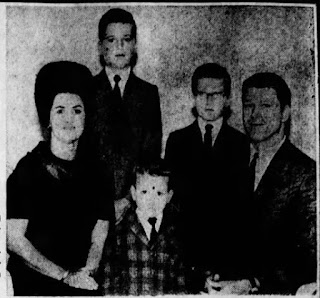
![]() |
| The Slack family in 1967 |
He was school board president in 2004 and a bond issue was passed in that year. He says now that "we have been able to accomplish a lot" in his time on the board, building new schools and boosting facilities. "We've been pretty successful. I don't take credit for that, but I guess we were doing something right."
He also became a Masonic Lodge member, and at First Baptist Church, was on the board of deacons, in the adult men's Bible classes, the adult choir, and on the properties and grounds committee.
He and Ginger later moved to Airline Baptist Church. And their religious convictions carried through to the family.
Terry Slack, after a decade coaching career at Airline High, including five years (1984-88) as head coach, became Northwest Louisiana area director for the Fellowship of Christian Athletes and has been FCA state director since 2011. Hayden now is the Northwest Louisiana area director.
J.W. always has stayed involved with Tech, serving on the Alumni Association executive committee in the mid-1970s, and following his sons' and grandson's careers as Bulldogs players.
Unsurprisingly, Terry and Hayden both call him "my biggest hero."
"He never interfered," said Terry. "He must have made a decision to back off and let my coaches do the coaching in junior and high school. ... He did not really get technical with me in talking football.
"People thought I would be a running back because he was," Terry added. "I played there a little, but mostly I was on defense."
Hayden played at Calvary Baptist under head coach Doug Pederson, who went on to be the Super Bowl-winning coach of the Philadelphia Eagles. J.W. did offer Hayden some advice on punting, but very little.
"Wish I had had some of his speed," said Hayden. "Obviously I did not know him as a player, but I know him as a man. He's a Godly man, with high character, and I know the great example he set for our family."
Of his Tech days, J.W. was especially proud to have been teammates -- as others were -- with the three Hinton brothers (Pat one year, Tommy for two and Joe for three). And, "I enjoyed my time there and made so many great friends."
Now, those friends who remain with us and all Tech fans will know J.W. Slack as a Hall of Famer. It was overdue.
Sunday, September 23, 2018
It must have been a darned good game ...
Some quick thoughts on college football ...
• First, Louisiana Tech at LSU ...
Confession: I did not watch the game. Too many mixed emotions. As I have said often (and written twice in recent weeks), love both schools, never want either one to lose.
So I just let them play, and saved myself the agony of watching and not having my heart racing.
Checked on the score twice -- once right before halftime (LSU, 24-7) and once when I knew the game was done (LSU, 38-21 ... and, obviously, it was much closer than that). Do not think LSU is the fifth- or sixth-best team in the country right now, not based on its inconsistent play in each of its four games (victories) this season -- play well for one or two quarters, mediocre in one or two quarters.
The Tigers got some great breaks -- bounces of the ball, missed officiating calls -- against Tech. This I know from reading about the game, talking to a good source about it, and watching highlights on YouTube and the LSU web site.
Figured the Bulldogs would give them a fight. Tech's program is solid, its teams are fun to watch, and LSU -- more often than not -- plays to the level of its opponent.
Yes, the Tigers more than did that in two impressive victories against Miami and Auburn, and although the final score against Southeastern Louisiana was 31-0, it was an extremely tepid second-half showing by LSU.
Still can't see better than an 8-4 or 9-3 record for LSU -- not on same level with Alabama and Georgia certainly, and a tough SEC West road ahead.
Tigers have too many offensive-line issues, and secondary is shaky, especially if the defensive front seven can't get more pressure on the passer than it did against Tech.
Tech should compete well in Conference USA, but next Saturday's test at North Texas will tell a lot. UNT might be the conference's best team this season.
Finally, glad Tech made a good showing at LSU. Did not want (or expect) a blowout loss, and that $1.3 million payday softens the effects of a loss.
(Oh, and it will be Tech at LSU in men's basketball in a couple of months. That will not be as heart-rendering for me.)
• Texas much deserved the victory against TCU. But to declare the Longhorns' program "back" among the elite is premature. Let's see (1) how UT does against Oklahoma a few weeks from now and (2) how it fares when it comes to Fort Worth to face TCU next year.
• I rarely pay attention to the poll rankings, don't even look at preseason predictions and do not think they are important until the sixth or seventh week of the season. And, remember, it is just a bunch of sports media and/or coaches doing the rankings. Everyone has an opinion, and you know what the saying is about opinions.
That said, this Alabama team is so much better than anyone else in the country, it deserves a battlefield promotion ... to the NFL.
• What makes college football so great is the big underdog -- especially, the mid-majors -- beating the "majors." So, giant-killer Troy beating LSU last year and Nebraska this season, Old Dominion knocking off Virginia Tech yesterday, North Texas routing Arkansas, Fresno State routing UCLA, and this "almost" shocker yesterday -- Army taking Oklahoma to overtime.
Maybe in the 1940s, Army beating OU would have been routine. In the 1950s, it would have been a great matchup. Since then, those programs have not been in the same hemisphere.
So, again, great for college football. Not so great if you are on the losing end (hello LSU, Arkansas, Nebraska, UCLA).
• We have railed often about how overbearing college football head coaches can be, how they are given god-like treatment. Two items -- and two of my favorite targets in this regard, Nick Saban and Gary Patterson -- caught my attention today.
Saban, closing his media session yesterday after his team's romp past Texas A&M, said "... I would appreciate it if you would sort of look at some of the things we didn't do so well ..."
That is part of his "rat poison" theme, which he loves to use to keep his players grounded and motivated. Yes, the rest of the country feels so badly for those less-than-perfect Alabama players.
Let's see ... 53 points per game, average winning margin 41 points per game. So many things wrong.
Ridiculous, preacher Saban.
TCU down 15 points, 2:44 remaining, 4th-and-4 at its 38 ... Patterson had his team punt the football away to Texas.
Punt? Needing two scores? What were the Frogs' chances after they punted?
Asked about his "strategy" afterward, Patterson said he had two timeouts remaining and he was hoping for his defense to stop Texas, get the ball back and score quickly, then recover an onside kick.
"... I don't play to lose," he said. "I don't play to get through it, but I had two [timeouts]. ... I know how to manage games. It wasn't that play that got us beat. I can promise you that. And you had a backup quarterback in the game."
Excuse me, but that is BS. He waved a white flag, that's all.
Yes, he can manage games (162-59 record in 18-plus seasons) and I often have said that Patterson and his staff do as good a job as any school in the country.
But, sorry, this was a mistake. Heaven forbid a coach making $4.75 million -- base salary -- a year admit a mistake. Coach P (for paranoia) will not do that.
• The other side: Louisiana Tech head coach Skip Holtz, about a 4th-and-1 play -- a quarterback sneak -- that did not work late in the game at LSU (the Tigers piled it up and stopped it short).
"I'm upset with myself on the fourth-down call I made," Holtz said. "Not the decision to go for it, but the call. I should have called a timeout. It was a dumb call. I want to put our players in a position to succeed, and I don't think I gave our guys the best to do that [on that play."
A dumb call. Got that, Gary Patterson?
• First, Louisiana Tech at LSU ...
Confession: I did not watch the game. Too many mixed emotions. As I have said often (and written twice in recent weeks), love both schools, never want either one to lose.
So I just let them play, and saved myself the agony of watching and not having my heart racing.
![]() |
| LSU could not pile up the score on Louisiana Tech (Getty Images photo) |
The Tigers got some great breaks -- bounces of the ball, missed officiating calls -- against Tech. This I know from reading about the game, talking to a good source about it, and watching highlights on YouTube and the LSU web site.
Figured the Bulldogs would give them a fight. Tech's program is solid, its teams are fun to watch, and LSU -- more often than not -- plays to the level of its opponent.
Yes, the Tigers more than did that in two impressive victories against Miami and Auburn, and although the final score against Southeastern Louisiana was 31-0, it was an extremely tepid second-half showing by LSU.
Still can't see better than an 8-4 or 9-3 record for LSU -- not on same level with Alabama and Georgia certainly, and a tough SEC West road ahead.
Tigers have too many offensive-line issues, and secondary is shaky, especially if the defensive front seven can't get more pressure on the passer than it did against Tech.
Tech should compete well in Conference USA, but next Saturday's test at North Texas will tell a lot. UNT might be the conference's best team this season.
Finally, glad Tech made a good showing at LSU. Did not want (or expect) a blowout loss, and that $1.3 million payday softens the effects of a loss.
(Oh, and it will be Tech at LSU in men's basketball in a couple of months. That will not be as heart-rendering for me.)
• Texas much deserved the victory against TCU. But to declare the Longhorns' program "back" among the elite is premature. Let's see (1) how UT does against Oklahoma a few weeks from now and (2) how it fares when it comes to Fort Worth to face TCU next year.
• I rarely pay attention to the poll rankings, don't even look at preseason predictions and do not think they are important until the sixth or seventh week of the season. And, remember, it is just a bunch of sports media and/or coaches doing the rankings. Everyone has an opinion, and you know what the saying is about opinions.
That said, this Alabama team is so much better than anyone else in the country, it deserves a battlefield promotion ... to the NFL.
• What makes college football so great is the big underdog -- especially, the mid-majors -- beating the "majors." So, giant-killer Troy beating LSU last year and Nebraska this season, Old Dominion knocking off Virginia Tech yesterday, North Texas routing Arkansas, Fresno State routing UCLA, and this "almost" shocker yesterday -- Army taking Oklahoma to overtime.
Maybe in the 1940s, Army beating OU would have been routine. In the 1950s, it would have been a great matchup. Since then, those programs have not been in the same hemisphere.
So, again, great for college football. Not so great if you are on the losing end (hello LSU, Arkansas, Nebraska, UCLA).
• We have railed often about how overbearing college football head coaches can be, how they are given god-like treatment. Two items -- and two of my favorite targets in this regard, Nick Saban and Gary Patterson -- caught my attention today.
Saban, closing his media session yesterday after his team's romp past Texas A&M, said "... I would appreciate it if you would sort of look at some of the things we didn't do so well ..."
That is part of his "rat poison" theme, which he loves to use to keep his players grounded and motivated. Yes, the rest of the country feels so badly for those less-than-perfect Alabama players.
Let's see ... 53 points per game, average winning margin 41 points per game. So many things wrong.
Ridiculous, preacher Saban.
TCU down 15 points, 2:44 remaining, 4th-and-4 at its 38 ... Patterson had his team punt the football away to Texas.
Punt? Needing two scores? What were the Frogs' chances after they punted?
Asked about his "strategy" afterward, Patterson said he had two timeouts remaining and he was hoping for his defense to stop Texas, get the ball back and score quickly, then recover an onside kick.
"... I don't play to lose," he said. "I don't play to get through it, but I had two [timeouts]. ... I know how to manage games. It wasn't that play that got us beat. I can promise you that. And you had a backup quarterback in the game."
Excuse me, but that is BS. He waved a white flag, that's all.
Yes, he can manage games (162-59 record in 18-plus seasons) and I often have said that Patterson and his staff do as good a job as any school in the country.
But, sorry, this was a mistake. Heaven forbid a coach making $4.75 million -- base salary -- a year admit a mistake. Coach P (for paranoia) will not do that.
• The other side: Louisiana Tech head coach Skip Holtz, about a 4th-and-1 play -- a quarterback sneak -- that did not work late in the game at LSU (the Tigers piled it up and stopped it short).
"I'm upset with myself on the fourth-down call I made," Holtz said. "Not the decision to go for it, but the call. I should have called a timeout. It was a dumb call. I want to put our players in a position to succeed, and I don't think I gave our guys the best to do that [on that play."
A dumb call. Got that, Gary Patterson?
Tuesday, September 11, 2018
Opening Night at Joe Aillet Stadium -- 50 years ago
![]() |
| The first touchdown in the first game at Joe Aillet Stadium, 1968 season, by Louisiana Tech fullback Buster Herren (31). No. 50 is center John Harper. (photo by Ralph Findley) |
(Note: The last in the series commemorating the first 50 years of football at Louisiana Tech's Joe Aillet Stadium. This story is about the first game there and the view from the new press box.)
---
By Nico Van Thyn
(Louisiana Tech student sports information assistant, 1965-69)
The first football game at Louisiana Tech's new stadium -- then just Tech Stadium, renamed Joe Aillet Stadium four years later -- was Sept. 28, 1968, a night game against East Carolina University.
The most notable player in the game, of course, was Terry Bradshaw -- future Pro Football Hall of Famer, four-time Super Bowl winning quarterback.
Fortunately, he was on our team. Louisiana Tech won easily, 35-7, in what was to be a season of revival for Tech football (9-2 record, after dips to 4-4, 1-9 and 3-7 in previous seasons).
The stadium opening was, as you can imagine, a long-anticipated event after decades in the old Tech Stadium on the main campus.
The new place was less than a mile away, in an area which had been woods just a few years earlier but was picked out -- and envisioned for development -- by Joe Aillet, the longtime and by then legendary Tech athletic director-head football coach.
The press box at the old stadium had a certain charm because it was a tight fit -- two levels of seating, maybe 10 to 12 people on each row. So the occupants were in close proximity; it was not cozy.
The two radio crews, home and away, were near the ends on the top level; it wasn't much of a secret what the announcers were saying.
Obviously, the new stadium and new press box brought much excitement. We watched it being built over a two- or- three-year period.
It wasn't a long walk up to the old Tech Stadium press box, not as long as the walk to the new stadium press box. And the first couple of years, it was a walk; the elevator -- maybe for lack of funds -- was no installed then until much later. We got shafted on that.
So for the press box crew -- Tech's sports information department and the radio and film people -- it meant carrying up equipment up through the stands and back down afterward. A hassle, but Paul Manasseh -- Tech's SID that year before moving to a long tenure as SID at LSU -- never let much rattle him.
Seating was plentiful in this press box, there was elbow room for everyone, and there was a deck above for film and (when needed) TV crews (this was before the upstairs area was expanded years later).
But seating downstairs wasn't exactly comfortable, especially at first. Structurally, seats were built too close to the working tables, so people whose bellies were somewhat expanded -- we did have a couple of sportswriters who fit that description -- were unable to get into those seats. Adjustments had to be made quickly.
Second problem structurally: The area behind the seats on the lower level was too tight -- a tight squeeze just trying to move down the aisle. That never did get much better.
Third problem the first night: Although the air conditioning system surely had been tested, this was a humid Saturday night. When the air conditioning got cranked up, the windows in the press box looking out on the field fogged up.
Those of us trying to watch the game and keep statistics had to move around to find non-fogged areas. We even had to go outside the press box for a while to do our work.
That did get cleared up in a short while.
As for the football game, the Tech team came in feeling very good, having beaten an SEC opponent in the opening game the week before. Winning at Mississippi State 20-13 was a boost to the program after three mediocre seasons. (True, Mississippi State did not win a game that season, 0-8-2 record, but it was a "major" opponent for Tech).
Bradshaw, taking over as the permanent QB starter when Phil Robertson -- future "Duck Commander" -- decided not to play after being the starter in the 1966 and 1967 seasons (with Terry as his backup), showed his great promise in the first two games of 1968.
East Carolina was a new and very interesting opponent for Tech, and a challenging one. For one, it was one of the few college football teams still running the old single-wing offense -- a tricky scheme for the opposing defense. Two, under coach Clarence Stasavich, the Pirates were coming off consecutive season records of 9-1, 9-1, 9-1 and 8-2.
But Tech's team was up to the physical and mental challenge. And East Carolina could not stop Bradshaw's passing to talented receivers such as Tommy Spinks, Ken Liberto, Robbie Albright and tight end Larry Brewer.
Tech's running game balanced the attack, and it was fullback Buster Herren who scored the first touchdown in new Tech Stadium history.
The new stadium, strangely, did not mean a big boost in home attendance. This was years before official turnstile counts; crowds listed were guestimates by the wise media people in the press box.
Attendance for the East Carolina game was listed at 10,000 -- the original stadium capacity was 24,000 -- and that was what was listed for a couple of the conference games at the old Tech Stadium the previous season.
For the remaining three home games in 1968, the listed attendance was 14,000, 10,000 and 5,000 (a cold night game vs. New Mexico State on Thanksgiving). The press-box windows did not fog up that night.
Friday, August 17, 2018
In 1969, La. Tech 77, Lamar 40 was "astronomical"
(Wrote this for the Louisiana Tech sports information department as part of a series commemorating 50 years of football at Joe Aillet Stadium).
---
The lead of the game story -- 49 years ago -- said it was an “astronomical” score: Louisiana Tech 77, Lamar 40.
---
The lead of the game story -- 49 years ago -- said it was an “astronomical” score: Louisiana Tech 77, Lamar 40.
Even today, in this era of wide-open spread sets, no-huddle, fast-paced offensive football, it is unmatched in Louisiana Tech University history.
The night game of Nov. 15, 1969, remains the highest-scoring game ever at Joe Aillet Stadium (then, in its second season, called the new Tech Stadium). It was the seventh game played there; there have been 220 others.
(The only challengers were 107-point games: Tech 76, Rice 31, in 2014; Tech 55, Western Kentucky 52, in 2016.)
“I vaguely remember it,” said Mickey Slaughter, Tech’s offensive backfield coach that night and now 77, residing in Ruston. “They couldn’t stop us; we couldn’t stop them.”
![]() |
| Terry Bradshaw, La. Tech's superstar QB in 1968-69, set all sorts of passing records, but he could run, too. |
It was a crazy enough game that Tech QB Terry Bradshaw’s touchdown pass total was tripled by the opposing quarterback. Bradshaw had two TD passes; Lamar’s Tommy Tomlin had six.
Slaughter, who called Tech’s plays for the dozen years of the head coach Maxie Lambright era, recalled that “Bradshaw had a big night.” And of course he did -- 17-of-33 passing for 317 yards. Plus, he was Tech’s leading rusher -- eight carries for 57 yards.
Tomlin’s passing totals: 22-of-46, 308 yards, TD passes of 4, 11, 39, 9, 14 and 53.
Two Tech players from Texas recall it as a memorable game.
Senior wide receiver-kick returner Robbie Albright -- fastest Bulldog on the ‘69 team -- had some unique remembrances.
“Coach Lambright decided since we were playing a Texas team (the only one on Tech’s schedule that year], that the game captains should be from Texas,” said Albright, who was from Tyler and had come to Tech as a junior-college transfer in 1968 as an immediate long-ball threat in the Bradshaw-led offensive onslaught of that season. “So Larry Wright (defensive end) and I were the designated Texas seniors and game captains.”
“[It] was obviously a scorefest,” he said, looking back, and he started it (“opened the floodgates,” as he put it) -- with a (then-Tech record) 88-yard punt return for the first of the game’s 17 touchdowns.
Albright has a special memory -- and souvenir -- from the game. (See the last paragraph of this story.)
“That was a great game,” said Mark Graham, a junior defensive back in the first of his two all-Gulf States Conference seasons. And it was, he noted, “a grudge game for me.
“Lamar was in my backyard in high school,” he explained. Port-Neches [Graham’s school] is 13 miles from Beaumont [Lamar’s location] and “they did not offer me a scholarship. I had some high school buddies playing for the Cardinals.”
---
It is not only the highest-scoring game at the stadium, it is the highest scoring game -- two teams -- in Tech football history. It was four more points than any single NFL game ever (113, Washington Redskins 72, New York Giants 41, Nov. 27, 1966) and, although Tech and Lamar were not “major” college teams in 1969, their score exceeded any of the 661 games listed as “major” scores that season.
(A Tech team did score 100 points one day in 1922 against something called Clark Memorial College, and 89 the same year against what would become Southern Arkansas University.)
---
Considering the final score, Tech’s 542 yards total offense (to Lamar’s 493) and the winning margin, two remarkable facts: (1) Tech’s offense did not score in the first quarter; (2) Lamar actually had a 13-7 lead that almost lasted into the second quarter.
After Albright’s punt return TD, the Cardinals scored the next two touchdowns and had a chance for more. With 18 seconds remaining in the first quarter, David Brookings -- from Shreveport Byrd High -- intercepted a pass and returned it 18 yards for the tying score. The PAT kick made it 14-13 … and Tech never trailed again.
The Bulldogs poured on four touchdowns in the second quarter -- it was 42-21 at halftime, and four more in the last quarter, and -- somehow -- only one in the third.
It was a big game, points-wise, for Tech senior fullback Buster Herren (from Shreveport) -- a school-record four touchdowns, and he also became the school’s career scoring leader.
But it wasn’t like he dominated; his three TD runs totaled five yards (1, 2 and 2), his rushing totals were 15 carries, 53 yards. He caught a swing pass from Bradshaw and went 19 yards for his other score. [The scoring summary in The Shreveport Times the next morning did not list that play.]
The other Bradshaw TD pass that night was no surprise (and really the only Tech offensive score of much distance) -- a 38-yard connection with his favorite Woodlawn High-Tech target of six seasons, Tommy Spinks.
And Spinks -- also no surprise -- was the Tech’s top receiver, with five catches totaling 180 yards.
Lamar’s Pat Gibbs caught one more pass (six) than Spinks, for much less yardage (106), but for three touchdowns.
The other Tech touchdowns: another punt return (59 yards by fullback-tight end John Adams, from Jennings); a 3-yard run by fullback Mike Lord (Winnsboro); a 1-yard sneak by Bradshaw; and a late 5-yard run by backup QB Ken Lantrip (Lake Charles).
“We gained a substantial lead going into halftime, but the Cardinals kept coming … and scoring,” Albright recalled. And he and a teammate remember that Coach Lambright -- despite the big victory -- was not happy with a leaky defense.
“Although we maintained a three-touchdown lead,” Albright said, “Lambright would get upset every time they scored, and put the first team [offense] back in. I had never seen him so upset over such a convincing win.”
Senior defensive tackle Johnny Richard, from Church Point and an all-conference player that season, remember that “the first-team defense did not play much in the fourth quarter.
“We knew [the Tech coaches] were trying to get the returning players some experience,” added Richard, who is still working in the onshore/offshore well control industry in Houston, “but the first-team players were trying to completely shut down their offense. The second team couldn’t hold them and let them score.”
Graham said it was a tough defensive assignment that day, and not even an unusual Tech plan helped.
“Lamar had a prolific passing attack,” Graham said. “To counter that, we went to a spy coverage, the only time in my 41 games [at Tech] that the secondary used it. I was assigned their No. 1 target, man on man; the other guys were in zone coverage. Their attack was three- and five-step dropback and throw to a spot. They had a design that we had never seen in those days.
“They had a good night passing, but I broke up several of their attempts, and intercepted one.”
That was not unusual. Two weeks earlier, in Tech’s devastating, last-second loss at home (and homecoming) to Southern Mississippi 24-23 -- the only loss of an 8-1 regular season -- Graham had broken the school record with his 12th career pass interception.
Another unusual aspect of the game was the placekickers. Jorgen Gertz, an import from Denmark that season, went 11-for-11; he was Tech’s first soccer-style kicker. Ronnie Baird of Lamar kicked only two PATs … barefooted.
---
During the game, Bradshaw became the first Louisiana college quarterback to surpass 6,000 yards total offense in a career.
And yet his per-game output in 1969 was some 60 yards per game fewer than in 1968, the season he blossomed into a college superstar and Tech’s program recovered from three subpar seasons to a 9-2 bowl-game winner.
Slaughter was not immediately aware of his head coach’s displeasure. “I didn’t know about the defense,” he said. “I was in the press box and had my hands full trying to get our offense to score points.”
Thinking back on the game, the old QB/play-caller coach reflected, “I thought to myself -- a quarterback [he came close to recalling the Lamar star’s name] throws for six touchdowns and his team loses by 37 points. That’s pretty tough.”
It was Thomas Aswell, the Ruston News Bureau writer covering the game for The Shreveport Times, who used the “astronomical” adjective and wrote “both teams scored at will in the game defense forgot.”
Robbie Albright, though, did not forget -- he has a visible memento.
“I got the game ball,” said that night’s co-captain, “and had the team autograph it. I still have it. Terry, of course, signed it big and bold, right on the front! We see it, Terry, we see it.”
Albright is still laughing about it. It is an astronomical memory.
Subscribe to:
Posts (Atom)


